




NEW YORK: Fresh clashes between police and students opposed to Israel’s war in Gaza broke out on Thursday, raising questions about forceful methods being used to shut down protests that have intensified since mass arrests at Columbia University last week.
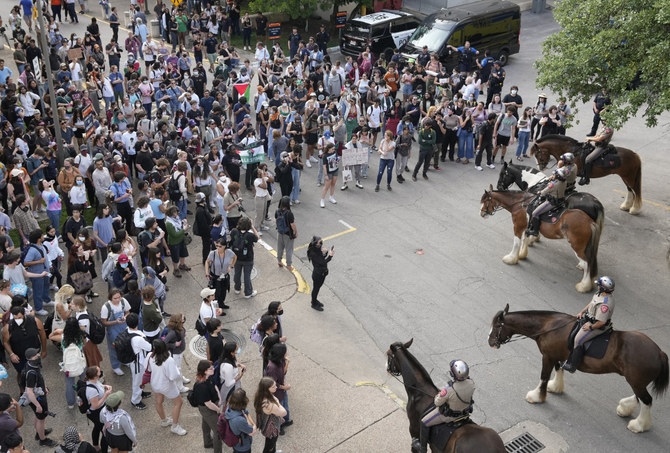
Over the past two days, law enforcement at the behest of college administrators have deployed Tasers and tear gas against students protesters at Atlanta’s Emory University, activists say, while officers clad in riot gear and mounted on horseback have swept away demonstrations at the University of Texas in Austin.
At Columbia, the epicenter of the US protest movement, university officials are locked in a stalemate with students over the removal of a tent encampment set up two weeks ago as a protest against the Israeli offensive.
The administration, which has already allowed an initial deadline for an agreement with students to lapse, has given protesters until Friday to strike a deal.
Other universities appear determined to prevent similar, long-running demonstrations to take root, opting to work with police to shut them down quickly and in some cases, with force.
Overall, more than 530 arrests have been made in the last week across major US universities in relation to protests over Gaza, according to a Reuters tally. University authorities have said the demonstrations are often unauthorized and called on police to clear them.

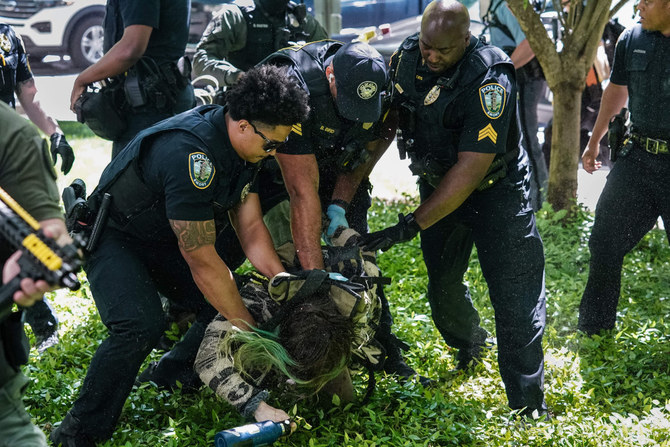
Police officers arrest a demonstrator during a pro-Palestinian protest against the war in Gaza at Emory University on April 25, 2024, in Atlanta, Georgia. (AFP)
At Emory, police detained at least 15 people on its Atlanta campus, according to local media, after protesters began erecting a tent encampment in an attempt to emulate a symbol of vigilance employed by protesters at Columbia and elsewhere.
The local chapter of the activist group Jewish Voice for Peace said officers used tear gas and Tasers to dispense the demonstration and take some protesters into custody.
Video footage aired on FOX 5 Atlanta showed a melee breaking out between officers and some protesters, with officers using what appeared to be a stun gun to subdue a person and others wrestling other protesters to the ground and leading them away.
“Several dozen protesters trespassed into Emory University’s campus early Thursday morning and set up tents,” the school wrote in response to an emailed request for comment. It described the protesters as “activists attempting to disrupt our university,” but did not comment directly on the reports of violence.
Atlanta police did not immediately respond to inquiries about the number of protesters who were detained or about reports over the use of tear gas and stun guns.
Similar scenarios unfolded on the New Jersey campus of Princeton University where officers swarmed a newly-formed encampment, video footage on social media showed.
Boston police earlier forcibly removed a pro-Palestinian encampment set up by Emerson College, arresting more than 100 people, media accounts and police said. The latest clashes came a day after police in riot gear and on horseback descended on hundreds of student protesters at the University of Texas at Austin and arrested dozens of them.
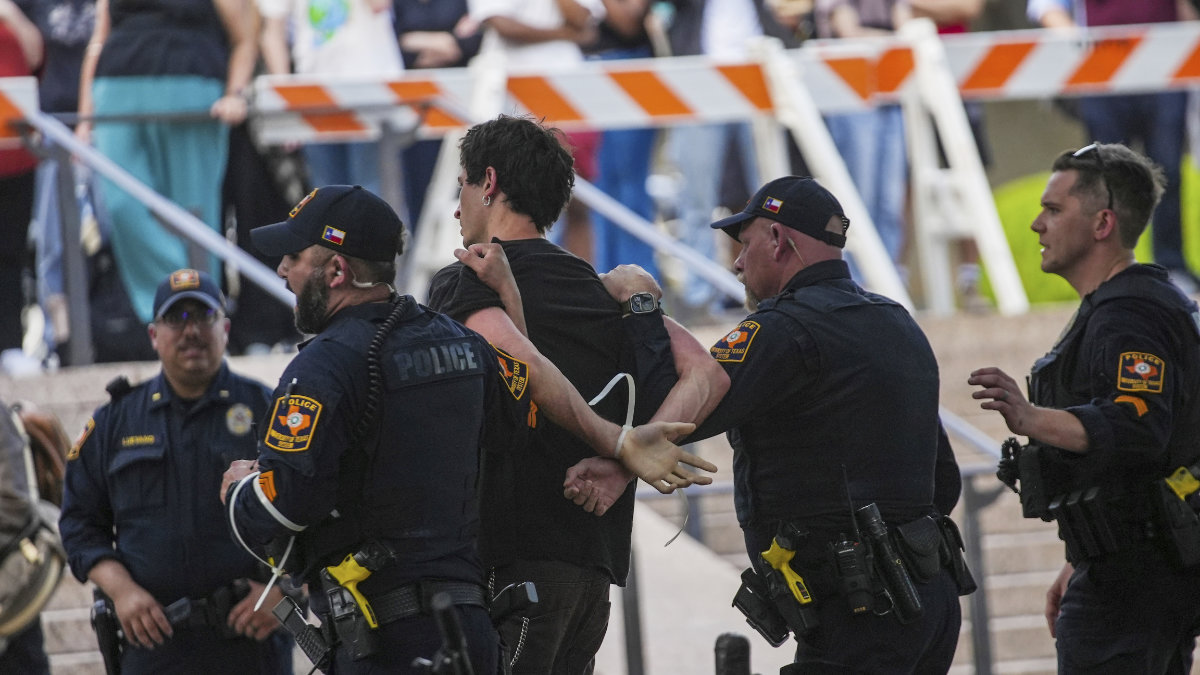
Police arrest a protester at the University of Texas on April 24, 2024, in Austin, Texas. (Austin American-Statesman via AP)
But prosecutors on Thursday dropped charges against most of the 60 people taken into custody, mostly on misdemeanor charges of criminal trespassing and disorderly conduct, and said they would proceed with only 14 of those cases.
In dropping the charges, the Travis County district attorney cited “deficiencies in the probable cause affidavits.”
‘Alarming reports’
Human Rights Watch and the American Civil Liberties Union have condemned the arrest of protesters and urged authorities to respect their free speech rights.
But some Republicans in Congress have accused university administrators of allowing Jewish students to be harassed, putting increasing pressure on schools to tightly control any demonstrations and to block any semi-permanent encampment.
US Education Secretary Miguel Cardona on Thursday said his department was closely monitoring the protests, including what he called “very alarming reports of antisemitism.”
In response, activist groups have strongly denied that the protests are antisemitic. Their aim is to pressure universities from divesting from companies that contribute to the Israeli military actions in Gaza, they say.
Even so, protest leaders have acknowledged that hateful rhetoric has been directed at Jewish students, but insist that people who tried to infiltrate and malign their movement are responsible for any harassment.
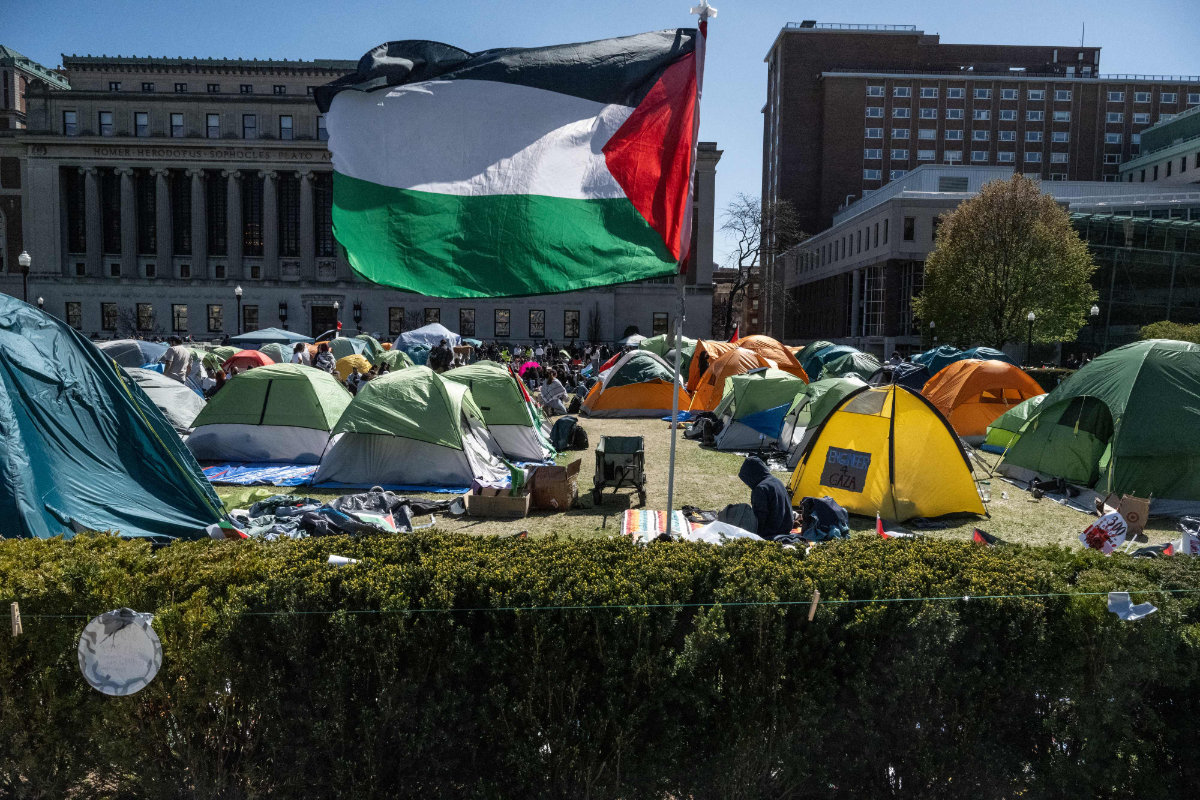
Columbia University students participate in an ongoing pro-Palestinian encampment on their campus in New York City on April 25, 2024, following last week's arrest of more than 100 protesters. (Getty Images/AFP)
Friday deadline at Columbia
At Columbia, officials have given protesters until 4 a.m. on Friday to reach an agreement with the university on dismantling dozens of tents set up on the New York City campus in a protest that started a week ago.
An initial deadline of midnight Tuesday came and went without an agreement, but administrators extended it for 48 hours, citing progress in the talks.
The university already tried to shut the protest down by force. On April 18, Columbia President Minouche Shafik took the unusual move of asking police to enter the campus, drawing the ire of many rights groups, students and faculty.
More than 100 people were arrested and the tents were removed from the main lawn. But within a few days, the encampment was back in place, and the university’s options appeared to narrow.
Protesters have vowed to keep the protests going until their universities agree to disclose and divest any financial holdings that might support the war in Gaza, and grant amnesty to students suspended from school during the demonstrations.
Student protesters have also demanded that the US government rein in Israeli strikes on civilians in Gaza, which have killed more than 34,000 people, according to Palestinian health authorities. Israel is retaliating against an Oct. 7 Hamas attack that killed 1,200 people and led to 253 taken hostage, according to Israeli tallies.


