

France threatens new sanctions against West Bank settlers

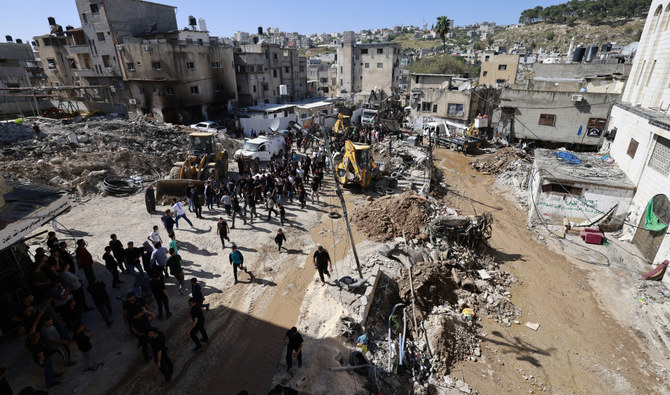
People carry the body of a man during his funeral procession, amid the devastation left behind following an Israeli raid in the Nur Shams camp for Palestinian refugees in the occupied West Bank, on April 21, 2024. (AFP/File)
Short Url
Updated 26 April 2024
Follow

France threatens new sanctions against West Bank settlers

  • In February, 28 ‘extremist Israeli settlers’ were banned from entering French territory
  • At least 488 Palestinians have been killed by Israeli troops or settlers in the West Bank since October 7, according to Palestinian officials

PARIS: France is considering extending sanctions on Israeli settlers behind violence against Palestinian civilians in the occupied West Bank, President Emmanuel Macron’s office said he spoke with Jordan’s King Abdullah II.

The two leaders “firmly condemned recent Israeli announcements about settlements” in the West Bank, “which are contrary to international law,” Macron’s office said in a statement.

Tensions have mounted in the occupied territories since the Hamas October 7 attack on Israel that set off the Gaza war. At least 488 Palestinians have been killed by Israeli troops or settlers in the West Bank since October 7, according to Palestinian officials.

In February, 28 “extremist Israeli settlers” were banned from entering French territory. Last week the European Union imposed sanctions on four Israeli settlers and two settler organizations for violence against Palestinians in the West Bank and Jerusalem.

Since the start of the year, Israeli authorities have declared nearly 1,100 hectares (2,720 acres) of the West Bank to be “state land” — twice as much as in the previous record year in 1999, according to the settlement watchdog Peace Now.

The status gives the government full control over how the land is used, inevitably leading it to being declared off-limits to Palestinians.

Some 490,000 Israeli settlers now live in the West Bank alongside three million Palestinians.

Macron and King Abdullah also spoke about the “catastrophic humanitarian situation in Gaza” and expressed “great concern about the perspective of an Israeli offensive on Rafah, where more than 1.5 million people are seeking refuge, and reiterated their opposition to such an operation,” the statement said.

“The two also insisted on the necessity of an immediate and durable ceasefire to allow massive deliveries of urgent aid and the protection of civilian populations,” it added.

Macron also “repeated that the liberation of hostages held by Hamas was an absolute priority for France.”


US envoy says Trump questioning why Iran has not ‘capitulated’

Updated 6 sec ago
Follow

US envoy says Trump questioning why Iran has not ‘capitulated’

  • US envoy Steve Witkoff said on Saturday that President Donald Trump is questioning why Iran has not “capitulated” in the face of Washington’s military build-up
WASHINGTON: US envoy Steve Witkoff said on Saturday that President Donald Trump is questioning why Iran has not “capitulated” in the face of Washington’s military build-up aimed at pressuring them into a nuclear deal.
The United States and Iran this week resumed Oman-mediated talks in Geneva aimed at averting the possibility of military action, after Washington dispatched two aircraft carriers, jets and weaponry to the region to back its warnings.
In a Fox News interview with Trump’s daughter-in-law Lara, Witkoff said the president was “curious” about Iran’s position after he had warned them of severe consequences in the event they failed to strike a deal.
“I don’t want to use the word ‘frustrated,’ because he understands he has plenty of alternatives, but he’s curious as to why they haven’t... I don’t want to use the word ‘capitulated,’ but why they haven’t capitulated,” he said.
“Why, under this pressure, with the amount of seapower and naval power over there, why haven’t they come to us and said, ‘We profess we don’t want a weapon, so here’s what we’re prepared to do’? And yet it’s sort of hard to get them to that place.”
The US envoy also confirmed in the interview that he had met with Reza Pahlavi, who has not returned to Iran since before the 1979 Islamic Revolution that ousted the monarchy.
“I met him at the direction of the president,” he said, without providing further details.
US-based Pahlavi last week told a crowd in Munich that he was ready to lead the country to a “secular democratic future” after Trump said regime change would be best for the country.
Witkoff’s comments come after Iranian Foreign Minister Abbas Araghchi said a draft proposal for an agreement with Washington would be ready in a matter of days.
Trump said on Thursday that Iran had at most 15 days to make a deal on concerns starting with its nuclear program.
As talks between the two nations continued in Geneva, Iran’s supreme leader Ayatollah Ali Khamenei on Tuesday said that Trump would not succeed in destroying the Islamic republic.
Western countries accuse the Islamic Republic of seeking to acquire nuclear weapons, which Tehran denies, though it insists on its right to enrichment for civilian purposes.
Iran, for its part, is seeking to negotiate an end to sanctions that have proven to be a massive drag on its economy, which played a role in sparking anti-government protests in December.