- An online petition with over 30,000 signatures urged the university not to provide a platform for Cofnas
- Cofnas previously faced backlash at Cambridge University for his critiques of diversity, equity, and inclusion programs
LONDON: An Oxford University college was the center of a freedom of speech controversy Tuesday for hosting an event featuring Nathan Cofnas, an academic widely criticized for his assertions that very few Black people would belong at the top of a merit-based society.
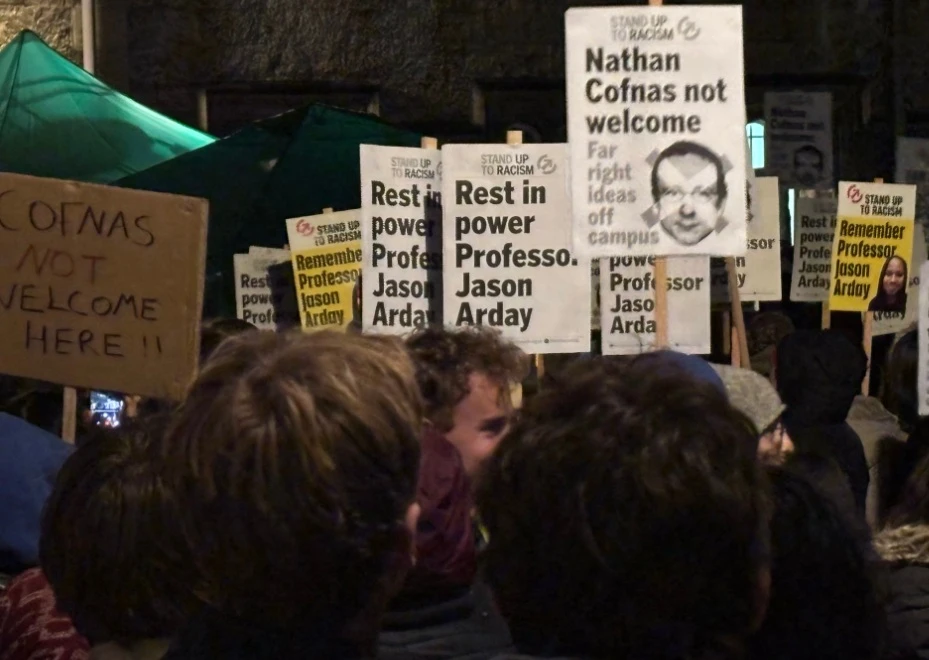
Hundreds of people turned up outside Oriel College ahead of the speech by Cofnas, who raised his profile earlier this year when he made plagiarism accusations against the late Cambridge professor Jason Arday. Some activists tried to block people from entering the college to attend the talk.
Ultimately, Cofnas spoke to about two dozen people inside the college, using a microphone to be heard over the chants of the crowds outside. He claimed that diversity, equity and inclusion efforts are based on a lie and that the idea that all races have equal potential is false, the student newspaper Cherwell reported. No arrests were immediately announced.
More than 30,000 people signed an online petition supported by the Stand Up to Racism Campaign saying the university should not have given Cofnas a platform to assert that DEI undermines higher education. Supporters, including some Oxford academics, backed Oriel for taking a stand for free speech.
Cofnas, who was invited to speak by a student society supporting the anti-immigration Reform UK party, has argued that in a meritocracy, Black people “would disappear from almost all high-profile positions outside of sports and entertainment.”
The backlash has included members of Parliament and American poet Amanda Gorman, now studying at Oxford. “It sends a very clear message to students of color and faculty and staff that racism is welcome here,” Gorman said in an Instagram video that challenged the organizers to give her or others at Oxford a similar platform to speak against white supremacist views.
Protesters placed a Ku Klux Klan hood and a sign reading “Racists welcome here” on the college’s statue of 19th-century imperialist Cecil Rhodes. In Parliament, a Labour lawmaker complained that “In 2026, Oxford University will give a platform to a eugenicist.”
“Free speech sits alongside equality law, not above it, and little thought seems to have been given to Oxford’s Black students,” lawmaker Bell Ribeiro-Addy added.
Cambridge University terminated the position of Cofnas, a philosophy researcher, in 2024 after his critique of DEI programs sparked protests. His views drew even wider attention this year after he accused Arday, lauded as the youngest Black professor in Cambridge history, of plagiarism and of fabricating much of his life story and achievements.
Arday, 41, was found dead at his London apartment in August after weeks of intense media scrutiny.
Cambridge then came under fire, accused of elevating Arday in a rush to promote diversity despite red flags about his qualifications. News organizations were criticized for amplifying Cofnas’ allegations into a cruel public takedown motivated by racism.
Oriel College said on its website that its decision to allow Tuesday’s event “does not imply endorsement by the College of the views of its speakers.”
The Oxford Universities’ Reform Society, which organized the event, stressed that its committee alone — not Oriel College or the wider University of Oxford — made the decision to host Cofnas, and that the college was simply complying with free speech laws.
The group said it seeks to “rebalance” representation at Oxford and described Cofnas as “repeatedly victimized.” Its statement said the group is “committed to broadening participation in university life by removing systemic barriers for marginalized voices.”
Cofnas took a postdoctoral position at Ghent University in Belgium this year but was suspended following the media storm over Arday.
He wrote in the Wall Street Journal in August that he was wrongly accused of racism and his views are misunderstood. He argued that he was citing Harvard’s own findings when he stated that under a colorblind system, Black students would make up just 0.7 percent of the university’s undergraduate population.
“Racial representation at many American institutions is maintained by Harvard-style affirmative action,” he wrote. “There are many brilliant black scholars. But it’s a difficult fact to face that in a truly colorblind system that didn’t take race into account, there would be a shocking lack of diversity in certain institutions.”
Cambridge University said last year that an inquiry concluded that “while seen by many as offensive,” Cofnas’ views “did not breach the law and did not contravene University regulations designed to uphold free speech.”