- US envoy Mike Waltz proposes amendments to Resolution 1701 as Washington and Paris explore arrangements to replace UN peacekeepers in southern Lebanon
- Lebanese officials reject direct military coordination with Israel and insist any successor force must operate under a UN mandate.
BEIRUT: The US and France are exploring new security arrangements for southern Lebanon as the UN peacekeeping mission prepares to end, but Lebanese officials are insisting that any replacement force must operate under a UN mandate to prevent a security vacuum along the border with Israel.
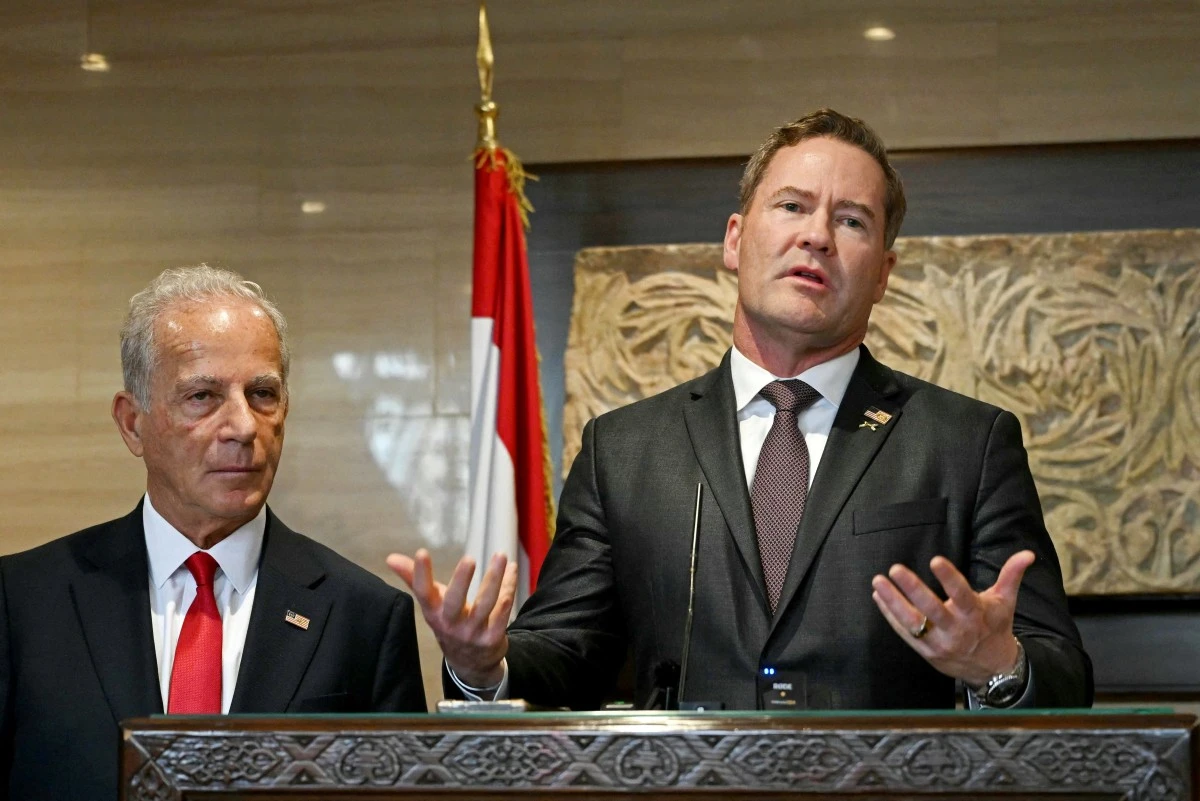
US Ambassador to the UN Mike Waltz, during meetings with Lebanese officials in Beirut on Monday, proposed retaining UN Security Council Resolution 1701 with certain amendments as part of efforts to establish a framework for the post-UNIFIL era.
His visit comes approximately six weeks before the mandate of the UN Interim Force in Lebanon expires, with the peacekeeping mission scheduled to begin an orderly withdrawal from southern Lebanon during 2027.
Waltz said negotiations over the future international presence would take place over the coming month, in coordination with France, which is drafting a new resolution aimed at securing consensus within the Security Council before UNIFIL’s mandate expires.
For Lebanon, the central concern is what will happen to the territory stretching from the Litani River to the Blue Line once the UN force departs.
Lebanese officials fear that the south could move from decades of internationally mandated oversight to security arrangements lacking a clear UN legal framework, raising questions about the authority, responsibilities and accountability of any successor mission.
Those concerns also extend to the future of Resolution 1701, which provides the international framework governing security arrangements and the cessation of hostilities along the Lebanese-Israeli border.
Lebanon rejects proposals that would require direct coordination between the Lebanese and Israeli armies to manage security developments in the south under the framework agreement, particularly if their principal objective were to confront Hezbollah and dismantle its military arsenal.
Prime Minister Nawaf Salam, who served as Lebanon’s ambassador and permanent representative to the UN from 2007 to 2017, emphasized during his meeting with Waltz the need to maintain an international presence in southern Lebanon under a Security Council mandate.
Such a mission, he said, should be responsible for monitoring, reporting, coordination and communication, while supporting the Lebanese Armed Forces in fulfilling their responsibilities and extending state authority across Lebanese territory.
Salam stressed that Resolution 1701 must remain the fundamental reference point for any future international security arrangements in the south. He told Arab News that the principles of reciprocity and phased implementation underpinning the agreement must be translated into practical measures and tangible results.
He called for a clear timetable ensuring parallel progress toward a complete Israeli withdrawal from Lebanese territory and the extension of state authority throughout the country, including the exclusive control of weapons by state institutions.
Salam also called for a credible mechanism to verify compliance by both sides, ensuring that commitments go beyond political declarations and translate into enforceable, verifiable measures on the ground.
He highlighted the importance of Washington’s role in implementing the US-sponsored framework agreement between Lebanon and Israel, particularly in securing an end to Israeli attacks and a complete withdrawal.
The ultimate objective, he said, should be a sustainable settlement that restores Lebanon’s full sovereignty rather than simply managing the conflict.
Waltz traveled by road to Naqoura, allowing him to observe the destruction in southern Lebanon and assess conditions on the ground.
He received a briefing from UNIFIL commanders on the force’s operations and mandate before meeting President Joseph Aoun and Parliament Speaker Nabih Berri in Beirut.
Waltz said his visit had been coordinated with US President Donald Trump and Secretary of State Marco Rubio to gain a firsthand understanding of the situation and hear Lebanese officials’ positions ahead of discussions on the future UN role in the country.
He said he would report his observations and the views expressed during his meetings to Washington and the Security Council, stressing the importance of assessing conditions on the ground before making decisions about the international force.
The US Embassy in Lebanon had previously said Waltz would discuss Washington’s support for implementing the trilateral framework and establishing a sovereign Lebanon free from Hezbollah and Iranian influence.
Waltz also raised questions about the cost and effectiveness of UNIFIL, saying the mission comprised between 8,000 and 11,000 troops and cost approximately $500 million annually. He argued that the substantial resources committed to the mission over the past two decades warranted a review and reform of its operations.
The US, he explained, is examining which capabilities and responsibilities should be preserved, particularly mine clearance, humanitarian assistance, maritime support and monitoring and verification mechanisms that may emerge from the trilateral dialogue.
Waltz said his visit to Naqoura had given him a clearer understanding of the security and humanitarian challenges confronting the south ahead of discussions on UNIFIL’s future and Resolution 1701.
He also said there was bipartisan support among Republicans and Democrats in the US for continuing the peace process, adding that Washington would work with France to incorporate elements of the trilateral dialogue into the new resolution governing the future international presence.
Emphasizing the Lebanese Army’s central role in extending state authority, Waltz said no country could have two armies and expressed hope that Hezbollah would voluntarily surrender its weapons. He said attacks in Lebanon and the wider region were unacceptable and could not continue.
Washington, he added, remained committed to supporting Lebanon’s security institutions and strengthening the army’s capabilities to protect Lebanese territory and its population.
Could a Sinai-style force replace UNIFIL?
Ahead of Waltz’s visit, reports suggested that Washington was considering replacing UNIFIL with an international military and civilian mission modeled on the Multinational Force and Observers deployed in Egypt’s Sinai Peninsula. Such an arrangement would involve an international force responsible for monitoring security provisions and verifying compliance outside the conventional structure of UN peacekeeping operations.
However, a Lebanese official source told Arab News that the model was unlikely to be applicable to Lebanon because of fundamental differences in the political and legal circumstances of the two countries.
The official explained that the Sinai force emerged from arrangements following the peace agreement between Egypt and Israel and was established through an agreement between the two countries specifying its mandate, operating procedures and military coordination mechanisms.
Lebanon, by contrast, has no peace agreement with Israel and is unwilling to enter arrangements that could amount to the normalization of military relations with the country.
MP Melhem Khalaf, who led a parliamentary campaign alongside other lawmakers calling for UNIFIL to remain in southern Lebanon, told Arab News that the proposals currently under discussion remained unclear.
“The Lebanese priority is to ensure that any mechanism replacing UNIFIL operates under the umbrella of the United Nations,” Khalaf said. He stressed that Resolution 1701 provided the necessary international framework and ensured that the UN would remain a witness to the implementation of the Security Council resolution.
President Aoun had previously conveyed a similar position to UN Deputy Secretary-General Amina Mohammed, expressing Lebanon’s openness to establishing an alternative mechanism under UN auspices to prevent a security vacuum.
He insisted that Resolution 1701 must remain the legal foundation for any future international arrangements.
Meanwhile, Rubio, who is closely following the discussions, recently raised the possibility of establishing a civilian monitoring force.
The US has been consulting several European countries, particularly France and Italy, about the proposed mission’s structure, mandate, operational mechanisms and potential participating nations.
The future of southern Lebanon after UNIFIL was also discussed during the G7 foreign ministers’ meeting on Nov. 9-10, with Rubio and French Foreign Minister Jean-Noel Barrot examining possible alternatives on the sidelines.
Barrot highlighted a consensus on the need to avoid a security vacuum following UNIFIL’s departure and move toward a new security architecture.
Rubio, meanwhile, argued that UNIFIL had become outdated and that the priority should now be to establish a civilian rather than military monitoring mission.
Such a force, he said, would need the confidence of all parties and would be tasked with assessing compliance with existing agreements and monitoring the obligations undertaken by each side.
Border communities fear losing a vital lifeline
As diplomatic discussions continue, negotiations between Lebanon and Israel remain stalled.
Israeli demolition and land-clearing operations are continuing in southern Lebanon, where the report describes approximately 700 sq. km of territory as being under Israeli occupation, leaving residents of dozens of villages displaced for a third consecutive year.
The approaching end of UNIFIL’s mission has heightened concerns among border communities that have relied on the international force not only for security monitoring but also for essential humanitarian assistance.
Residents of the predominantly Christian border villages of Rmeish, Debel and Ain Ebel, as well as Druze-majority and Sunni communities, fear the departure of UNIFIL could deprive them of one of the main factors enabling them to remain in their homes.
The peacekeeping force currently coordinates convoys transporting patients and delivering humanitarian supplies between isolated border villages and the cities of Tyre and Beirut, despite the security restrictions in place.
Residents fear that without an alternative mechanism to maintain these vital connections they could be forced to abandon their communities.
For Lebanon, the debate over UNIFIL’s replacement is therefore about more than the composition of an international monitoring force.
It concerns the future of international oversight along the border, the preservation of Resolution 1701 as a legal framework and the ability of vulnerable communities to remain in their villages once the UN peacekeepers withdraw.