- Ten women receive three months of professional training with sign-language interpreters
- Chef conducting classes says verbal skills are not always needed in the culinary profession
KARACHI: When Fatima Aslam attended a cooking course without a sign-language interpreter, she struggled to understand the techniques being taught and could only follow her instructor by watching demonstrations.
Now, at a culinary academy in Pakistan’s southern port city of Karachi, the aspiring baker is learning professional cooking skills with the help of interpreters, an experience she hopes will enable her to start her own business.
“I had taken training before where there was no sign language interpreter, so it was very difficult for me to learn things there,” Aslam told Arab News through an interpreter.
“But here, an interpreter is present, so I am able to understand everything, all the tips and tricks are clear to me,” she added.
Aslam is among 10 deaf women receiving three months of professional culinary training at Karachi’s Chocolate Academy under the National Foodpreneur Program, launched last month by Pakistani food manufacturer National Foods Limited in partnership with ConnectHear, an organization working to improve accessibility and employment opportunities for people with disabilities.
The initiative aims to equip participants with practical skills in preparing different cuisines, food hygiene, safety and professional kitchen operations, helping them pursue careers or establish businesses in the food industry.
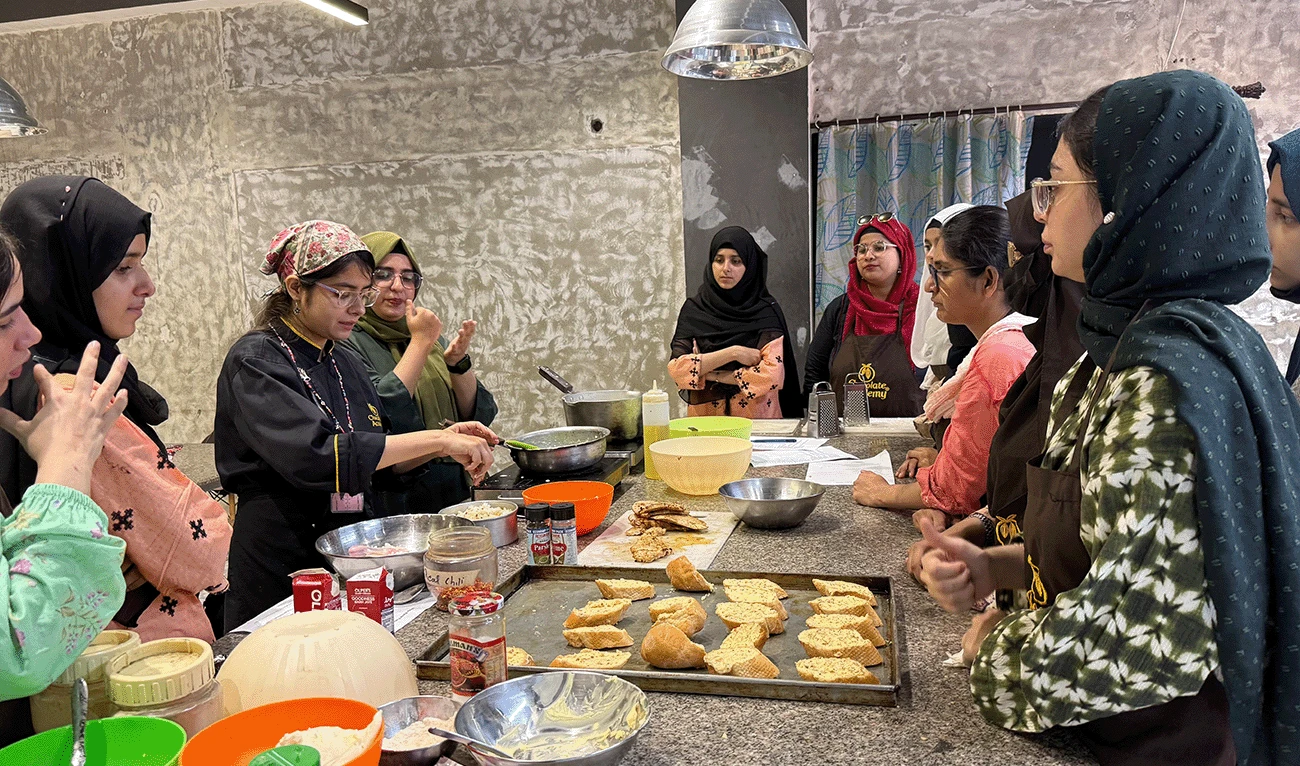
During a training session witnessed by Arab News on Saturday, participants fried chicken, boiled pasta and prepared ingredients as a professional chef demonstrated cooking techniques, with ConnectHear interpreters conveying the instructions in sign language.
Aliya Afzal, deputy manager for diversity, equity and inclusion at ConnectHear, said the program was designed to help members of the deaf community who were seeking employment but lacked the necessary professional skills.
“Our aim is to introduce them to these skills, help them develop expertise, and then connect them with the industry,” Afzal told Arab News.
She said ConnectHear hoped to secure industry placements for all 10 participants after they completed their training and encouraged employers willing to offer opportunities to come forward.
Aslam, who has enjoyed baking since childhood, said she was particularly interested in making decorated cakes and had learned to prepare fondant cakes during the course.
Another trainee, Bisma Mubeen, said she had learned to prepare cupcakes, pizzas and other dishes, skills she hoped would eventually help her earn an income.
“This is my first training where there is a sign language interpreter, I am able to ask and answer questions, share my opinions, and do everything independently,” Mubeen told Arab News through an interpreter.
Zainab Durrani, the chef conducting the classes, said sign-language interpreters were essential to ensuring the trainees understood detailed recipes, cooking techniques and instructions.
“Their presence makes a huge difference in our classes,” she told Arab News.
Durrani, who has five years of experience working with people with disabilities, said the trainees had shown enthusiasm for learning, with some practicing recipes at home and sharing their progress with instructors.
She said one participant was already running a cake business, while others had the potential to work independently or pursue jobs in professional kitchens.
“Because in the culinary profession, verbal communication is not always essential,” Durrani said. “What matters more is their practical, hands-on ability.”
She said the trainees could work in restaurant kitchens or even teach at culinary schools.
For Aslam, the training has brought her closer to a goal she has pursued since childhood: turning her interest in baking into a livelihood of her own.
She said she did not want to take up a job.
“I want to become a business owner, a home chef, and run my own business,” she said.