- The program connects Pakistani participants with an international network of more than 550 alumni
- One student secured corporate role before graduation, another fellow launched free career accelerator
KARACHI: Yusra Suriya, a Pakistani university student, last year joined a leadership fellowship in Karachi, where she met a senior executive from a global media agency whose mentorship helped her secure a place in WPP Media’s management trainee program this August, with the company waiving its graduation requirement after her internship.
The 22-year-old, who is a fourth-year management and entrepreneurship student at the Karachi School of Business and Leadership (KSBL), credits her professional development in part to Qimam, a leadership fellowship launched in Saudi Arabia in 2018 that expanded to Pakistan in 2025.
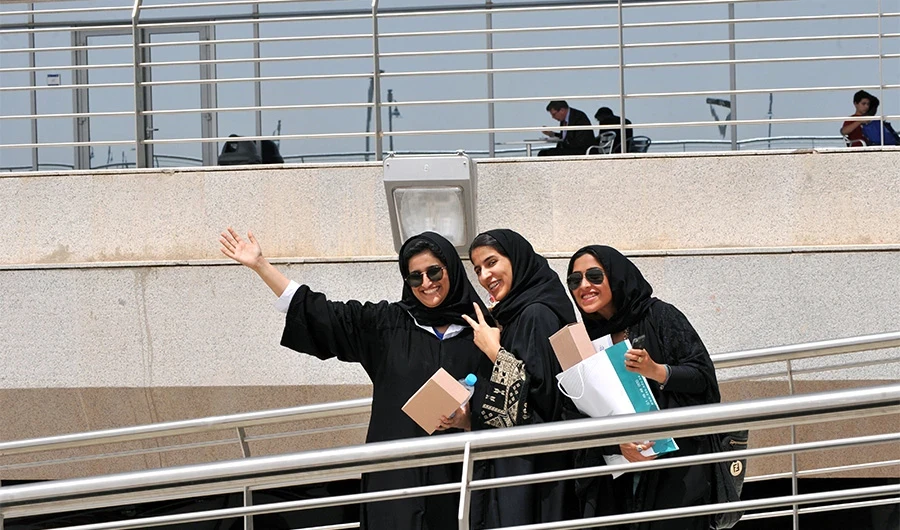
The fully funded fellowship brings together university students for leadership training, executive mentorship and corporate visits, according to its founders and partners. Its second Pakistani edition was held in the southern port city of Karachi in August this year.
“The biggest difference that I see is in our skillsets and the network that we were able to create, not just with our mentors, but with the people around us,” Suriya told Arab News.
“Right now, I’m working as one of the youngest MTs [management trainees] there at WPP,” she said, mentioning her global media company that creates innovative solutions to deliver growth for brands around the world.
During the fellowship, Suriya met Amna Khatib-Paracha, managing director of Mindshare, a media agency within WPP Media. The two met again when Suriya secured an internship at WPP the following summer.
The 22-year-old says the earlier interaction helped her understand the company’s expectations and prepare for her internship presentation, following which she was offered a place in its management trainee program.
The fellowship also gave Suriya the confidence to contest student government elections at her university, where her team secured a two-thirds majority and formed what she describes as the institution’s first women-led student government.
For Hassan Alam, a student at the Institute of Business Administration (IBA) who comes from Pakistan’s northern Gilgit region, the fellowship helps provide professional opportunities to students beyond the country’s universities.
In Jan., Alam launched The Capstone Program, a free career development initiative, offering Pakistani university students individual mentorship, online learning sessions and visits to organizations.
The program has so far selected 55 fellows from around 950 applicants across two cohorts, involving more than 40 mentors, according to Alam. Four of its participants subsequently secured places in Qimam’s second Pakistani fellowship.
Although Alam had conceived the initiative before attending Qimam in 2025, he said the fellowship demonstrated how such a model could work.
“Joining Qimam showed me that the model actually works: direct access to senior professionals is life-changing,” Alam told Arab News. “The real value was confidence and the push to start something of my own.”
For Malaika Khan, 23, who comes from Zhob in Pakistan’s southwestern Balochistan province, the fellowship helped open doors to further education.
In July, Khan, an economics graduate who works as a human resources associate at the Rapidev digital intelligence products and solutions provider, secured a scholarship worth $19,755 from US-based education institution One League for a Master of Business Administration (MBA) program, with a Generative AI and Data Science track.
Khan credited Qimam with introducing her to the opportunity and supporting her application.
“I still have this continued connection with Qimam,” she told Arab News.
Farooq Awad, founder and CEO of the Qimam Foundation, said their leadership program was conceived with a vision extending beyond the Kingdom.
“From day one, the dream was always to make it a regional matter or a regional platform,” Awad told Arab News.
Drawing inspiration from international scholarship programs such as Rhodes and Fulbright, Qimam sought to identify talented young people early in their careers and provide them with opportunities to realize their potential within the region, according to Awad.
The foundation currently operates in Saudi Arabia, Pakistan and Jordan, and has plans to expand into the United Arab Emirates and Syria in 2027. While each country’s fellowship is tailored to local professional needs, Pakistani participants gain access to an international network of more than 550 alumni, including graduates from Saudi Arabia.
Awad said graduates of the inaugural Pakistani cohort played a central role in organizing this year’s fellowship in Karachi under the guidance of senior Saudi alumni.
“The majority of the work was done through the Pakistani alumni from year one,” he said, adding that his foundation covers participants’ transportation, accommodation, meals and training expenses.
For Suriya, the benefits have extended beyond her own career. She says members of her cohort remain in regular contact, share professional and educational opportunities, and draw on each other’s expertise.
“All of us are really helping each other out,” Suriya said.