- Pakistan, Saudi Arabia and Türkiye on Friday discussed ways to implement collective defense commitments, counter Houthi attacks
- Former diplomats say Friday’s meeting focused on how the three countries could translate their commitments into practical measures
ISLAMABAD: The Makkah defense alliance between Saudi Arabia, Pakistan and Türkiye appears to be moving from a political understanding toward practical cooperation, Pakistan’s former diplomats said on Saturday, with Saudi Arabia’s security emerging as a central pillar of the alliance.
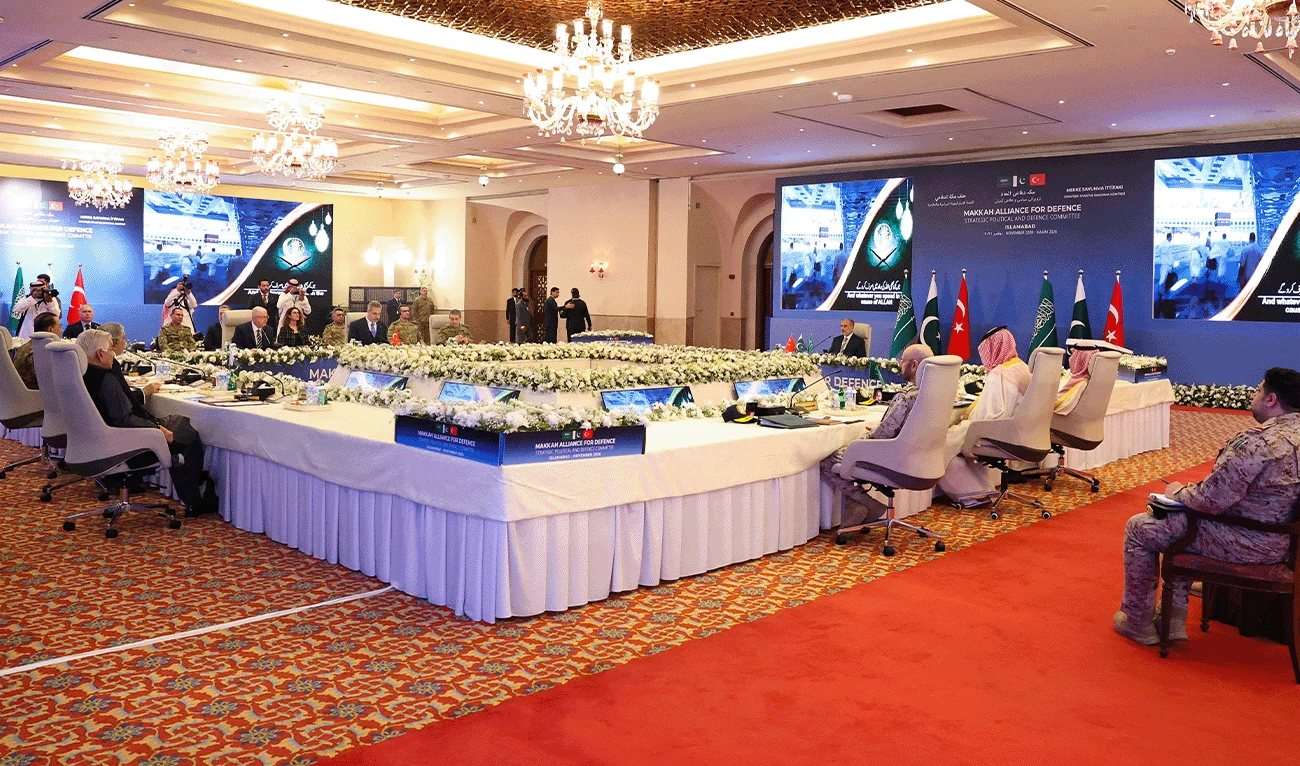
The alliance’s Strategic, Political and Defense Committee (SPDC) held its second meeting in Islamabad on Friday that marked another step toward consolidating the arrangement established in August, amid heightened regional tensions following the US-Israeli war on Iran.
The three countries agreed on the principles to admit new members to the alliance, while Pakistani Prime Minister Shehbaz Sharif reaffirmed Islamabad’s full support for Saudi Arabia’s sovereignty, territorial integrity and security.
The discussions came as the alliance’s members worked toward implementing their collective defense commitments and strengthening the Kingdom’s defenses against ongoing attacks by Yemen’s Iran-aligned Houthi militants.
Former Pakistani Foreign Secretary Aizaz Chaudhry said the Makkah Joint Defense Agreement was founded on the principle of collective security, with the latest meeting focusing on how the three countries could translate their commitments into practical measures.
“Since its signing last August, the three signatories have completed the process of formal endorsements and are now ready to engage in substantive discussions on what exactly is to be done to counter the aggression that has taken place against Saudi Arabia,” Chaudhry told Arab News.
“The mechanism has been put in place and they need to identify, based on the information provided by Saudi Arabia, exactly what support these two countries can extend. That is why these meetings have become crucially important.”
The Houthis have repeatedly attacked the Kingdom over the last few months, amid US strikes on Iran and Tehran’s counterattacks on US interests as well as civilian, energy and aviation infrastructure in Gulf countries.
Chaudhry said the Makkah pact tended to fill up a security vacuum in the region that was created after the US could not ensure security of Gulf states during its war with Iran.
“It is not against any country and is based on the concept of collective security,” he said.
The Makkah Joint Defense Agreement commits the three countries to treating an armed attack against any one of them as an attack against all. At Friday’s meeting, the three sides reviewed progress toward practical implementation of their collective defense commitments.
The alliance’s institutional development has accelerated since its first meeting in Istanbul on Aug. 31, when the three countries agreed to establish a permanent secretariat in Riyadh and pursue joint development and production of defense technology. At emergency talks in Riyadh on Oct. 5, they confirmed retired Pakistani Lt. Gen. Nauman Mahmood as the alliance’s first secretary-general for a three-year term.
On Friday, Pakistan’s Foreign Minister Ishaq Dar said the countries were satisfied with progress toward making the secretariat operational and had reaffirmed their commitment to cooperation in defense industries, technological development, military training and capacity building. Turkish FM Hakan Fidan said the three countries had discussed a roadmap for admitting prospective members and agreed on some principles. He did not identify any prospective members or elaborate on the principles agreed upon.
Former Pakistani ambassador to the US, United Kingdom and United Nations Maleeha Lodhi said Friday’s meeting demonstrated growing institutionalization of the alliance and highlighted Pakistan’s role in the emerging regional security architecture.
“Every successive meeting of the Makkah alliance represents an advance toward greater consolidation and institutionalization,” Lodhi told Arab News.
“This brings Pakistan credit too as it is at present headed by a former Pakistani military officer and shows the effort the country is putting in. It also places Pakistan at the center of the Middle East’s security diplomacy.”
The alliance’s development was further cementing defense cooperation among the three countries and conveying a message of solidarity on collective deterrence, according to the diplomats.
“It also indicates how regional security arrangements are emerging outside the US-led system,” she added.
Masood Khan, another former Pakistani ambassador to the US and UN, said the three countries deserved recognition for moving quickly to develop the alliance but stressed that its next phase should focus on strengthening its operational capacity.
“Now that they have created such an impressive, such a momentous organization, it needs consolidation in all aspects, whether they are financial, military, operational,” Khan said.
The three countries have repeatedly described the Makkah pact as a defensive arrangement not directed against any country.
Former Pakistani diplomats believed that the emerging security architecture could eventually provide an opportunity for broader regional participation.
“I think these countries need to consolidate the architecture that they have been building,” Chaudhry said.
“It is my sense that a new security architecture is now getting in place for our region.”