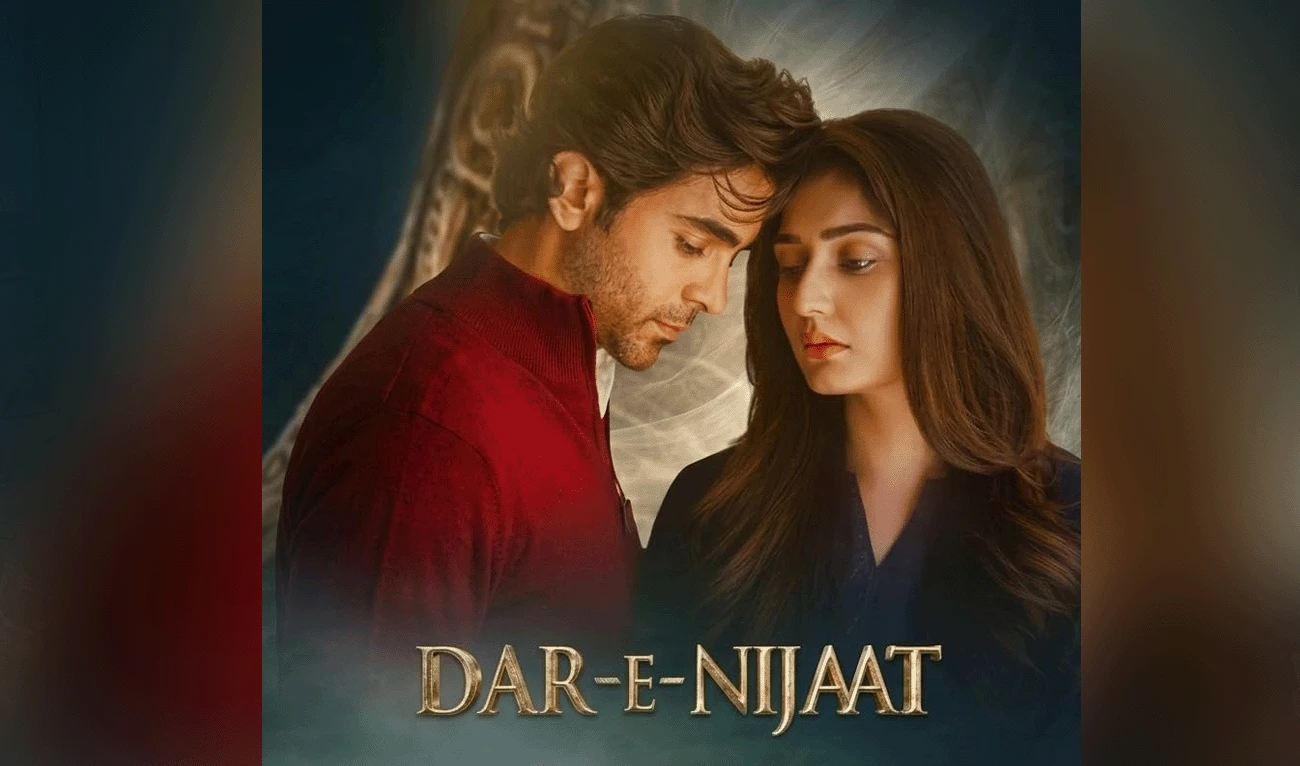
- Clips from the show have gone viral on Indian social media ever since it started airing on Aug. 1
- Numerous reels featuring lead characters from the show regularly feature on Indian social media
ISLAMABAD: The popularity of Pakistani dramas in India is not a new phenomenon. Whether it is ‘Zindagi Gulzar Hai,’ ‘Humsafar,’ or ‘Mere Paas Tum Ho,’ these Pakistani dramas have found a special place in the hearts of Indian audiences. Now, ‘Dar-e-Nijat’ has successfully carved out a space for itself among Gen Z.
The characters from Dar-e-Najat — Abu Bakar and Zaryab — have gained immense popularity across the border. Gen Z, in particular, is quite enamored with these characters, and numerous reels featuring them are being shared across social media platforms.
Independent Urdu reached out to the Indian Gen Z and requested them to share their thoughts about the show, explaining why they like it so much and how it has managed to win them over.
“Abu Bakar is, in essence, a gentle, loving, and caring husband. He is an incredibly loyal hero,” said Arhan, a sociology student in New Delhi who only gave his first name.
“Above all, he never raises his voice at a woman, nor does he ever behave disrespectfully toward her. He is someone who tolerates everything.”
On the contrary, the heroine’s ex-boyfriend embodies a highly toxic and negative mindset, according to Arhan. He presents Islam in negative light, focusing solely on rigid demands as if religion were limited entirely to a few concepts.
In the show, Arhan notes, Abu Bakar, practices his faith in a “natural way.”
Dar-e-Nijat began airing on a private Pakistani television channel on August 1, 2026. The screenplay is written by Umera Ahmed and directed by Saqib Khan.
Clips from the show have gone viral on social media in India that it is rare to find someone whose social media feed has not yet shown a clip from the drama.
The show has also gained popularity in Bangladesh, Dubai, and the Maldives.
Guldasta was another one of the millions of Gen Z viewers who was introduced to the character of Abu Bakar through Instagram Reels. She views him as a “green flag.”
“True religion is about being a good human being — exercising patience and restraint, not raising one’s voice at a woman over every little thing, and not reducing a woman to merely a physical object. At its core, it is about mutual respect and caring for one another,” she said.
“This character is not just a ‘good man’; he embodies a whole world of virtues. Even my Hindu friends watch this drama. It highlights fundamental human qualities, including ethics, that people often forget or begin to overlook.”
Zayed, another young student, highlighted the differences between Indian and Pakistani dramas, saying that Indian serials often focus on domestic conflicts, whereas Pakistani dramas do not follow this pattern. He said Indian movies are popular in Pakistan, while Pakistani dramas have huge audience in India.
To a question, Guldasta remarked that humanity and ethics transcend borders.
“I think, being a human and having morality is far beyond the borders can divide,” she said.
“It is just that people are trying to relate because morality is something that should be basic to everybody.”