- Security chief says negotiations require US steps to build trust and fulfill Iran’s conditions
- Munir says shared border reopened Tuesday morning, according to Iranian state media
ISLAMABAD: Iran will not allow any enriched nuclear material to leave the country, its security chief told Pakistan’s army chief on Tuesday during talks in Tehran, as Islamabad seeks to revive stalled diplomacy with Washington.
Pakistan helped broker a June agreement intended to halt the US-Iran war, reopen the Strait of Hormuz and allow negotiations on a lasting settlement. The agreement subsequently unraveled, leaving disputes over Iran’s nuclear program, sanctions and access to the vital energy shipping route unresolved.
Washington wants Iran’s nuclear program addressed at the outset of negotiations, while Tehran says steps to reopen Hormuz and end economic and military pressure must come first. The impasse has prolonged a conflict that began with US and Israeli strikes on Iran in February.
“All enriched nuclear material will remain in Iran. Not even a single particle of enriched nuclear material will leave the country; these materials constitute a major asset and national wealth for the Iranian people, intended for domestic use,” Supreme National Security Council Secretary Mohsen Rezaei told Pakistan’s Field Marshal Asim Munir, according to state-run IRNA.
Rezaei said Iranian officials and the public were united in opposing negotiations until Washington took steps to build trust, beginning with the fulfillment of Iran’s conditions.
The statement underscored Tehran’s position on the future of its nuclear stockpile, a central issue in diplomacy over a program Iran says is intended for peaceful purposes. Enriched uranium can fuel nuclear reactors but, at sufficiently high enrichment levels, can also be used in nuclear weapons.
Iran has proposed reopening the Strait of Hormuz within seven days if its conditions are met, including lifting the US blockade on Iranian ports, easing restrictions on oil exports and ending regional hostilities. Foreign Minister Abbas Araghchi said on Sunday that the proposal remained on the table.
The narrow passage connects the Gulf to the open sea and, before the war, carried about a fifth of global trade in oil and liquefied natural gas. Disruption there has threatened energy supplies and increased costs for importing countries.
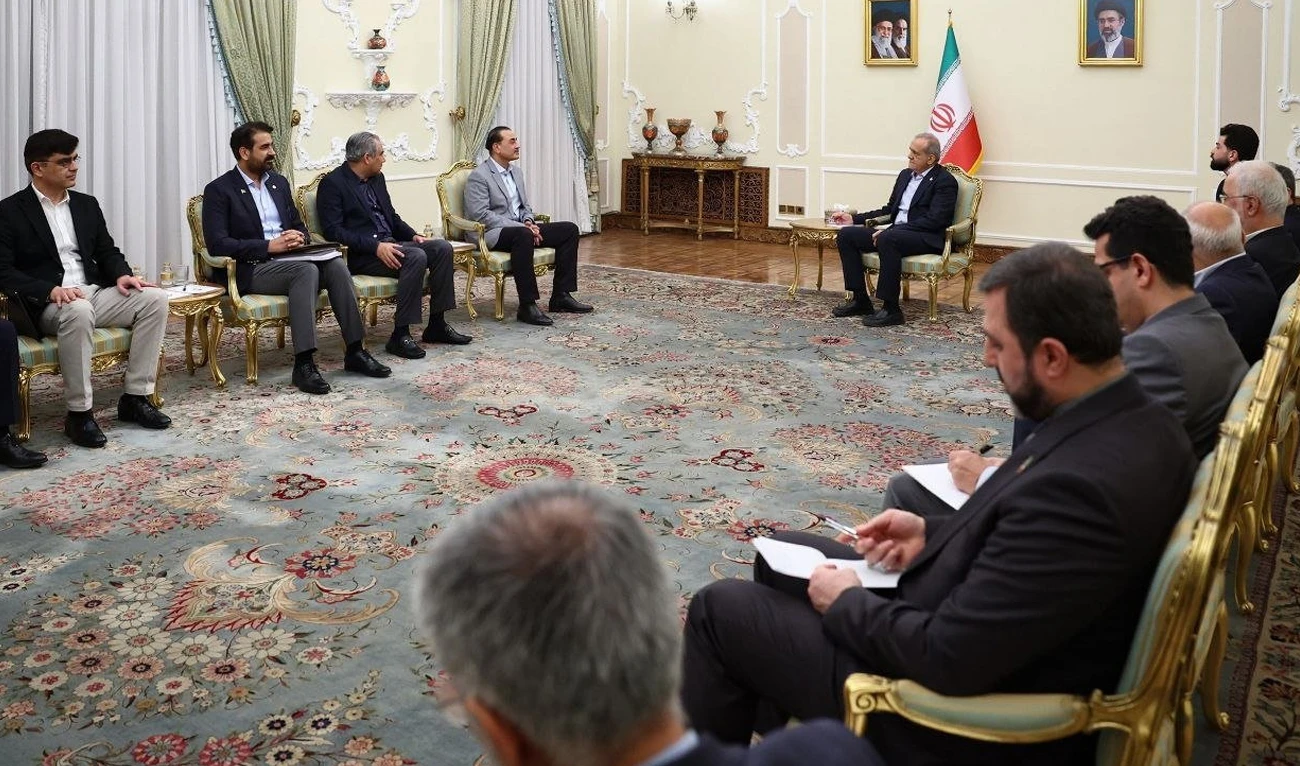
During his visit to Tehran, Munir also met Iranian President Masoud Pezeshkian and Araghchi on Tuesday, according to Iranian state media. Pakistan’s Interior Minister Mohsin Naqvi accompanied him.
Pezeshkian thanked Pakistan for its efforts to reduce tensions through diplomacy, but said Washington must remove pressure, threats and sanctions before negotiations could take place, according to IRNA.
“For any negotiations to take place, pressures, threats, and sanctions must first be removed.”
The Iranian president accused Washington of causing regional tensions and disruptions in the Strait of Hormuz, and cited attacks on Iran during negotiations as evidence of past US bad faith.
In a separate summary of Tuesday’s discussions, IRNA said senior Iranian officials told Munir that Washington must return to the “Islamabad understanding” and fulfill Tehran’s seven-point conditions.
The agency also reported that Munir received Iran’s response to a message from the Americans, describing the response as clear, serious and explicit. The summary did not disclose the contents of either message.
Iranian foreign ministry spokesman Esmaeil Baqaei said earlier on Tuesday that discussions with Munir would cover negotiations with Washington, while emphasizing the visit’s bilateral focus.
The talks will “relate to issues concerning the negotiations, but they are mainly focused on bilateral relations and strengthening interactions and cooperation,” he said.
BORDER REOPENED
Munir also said the Pakistan-Iran border had reopened on Tuesday morning, following a temporary suspension of trade that stranded cargo at two major crossings.
“We explicitly state that the issues concerning the Iran-Pakistan border have been resolved, and the border has been reopened as of this morning,” IRNA quoted him as saying.
Pakistan suspended trade at the Taftan and Gabd-Rimdan crossings in southwestern Balochistan province on Saturday. Provincial officials said the restrictions were intended to address security concerns, curb smuggling and improve border management.
The closure disrupted shipments of goods including liquefied petroleum gas and fresh food. Traders told Arab News that more than 2,000 containers were stranded at Gabd-Rimdan, with hundreds of trucks also stuck at Taftan.
The visit, Munir’s fifth since the June agreement, comes amid Iranian warnings that fighting with the United States could resume, despite the absence of US strikes on Iran since September.
“We live with this possibility day and night, and we cannot rule it out, even as we speak,” Baqaei told reporters on Tuesday.
Munir’s talks followed a visit to Tehran by Russian Foreign Minister Sergei Lavrov on Monday, as diplomatic contacts continued over the conflict.
Pakistan’s mediation also comes amid attacks this month by Yemen’s Iran-aligned Houthi militia against Saudi energy and civilian infrastructure. Islamabad, which has defense agreements with Saudi Arabia, has pledged to support the Kingdom’s security.