- IMF director Jihad Azour urges deeper tax reforms to sustain economic recovery, boost private investment
- Muhammad Aurangzeb calls for predictable tax policies, says Pakistan must avoid boom-and-bust cycles
KARACHI: A senior International Monetary Fund (IMF) official warned on Tuesday Pakistan remains vulnerable to rising energy prices, trade disruptions and tighter global financing conditions, as Finance Minister Muhammad Aurangzeb called for predictable tax policies to encourage private investment and sustain economic growth.
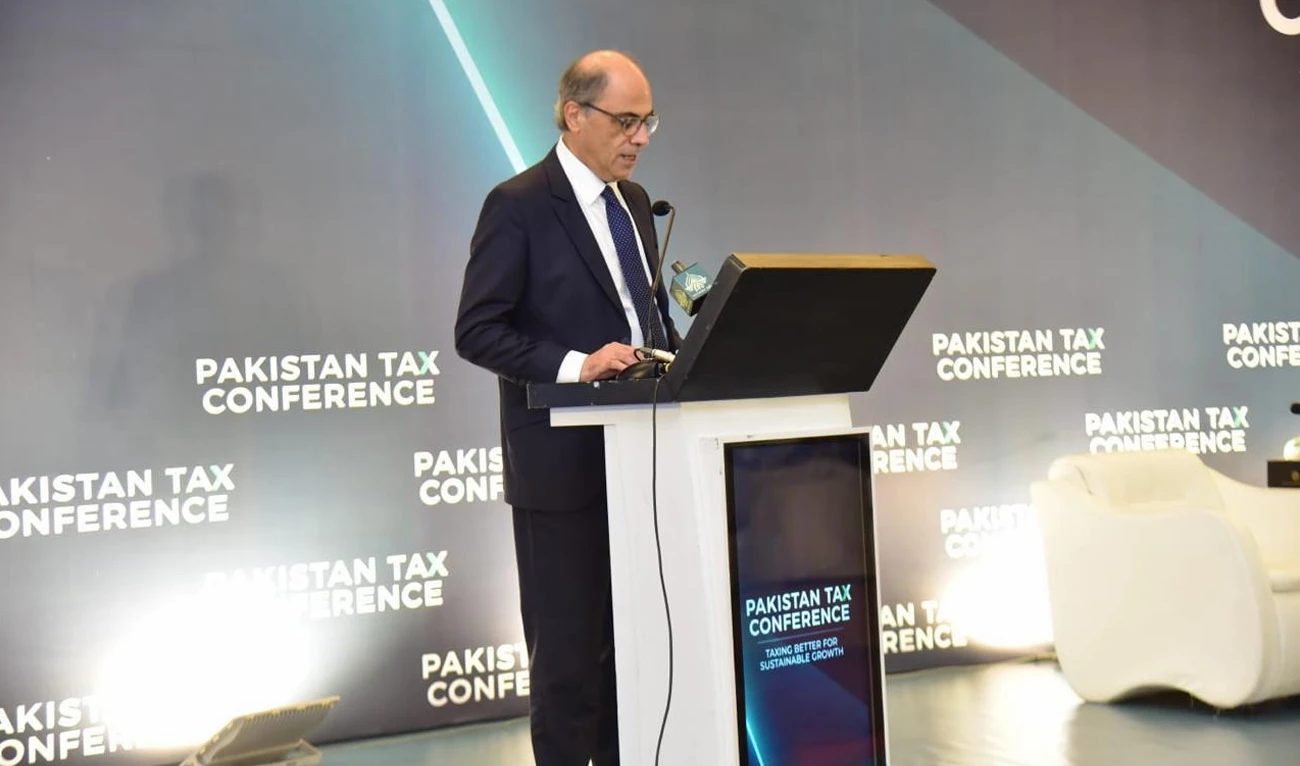
Jihad Azour, the IMF’s director for the Middle East and Central Asia, made the remarks at a tax reform workshop in Islamabad, where he acknowledged Pakistan’s progress in restoring macroeconomic stability but stressed the need for deeper reforms.
Pakistan is implementing a $7 billion IMF program aimed at addressing longstanding structural weaknesses, including a narrow tax base and persistent fiscal imbalances.
“For Pakistan, exposure to higher energy and food prices, disruption to trade and supply chains, weaker external demand and an abrupt tightening in global financing conditions heightens the premium on preserving stability while supporting the recovery,” Azour said in a televised address to the gathering.
His warning comes amid ongoing US-Iran hostilities and wider instability in the Middle East, which have raised concerns about energy costs, international trade and economic growth in countries dependent on imported fuel, including Pakistan.
Azour said Pakistan had made important progress in rebuilding confidence and strengthening its external buffers despite repeated economic shocks.
However, he said the next challenge was to translate those gains into stronger and more durable growth through reforms that improved competitiveness, encouraged investment and expanded opportunities for the private sector.
He said fiscal policy needed to go beyond meeting primary balance targets and maintaining debt sustainability to support economic recovery, public investment and social spending.
He called for broadening the tax base, strengthening revenue administration, reducing tax concessions and addressing undertaxed sectors while making the system fairer.
The IMF official also emphasized coordination between federal and provincial governments, institutional ownership and effective implementation of reforms.
Speaking at the same workshop, Aurangzeb said businesses could no longer be subjected to unexpected tax changes in successive annual budgets as Pakistan sought to shift from economic stabilization to sustainable growth.
“We owe it to the private sector, we owe it to the nation, we owe it to the country,” he said during his speech. “We cannot continue to give surprises to private sector investment at every single budget.”
Pakistan has struggled for decades with weak revenue collection and repeated balance-of-payments crises, forcing successive governments to seek IMF assistance. Businesses have frequently complained about unpredictable taxation, high energy costs and policy uncertainty.
Aurangzeb said the government needed to move beyond designing tax policies primarily to meet revenue targets and instead consider their wider economic impact.
“We have to continue to have a tax design which is led by economic value considerations, not by making the math work,” he said.
The minister said the government had begun recalibrating taxation for export-oriented industries in the last budget, with future efforts aimed at ensuring policy continuity.
Turning to Pakistan’s economic performance, Aurangzeb said the country’s combined fiscal and external deficits had narrowed from 12.5 percent of gross domestic product a few years ago to 2.6 percent in the last fiscal year.
“Last fiscal year, we had a fiscal deficit which is now at a 22-year low,” he said.
He said Pakistan had recorded three consecutive years of primary budget surpluses, while the tax-to-GDP ratio had increased from 8.8 percent to 10.3 percent.
Aurangzeb also warned against returning to consumption-driven growth financed by excessive liquidity, saying such policies had contributed to Pakistan’s repeated economic crises.
“Those have actually led us to the boom-and-bust cycles. And one thing is for sure: we will not let that repeat,” he said.
The minister said future economic expansion needed to be sustainable and export-led, supported by tax reforms that encouraged productive investment rather than short-term consumption.