- Khan’s PTI party confirms religio-political leader Maulana Fazlur Rehman is trying to resolve the deadlock with government
- Analyst says PTI’s movement appears to be mobilizing local crowds rather than moving large number of protesters to Islamabad
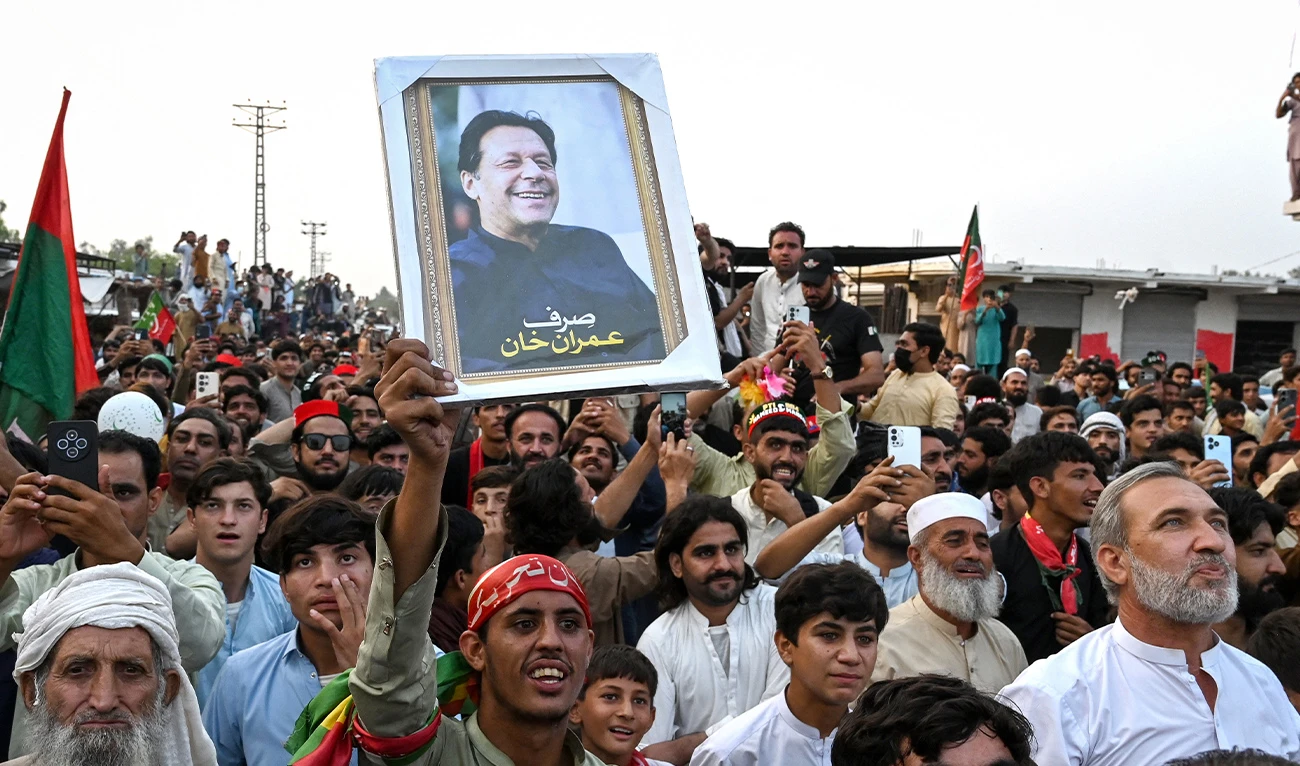
ISLAMABAD: Jailed former prime minister Imran Khan’s party continued its protest march toward Islamabad as fresh efforts to reopen a dialogue with the government gathered pace through a mediator on Thursday, with government and party officials denying any direct contact between the two sides.
The march, led by the chief minister of Khyber Pakhtunkhwa province that is ruled by Khan’s Pakistan Tehreek-e-Insaf (PTI) party, is mainly seeking the release of the jailed ex-premier and other party members.
However, it has progressed slowly toward the capital since its start from the northwestern Lakki Marwat district on Sunday. Party members said the caravan is expected to reach KP’s Swabi on Oct. 11 before moving on to Attock in Punjab and ultimately Islamabad.
PTI’s KP Information Secretary Shaukat Yousafzai on Thursday confirmed to Arab News that Maulana Fazlur Rehman, head of the Jamiat Ulema Islam-Fazl (JUI-F) party, was trying to resolve the deadlock between the sides after the failure of two rounds of the government-PTI talks.
“There are absolutely no [direct] contacts,” Yousafzai said. “Maulana Fazlur Rehman Sahib is involved... We have full trust in him.”
The opposition launched the march over restricted access to Khan, his prolonged imprisonment and differences over counterterrorism policy in KP.
The government has asked Rehman to play a role in resolving the issue, according to reports. While renewed negotiations through Rehman could offer a possible route out of confrontation, Yousafzai said access to Khan remained central to any settlement.
“If the meeting takes place, all paths will open up. Imran Khan will issue directives. Without him, this long march cannot be called off,” he said.
PTI has repeatedly demanded access to Khan, who has been jailed since Aug. 2023, while government officials have denied the PTI negotiating team access to him.
Heightened political tensions have also raised the prospect of federal intervention in KP, the northwestern Pakistani province that is facing a sharp surge in militancy, which the government side earlier said was the main point of talks with PTI.
Khyber Pakhtunkhwa Governor Faisal Karim Kundi, a federal representative in the province, pointed to the killing of dozens of soldiers, policemen and civilians in recent attacks in the province, when asked whether sufficient grounds existed for the imposition of governor’s rule in the region.
“On a daily basis, martyrdoms are taking place, and their (PTI’s) circus is going on,” he said, accusing the provincial leadership of not “owning” the country’s fight against militants.
“This depends on the President of Pakistan and the Prime Minister of Pakistan,” Kundi said, when asked if emergency measures were on the cards if PTI continued its march on Islamabad.
The governor said he was unaware of any backdoor talks happening with the PTI.
LACK OF PARTICIPATION
Since its start, the opposition march has struggled to maintain a consistent timeframe for reaching the capital, with Yousafzai saying the party would announce its next move after the marchers reach the Swabi district in KP on Oct. 11.
“Our ultimate destination is Islamabad,” he added.
Peshawar-based journalist and analyst Mehmood Jan Babar said the movement appeared to be mobilizing local crowds rather than moving a large number of protesters toward Islamabad.
“People have mainly come out in the chief minister’s own constituency and area, Darra Adam Khel and Khyber, where the Afridi tribe is predominant,” Babar said.
“In each district, local mobilization occurs, but people return to their homes afterward,” he said. “There isn’t a permanent crowd accompanying them that would allow us to analyze a sustained movement.”
Babar said the march’s itinerary remained uncertain, with the convoy moving between districts before its arrival in Swabi, a point after which the situation for Khan’s party may change.
WAITING GAME
Islamabad-based analyst Ansar Abbasi said the federal government appeared to be giving PTI more time in the hope that the march would be called off.
“Various constitutional options are naturally being considered and are under discussion,” Abbasi said, adding that the government wanted to give some time “so that this politics of confrontation can end.”
This, he said, meant that governor’s rule could be “avoided” for now.
Babar said the situation was being driven by pressure rather than dialogue.
“Everything is currently being driven by pressure,” he said, adding that the federal government appeared to be assessing the strength of PTI’s mobilization campaign before deciding whether to engage it seriously.