HOUSTON: Schlumberger Ltd, the world's No. 1 oilfield services provider, said it expects a "significant global supply deficit" of crude oil, assuming steady growth in demand, given the sharp decline in spending on exploration and production.
Energy companies have halved their E&P budgets since oil prices began their slump in June 2014, scaling back drilling to focus on the most prolific oil fields, a strategy called high-grading.
"As the opportunities for activity high-grading are exhausted, we should see a further acceleration in the global production decline," Schlumberger Chief Executive Paal Kibsgaard said on an earnings conference call on Friday.
The IEA, which coordinates the energy policies of industrial nations, earlier this month raised its forecast for global oil demand growth by 0.1 million barrels per day (bpd) to 1.4 million bpd in 2016 and 1.3 million bpd in 2017.
Schlumberger reported a better-than-expected adjusted profit for the second quarter on Thursday, and said it was considering rolling back pricing concessions.
The view echoed that of smaller rival Halliburton Co., which said on Wednesday that "deep, uneconomic pricing cuts" would have to be reversed.
"Inevitably service industry pricing has to recover and as it does, this will consume a large part of the E&P investment increases intended for additional activity, which will further amplify the pending oil supply deficit," Kibsgaard said.
Oil producers have said their ability to keep pumping oil without spending more was due to lower prices for oilfield services and better production techniques that drastically lower costs for each new well, while yielding more oil.
But Kibsgaard said the low costs were not indicative of a "permanent improvement in the underlying industry performance", emphasizing there had be no fundamental changes in technology, quality efficiency, collaboration or the industry's business model.
"What has taken place over the past 21 months is instead a redistribution of the profit and cash flow shortfall from previously sitting mostly with the oil producers to now representing an unsustainable burden for the supply industry."
Schlumberger's shares were down 0.7 percent at $79.43.


Schlumberger sees 'significant global oil supply deficit'

Schlumberger sees 'significant global oil supply deficit'

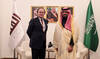
Saudi investment pipeline active as reforms advance, says Pakistan minister
ALULA: Pakistan’s Finance Minister Mohammed Aurangzeb described Saudi Arabia as a “longstanding partner” and emphasized the importance of sustainable, mutually beneficial cooperation, particularly in key economic sectors.
Speaking to Arab News on the sidelines of the AlUla Conference for Emerging Market Economies, Aurangzeb said the relationship between Pakistan and Saudi Arabia remains resilient despite global geopolitical tensions.
“The Kingdom has been a longstanding partner of Pakistan for the longest time, and we are very grateful for how we have been supported through thick and thin, through rough patches and, even now that we have achieved macroeconomic stability, I think we are now well positioned for growth.”
Aurangzeb said the partnership has facilitated investment across several sectors, including minerals and mining, information technology, agriculture, and tourism. He cited an active pipeline of Saudi investments, including Wafi’s entry into Pakistan’s downstream oil and gas sector.
“The Kingdom has been very public about their appetite for the country, and the sectors are minerals and mining, IT, agriculture, tourism; and there are already investments which have come in. For example, Wafi came in (in terms of downstream oil and gas stations). There’s a very active pipeline.”
He said private sector activity is driving growth in these areas, while government-to-government cooperation is focused mainly on infrastructure development.
Acknowledging longstanding investor concerns related to bureaucracy and delays, Aurangzeb said Pakistan has made progress over the past two years through structural reforms and fiscal discipline, alongside efforts to improve the business environment.
“The last two years we have worked very hard in terms of structural reforms, in terms of what I call getting the basic hygiene right, in terms of the fiscal situation, the current economic situation (…) in terms of all those areas of getting the basic hygiene in a good place.”
Aurangzeb highlighted mining and refining as key areas of engagement, including discussions around the Reko Diq project, while stressing that talks with Saudi investors extend beyond individual ventures.
“From my perspective, it’s not just about one mine, the discussions will continue with the Saudi investors on a number of these areas.”
He also pointed to growing cooperation in the IT sector, particularly in artificial intelligence, noting that several Pakistani tech firms are already in discussions with Saudi counterparts or have established offices in the Kingdom.
Referring to recent talks with Saudi Minister of Economy and Planning Faisal Alibrahim, Aurangzeb said Pakistan’s large freelance workforce presents opportunities for deeper collaboration, provided skills development keeps pace with demand.
“I was just with (Saudi) minister of economy and planning, and he was specifically referring to the Pakistani tech talent, and he is absolutely right. We have the third-largest freelancer population in the world, and what we need to do is to ensure that we upscale, rescale, upgrade them.”
Aurangzeb also cited opportunities to benefit from Saudi Arabia’s experience in the energy sector and noted continued cooperation in defense production.
Looking ahead, he said Pakistan aims to recalibrate its relationship with Saudi Arabia toward trade and investment rather than reliance on aid.
“Our prime minister has been very clear that we want to move this entire discussion as we go forward from aid and support to trade and investment.”