Prince Faisal chairs King Fahd National Library’s first board meeting of 2026

1 / 2
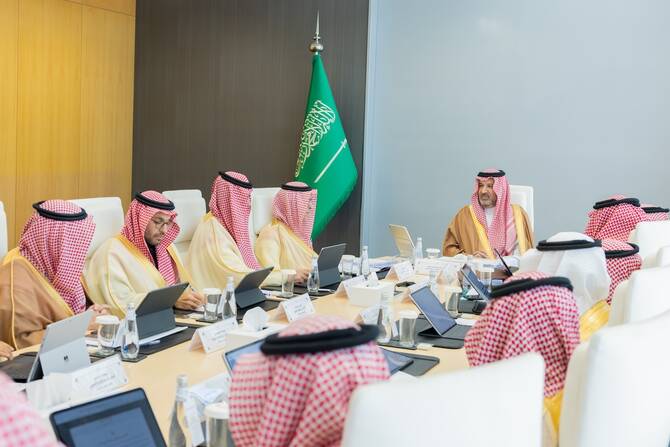
Prince Faisal bin Salman, chairman of the King Fahd National Library, on Sunday chaired the library’s first board of trustees meeting for 2026, attended by the distinguished board members. (Supplied)
2 / 2
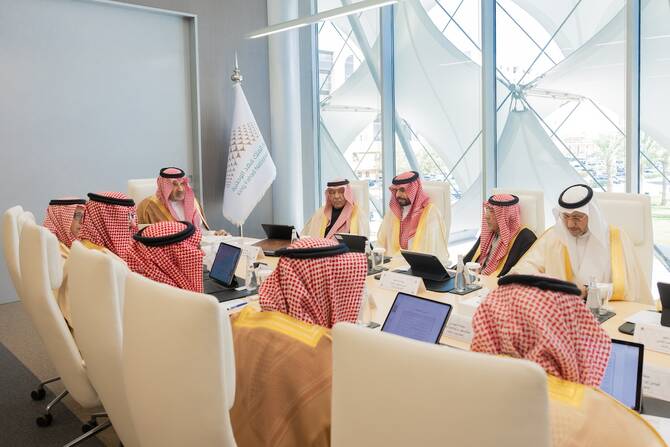
Prince Faisal bin Salman, chairman of the King Fahd National Library, on Sunday chaired the library’s first board of trustees meeting for 2026, attended by the distinguished board members. (Supplied)
Short Url
Updated 08 February 2026
Follow

Prince Faisal chairs King Fahd National Library’s first board meeting of 2026

  • Board approved the formation of the supreme supervisory committee for the “Memory of a Nation” project and appointed CEO and committee secretary

RIYADH: Prince Faisal bin Salman, chairman of the King Fahd National Library, on Sunday chaired the library’s first board of trustees meeting for 2026, attended by the distinguished board members.

He emphasized that, since its founding through King Salman’s initiative and support, the library has played a pivotal role in preserving and providing access to Saudi intellectual and cultural heritage, while promoting activities that advance the country’s transformation toward a knowledge-based society.

The board approved the formation of the supreme supervisory committee for the “Memory of a Nation” project, appointed a CEO and a committee secretary, and endorsed the project’s organizational structure and charter.

The “Memory of a Nation” project is a national, institutional, and participatory program. It aims to collect, preserve, organize, and provide access to Saudi Arabia’s cultural and knowledge heritage in both physical and digital formats through a unified national digital platform with governance ensuring institutional integration, sustainability, and asset protection.

The board also discussed the “Deposit Empowerment” program, designed to transform the library into an integrated national deposit center, build a reliable database of intellectual production, improve access to deposit services, and enhance the participation of relevant entities to ensure the sustainable and organized use of Saudi intellectual output.

The board approved rules for deposit violations and their investigation and agreed to establish a permanent specialized committee. It also endorsed the regulatory framework for manuscripts and rare books and ratified the previous fiscal year’s final accounts.

The meeting concluded with a review of reports on the library’s progress and the adoption of the necessary recommendations.


Saudi project clears 2,676 explosive devices in Yemen

Updated 22 February 2026
Follow

Saudi project clears 2,676 explosive devices in Yemen

  • Ousama Al-Gosaibi, Project Masam’s managing director, said the initiative had cleared a total of 544,187 mines since it began in 2018

RIYADH: Members of Saudi Arabia’s Project Masam removed 2,108 explosive devices from various regions of Yemen last week.

The total included 2,484 unexploded ordnances, 149 anti-tank mines, 17 anti-personnel mines and 26 improvised explosive devices, according to a recent report.

The explosives were planted indiscriminately and posed a threat to civilians, including children, women and the elderly.

The demining operations took place in Marib, Aden, Jouf, Shabwa, Taiz, Hodeidah, Lahij, Sanaa, Al-Bayda, Al-Dhale and Saada.

Ousama Al-Gosaibi, Project Masam’s managing director, said the initiative had cleared a total of 544,187 mines since it began in 2018.

Teams are tasked with clearing villages, roads and schools to facilitate the safe movement of civilians and delivery of humanitarian aid.

The project trains local demining engineers, provides them with modern equipment, and offers support to Yemenis injured by the devices.