

Saudi investment pipeline active as reforms advance, says Pakistan minister

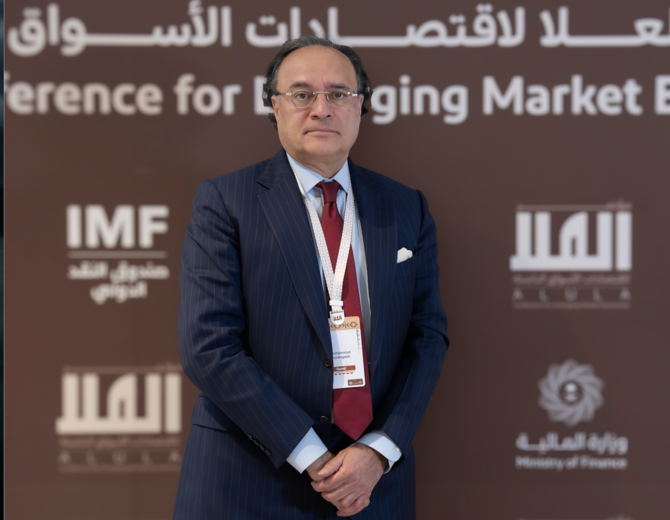
Pakistan’s Finance Minister Muhammad Aurangzeb. AN photo by Huda Bashatah
Short Url
Updated 09 February 2026
Follow

Saudi investment pipeline active as reforms advance, says Pakistan minister

ALULA: Pakistan’s Finance Minister Mohammed Aurangzeb described Saudi Arabia as a “longstanding partner” and emphasized the importance of sustainable, mutually beneficial cooperation, particularly in key economic sectors.

Speaking to Arab News on the sidelines of the AlUla Conference for Emerging Market Economies, Aurangzeb said the relationship between Pakistan and Saudi Arabia remains resilient despite global geopolitical tensions.

“The Kingdom has been a longstanding partner of Pakistan for the longest time, and we are very grateful for how we have been supported through thick and thin, through rough patches and, even now that we have achieved macroeconomic stability, I think we are now well positioned for growth.”

Aurangzeb said the partnership has facilitated investment across several sectors, including minerals and mining, information technology, agriculture, and tourism. He cited an active pipeline of Saudi investments, including Wafi’s entry into Pakistan’s downstream oil and gas sector.

“The Kingdom has been very public about their appetite for the country, and the sectors are minerals and mining, IT, agriculture, tourism; and there are already investments which have come in. For example, Wafi came in (in terms of downstream oil and gas stations). There’s a very active pipeline.”

He said private sector activity is driving growth in these areas, while government-to-government cooperation is focused mainly on infrastructure development.

Acknowledging longstanding investor concerns related to bureaucracy and delays, Aurangzeb said Pakistan has made progress over the past two years through structural reforms and fiscal discipline, alongside efforts to improve the business environment.

“The last two years we have worked very hard in terms of structural reforms, in terms of what I call getting the basic hygiene right, in terms of the fiscal situation, the current economic situation (…) in terms of all those areas of getting the basic hygiene in a good place.”

Aurangzeb highlighted mining and refining as key areas of engagement, including discussions around the Reko Diq project, while stressing that talks with Saudi investors extend beyond individual ventures.

“From my perspective, it’s not just about one mine, the discussions will continue with the Saudi investors on a number of these areas.”

He also pointed to growing cooperation in the IT sector, particularly in artificial intelligence, noting that several Pakistani tech firms are already in discussions with Saudi counterparts or have established offices in the Kingdom.

Referring to recent talks with Saudi Minister of Economy and Planning Faisal Alibrahim, Aurangzeb said Pakistan’s large freelance workforce presents opportunities for deeper collaboration, provided skills development keeps pace with demand.

“I was just with (Saudi) minister of economy and planning, and he was specifically referring to the Pakistani tech talent, and he is absolutely right. We have the third-largest freelancer population in the world, and what we need to do is to ensure that we upscale, rescale, upgrade them.”

Aurangzeb also cited opportunities to benefit from Saudi Arabia’s experience in the energy sector and noted continued cooperation in defense production.

Looking ahead, he said Pakistan aims to recalibrate its relationship with Saudi Arabia toward trade and investment rather than reliance on aid.

“Our prime minister has been very clear that we want to move this entire discussion as we go forward from aid and support to trade and investment.”


G7 countries to release oil reserves as IEA agrees to largest ever market intervention

Updated 11 March 2026
Follow

G7 countries to release oil reserves as IEA agrees to largest ever market intervention

  • IEA recommends release of 400 million barrels

RIYADH: Germany, Japan and Austria will release part of their oil reserves after the International Energy Agency recommended the release of 400 million barrels of oil ‌from stockpiles, the largest ‌such move in IEA ​history.

In a statement, IEA Executive Director Fatih Birol said the flow of oil, gas and other commodities through the Strait of Hormuz have all but stopped, leading global energy supply to fall by around 20 percent.

Ahead of the confirmation of the move — a larger intervention than the 182.7 million barrels that were released in 2022 by in response to Russia’s invasion of Ukraine — several countries began setting out plans to bring their reserves into play as countries grapple with ​soaring crude prices amid ​the US-Israeli war with Iran. 

Birol said: “I can now announce that IEA countries have decided to launch the largest ever release of emergency oil stocks in our agency's history. 

“IEA countries will be making 400 million barrels of oil available to the market to offset the supply lost through the effective closure of the strait.

“This is a major action aiming to alleviate the immediate impacts of the disruption in markets.”

Germany’s Economy ⁠Minister ​Katherina Reiche ⁠confirmed on Wednesday her government plans to limit petrol price increases at filling stations to once a day and to introduce more stringent antitrust regulation of the sector.

She did not ⁠give an exact timing for ‌those measures, but added that ‌the US and ​Japan would be the ‌largest contributors to the release of the ‌oil reserves.

The US has not confirmed it would do so, but its Interior Secretary Doug Burgum told Fox News on Wednesday that “these are the kinds of moments that these reserves are used for.”

The announcements did not stop oil prices rising, with Brent crude up 3.26 percent to $90.66 a barrel at 4:29 p.m Saudi time, and West Texas Intermediate up 3.12 percent to $86.05. Both were some way below the $119 a barrel seen earlier in the week.

“The situation regarding oil supplies is tense, as the Strait of Hormuz is currently virtually impassable,” Germany’s Reiche said.

“We will comply with this request and ‌contribute our share, because Germany stands behind the IEA’s most important principle: mutual ⁠solidarity,” Reiche ⁠said about the IEA’s request.

According to a statement by Reiche’s ministry, Germany will contribute 2.64 million tonnes of oil. This corresponds to 19.51 million barrels.

Reiche stressed there was no supply shortage in the country, which has a legally mandated reserve of oil and oil products intended to cover 90 days’ demand.

South Korea will release 22.46 million ​barrels of oil, which represents 5.6 percent of the total IEA ask, the ⁠country's industry ministry said.

“The government will consult with the IEA ⁠secretariat on details, such ‌as ‌the ​timing ‌and amount, from ‌the perspective of national interests in accordance with domestic conditions,” ‌the ministry said in a statement.

The ⁠ministry ⁠said it would continue to coordinate closely with major countries in responding to high oil prices to minimise any domestic ​impact.

Austrian Economy Minister Wolfgang Hattmannsdorfer said his country was releasing part of the emergency oil reserve and extending the national strategic gas reserve, adding: “One thing is clear: in a crisis, there must be no crisis winners at the expense of commuters and businesses.”

Acting ahead of the IEA move, G7 ​member Japan announced plans to release 15 days' worth of ‌private-sector oil reserves and one month's worth of state oil reserves.

“Rather than wait for formal IEA approval ‌of a coordinated international reserve release, Japan will act first to ease global energy market supply and demand, releasing reserves as early as the 16th of this month,” Prime Minister Sanae Takaichi said in a broadcast statement.

Following a meeting with the IEA on Wednesday, G7 energy ministers said: “In principle, we support the implementation of proactive measures to address the situation, including the use of strategic reserves.”

All IEA member countries are required to keep 90 days’ worth of their nation’s oil use in reserve in case of global disruption.