

Pakistani, Saudi ministers discuss investments, tech talent collaboration at AlUla Conference

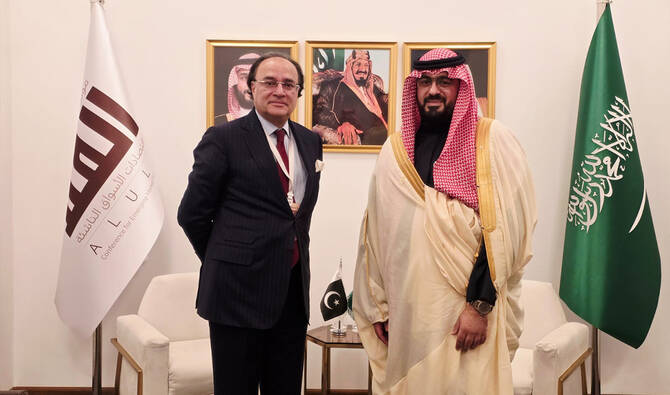
Pakistan’s Finance Minister Muhammad Aurangzeb (L) meeting with Saudi Arabia’s Economy Minister Faisal bin Fadhil Alibrahim on the sidelines of the AlUla Conference 2026 on February 8, in Saudi Arabia. (Finance Ministry)
Short Url
Updated 08 February 2026
Follow

Pakistani, Saudi ministers discuss investments, tech talent collaboration at AlUla Conference

  • Saudi Economy Minister Faisal bin Fadhil Alibrahim praises ‘high-quality’ AI, tech talent being produced by Pakistan
  • Pakistan planning a structured pipeline of quality human resource for Saudi Arabia, other key markets, minister says

KARACHI: Pakistan’s Finance Minister Muhammad Aurangzeb met Saudi Arabia’s Economy Minister Faisal bin Fadhil Alibrahim on the sidelines of the AlUla Conference 2026, where the two officials discussed investments and cooperation in technology and human capital development, the Pakistani finance ministry said on Sunday.

Pakistan and Saudi Arabia share a long-standing strategic partnership in political, security and economic domains, underpinned by deep religious and cultural ties.

Both countries have moved closer to broaden their cooperation in recent months, signing a landmark defense pact in Sept. and agreeing to launch an economic cooperation framework a month later to strengthen bilateral trade and investment relations.

During their meeting on the sidelines of the AlUla Conference for Emerging Market Economies, the two ministers discussed follow-ups on matters relating to Saudi investments in Pakistan as well as bilateral economic cooperation.

“The Saudi minister strongly highlighted the high-quality artificial intelligence and technology talent being produced by Pakistan, noting that it ranks among the top one or two globally,” the Pakistani finance ministry said.

“He stated that Saudi Arabia is keen to leverage Pakistani tech talent to lead and support the technological transformation underway in the Kingdom.”

The development comes months after Saudi Arabia’s GO Telecom technology firm opened an artificial intelligence (AI) hub in Islamabad to boost cooperation in AI and data infrastructure.

During their meeting, Finance Minister Aurangzeb shared that Pakistan is planning to create a structured pipeline of quality human resources for key international markets, including Saudi Arabia, to generate economic impact for both sides, according to his ministry.

The Saudi minister mentioned progress on a proposed Free Trade Agreement between Pakistan and the Gulf Cooperation Council (GCC) to prioritize increased trade and exchanges.

“Aurangzeb assured that dedicated teams from the Pakistani side are actively leading the process for finalizing Saudi Arabia’s investment commitments in Pakistan,” the finance ministry added.

Pakistan and Saudi Arabia have signed several memorandums of understanding (MoUs) for investment worth billions of dollars in sectors such agriculture, technology energy and others in recent years.


Pakistan says Afghanistan operation targeting only militants

Updated 7 sec ago
Follow

Pakistan says Afghanistan operation targeting only militants

  • Both countries claim to have inflicted heavy battlefield losses on the other since the clashes began on Feb. 26
  • Islamabad has been bombing areas it says harbor ‘militant targets’ in Afghanistan, an allegation Kabul has denied

ISLAMABAD: Pakistan’s Information Minister Ataullah Tarar has said that no civilian areas were targeted in the ongoing Afghanistan operation and Pakistani strikes were solely aimed at militant infrastructure and support networks, his office said on Monday.

The statement came after the Afghan Taliban government and the United Nations mission in Kabul accused Pakistan of targeting civilian areas during the ongoing operation, “Ghazab Lil Haq,” or the “Wrath for Truth.”

Clashes between the countries began on Feb. 26, when Afghan forces launched an attack on Pakistani military along their shared border in retaliation for Pakistan’s earlier airstrikes on what Islamabad said were militant camps inside Afghanistan.
In a conversation with foreign media correspondents, Tarar said that Pakistan was taking action inside Afghanistan based on “accurate” intelligence information.

“Pakistan has not targeted any civilian area in Afghanistan,” he was quoted as saying by his ministry. “Pakistan is only targeting the infrastructure of terrorists and their support system.”

The minister denied reports of civilian deaths, saying the UN agency was “completely dependent on the Taliban government” for information. The UN rights chief said Friday that 56 Afghan civilians had been killed, nearly half of them children, since the hostilities began.

Tarar also dismissed as “just propaganda” the claims made by an Afghan defense ministry spokesperson about inflicting battlefield losses on Pakistan. Tarar said on Sunday that 583 Afghan Taliban fighters had so far been killed in Pakistani strikes, a claim difficult to verify independently.

Islamabad has long accused Kabul of sheltering militant groups, including the Pakistani Taliban, or the Tehreek-e-Taliban Pakistan, and facilitating attacks against Pakistan. Afghanistan denies the allegations and says Islamabad’s security challenges are an internal matter.

Afghanistan has called for dialogue to resolve the conflict. Pakistan, however, has rejected talks, saying the operation will continue until its objectives are met.

“There is a nexus between the Afghan Taliban government and several terrorist organizations operating from Afghan soil,” Tarar added.