

TV reporter dies after falling from rooftop during Pakistan kite-flying festival

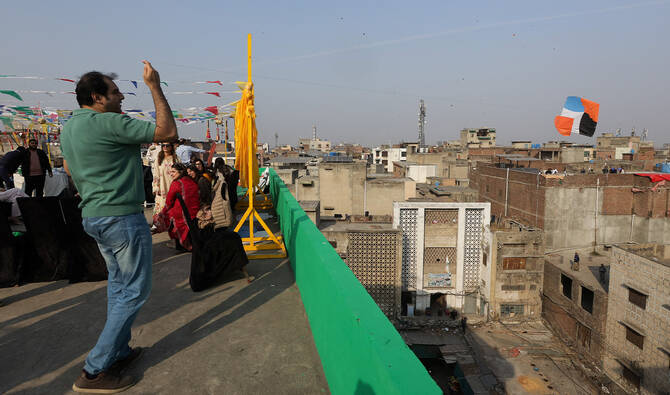
A man flies a kite from a rooftop to mark Basant, a kite-flying festival, in Lahore, Pakistan February 6, 2026. (REUTERS)
Short Url
Updated 08 February 2026
Follow

TV reporter dies after falling from rooftop during Pakistan kite-flying festival

  • Pakistan's Lahore marked the Basant festival on Feb. 6-8 after the Punjab government lifted an 18-year-old ban on kite flying
  • Malik Zain, a reporter affiliated with GNN news channel, fell from a four-storey building while flying a kite, Lahore police say

ISLAMABAD: A television reporter died after falling from a rooftop while flying a kite during the Basant spring festival in the eastern Pakistani city of Lahore, police and hospital authorities confirmed on Sunday.

Pakistan's Lahore marked the Basant festival on Feb. 6-8 after the Punjab provincial government this year lifted a ban on kite flying after 18 years, with extensive safety measures in place.

The festival, which marks the onset of spring, was banned in 2008 after deaths and injuries to motorcyclists and pedestrians from stray kite strings, sometimes coated with metal to make them more formidable in mid-air battles.

Malik Zain, a reporter affiliated with private news channel GNN, fell from the rooftop of a building during the final day of Basant celebrations in the eastern Pakistani city, according to police.

"Lahore journalist Malik Zain died after falling from the fourth floor while flying a kite in Gulshan-e-Ravi during Basant," the Lahore police said in a statement.

The reporter was shifted to the government-run Mian Munshi District Headquarters Hospital where he was pronounced dead, with cardiopulmonary arrest mentioned as the cause of death.

"Head injury due to fall from height," hospital authorities diagnosed in their report into Zain’s death.

The development came hours after Punjab Chief Minister Maryam Nawaz extended timings for Basant till early Monday morning.

“I am pleased to announce that Basant celebrations timings are being extended till 5:00 AM tomorrow morning,” CM Nawaz said in an X post on Sunday, highlighting the festivity, unity and joy across Lahore.

“This extension is a reward for the people of Lahore for celebrating Basant with great discipline and for responsibly following all safety SOPs (standard operating procedures).”

The Punjab government ‍banned the use of metallic or chemical-coated strings during the festival. Kites ‍and strings had to bear individual QR codes so they could be traced, and ‍motorcyclists had to attach safety rods to their bikes to fend off stray thread.

Some 4,600 producers had registered with the authorities to sell kites and strings ahead of the festival. Authorities had made it mandatory for owners to register rooftops with 30 or more revelers, while dozens of roofs ​had been declared off-limits after inspections.


Pakistan reports current account surplus in Jan. owing to improved trade, remittances

Updated 17 February 2026
Follow

Pakistan reports current account surplus in Jan. owing to improved trade, remittances

  • Pakistan’s exports crossed the $3 billion mark in Jan. as the country received $3.5 billion in remittances
  • Last month, IMF urged Pakistan to accelerate pace of structural reforms to strengthen economic growth

ISLAMABAD: Pakistan recorded a current account surplus of more than $120 million in January, the country’s finance adviser said on Tuesday, attributing it to improved trade balance and remittance inflows.

Pakistan’s exports rebounded in January 2026 after five months of weak performance, rising 3.73 percent year on year and surging 34.96 percent month on month, according to data released by the country’s statistics bureau.

Exports crossed the $3 billion mark for the first time in January to reach $3.061 billion, compared to $2.27 billion in Dec. 2025. The country received $3.5 billion in foreign remittances in Jan. 2026.

Khurram Schehzad, an adviser to the finance minister, said Pakistan reported a current account surplus of $121 million in Jan., compared to a current account deficit of $393 million in the same month last year.

“Improved trade balance in January 2026, strong remittance inflows, and sustained momentum in services exports (IT/Tech) continue to reinforce the country’s external account position,” he said on X.

Pakistan has undergone a difficult period of stabilization, marked by inflation, currency depreciation and financing gaps, and international rating agencies have acknowledged improvements after Islamabad began implementing reforms such as privatizing loss-making, state-owned enterprises (SOEs) and ending subsidies as part of a $7 billion International Monetary Fund (IMF) loan program.

Late last month, the IMF urged Pakistan to accelerate the pace of these structural reforms to strengthen economic growth.

Responding to questions from Arab News at a virtual media roundtable on emerging markets’ resilience, IMF’s director of the Middle East and Central Asia Jihad Azour said Islamabad’s implementation of the IMF requirements had been “strong” despite devastating floods that killed more than 1,000 people and devastated farmland, forcing the government to revise its 4.2 percent growth target to 3.9 percent.

“What is important going forward in order to strengthen growth and to maintain the level of macroeconomic stability is to accelerate the structural reforms,” he said at the meeting.

Azour underlined Pakistan’s plans to privatize some of the SOEs and improve financial management of important public entities, particularly power companies, as an important way for the country to boost its capacity to cater to the economy for additional exports.

“This comes in addition to the effort that the authorities have made in order to reform their tariffs, which will allow the private sector of Pakistan to become more competitive,” the IMF official said.