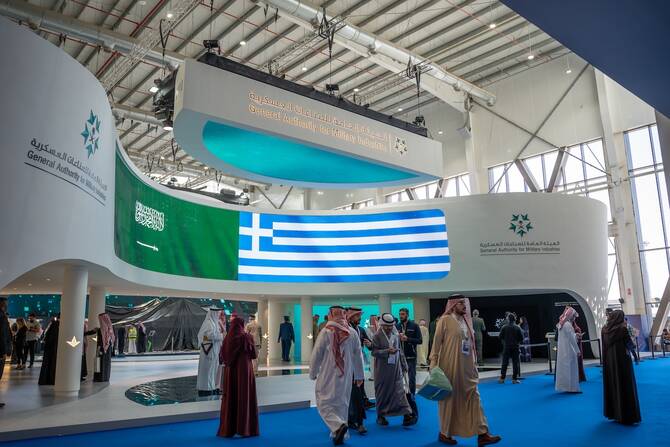

RIYADH: The World Defense Show, Saudi Arabia’s annual conference put on by the General Authority for Military Industries, convened on Sunday, bringing together official delegations, government entities, and leading international companies specializing in the defense and security sectors.
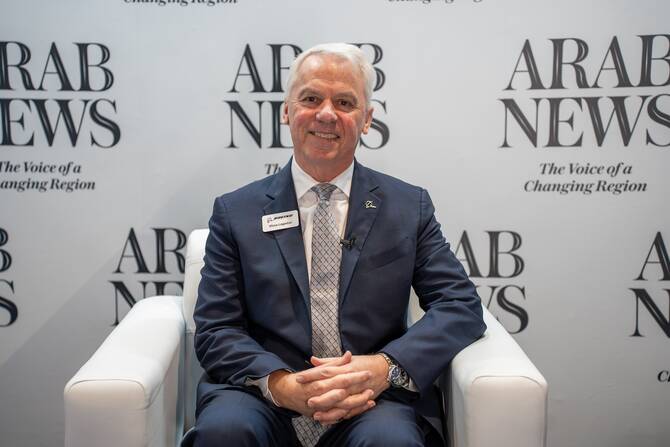
Arab News spoke to Boeing — the world’s largest aerospace company and leading manufacturer for jetliners — about its presence in the region and Saudi Arabia’s evolving role in shaping the future of the global aerospace and defense industry.
“Boeing’s legacy in Saudi Arabia, first of all, spans almost 80 years and we have over 400 defense articles that are currently in Saudi Arabia and that makes (it) one of the biggest partners that we have in the defense business outside of the United States,” Vincent Logsdon, vice president of international business development, defense, space, and security at Boeing, told Arab News.
“What we’re really interested in is evolving that relationship and we’re doing that by things like joint ventures, investing in human capital, and we really want to be a part of the finishing help on getting to Vision 2030, where Saudi Arabia is going,” he said.
The company sees the Kingdom as a cornerstone of what they are doing with aerospace and a country that can take their technologies to the next step, prompting investment in various areas.
Logsdon said: “As we continue to invest in Saudi Arabia, as Boeing, we invest across the board. A lot of industry cooperation is something that we’re very involved in. We also continue to invest in the local community, which I think is very important.
“We’re investing in areas such as women empowerment, health, education, and we continue to put our money where our mouth is. We’re here not only to sell platforms. We’re here to be a strategic partner.”
It was reported by Bloomberg News recently that Saudi Arabia’s flagship carrier, Saudia Airlines, is in early talks with Boeing and Airbus to buy at least 150 narrowbody and widebody jets.
“If you look at the things that Saudi Arabia is currently doing in the market, they have very advanced capabilities, and from a Boeing perspective, we’re very interested in providing a family of systems and helping along that path because that is the future of warfare,” Logsdon added.
“That is the future of defense, taking all those different systems and achieving your objective that way versus one system at a time partition,” Logsdon said. “And we think that Saudi Arabia has very much the capability to do those things, not only what the Kingdom is currently operating, but how we see the Kingdom operating in the future.”
WDS is a platform for countries and entities to share expertise, offer opportunities for partnership and explore the latest technologies in the industry.
The show supports efforts to localize more than 50 percent of military spending, in line with Vision 2030, while also contributing to higher operational readiness and strengthening the Kingdom’s strategic independence in the defense sector.
For companies like Boeing, participation at WDS offers a direct channel to align their global strategies with Saudi Arabia’s evolving regulatory, industrial and security priorities.
Logsdon said: “The World Defense Show is incredibly important and we brought a very large team this year. We’ve invested significantly in being here and showing up in Saudi Arabia and the region because we feel that this is a very important market for us and we feel that there’s a lot of work to do here to continue to drive the future of aerospace.”
As new technologies mature, defense exhibitions are increasingly serving as platforms for forward-looking dialogue rather than traditional equipment displays.
“So, we’re seeing here a lot of different countries, a lot of different ideas, different new technologies and we also see the future here. We’re starting to talk about things like AI and autonomy and those types of things are the future of warfare and we certainly want to be a part of that and in the cutting edge to see what is out there so being here gives us access to all of that,” he said.