Leaders of Romania and Argentina invited to Trump's ‘Board of Peace’ meeting

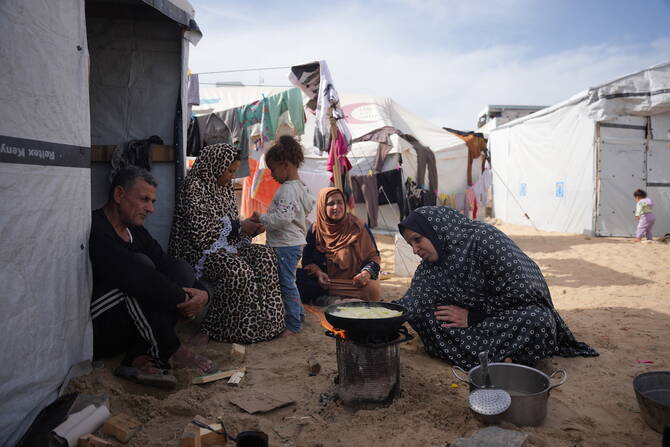
Palestinians cook food over a fire beside their tent in Khan Younis, in the southern Gaza Strip on Saturday. (AP)
Short Url
Updated 08 February 2026
Follow

Leaders of Romania and Argentina invited to Trump's ‘Board of Peace’ meeting

  • Nicusor Dan said Romania had not yet decided whether to participate, Argentina’s Javier Milei said he would attend
  • The board was originally designed to oversee the Gaza truce and post-war reconstruction

BUCHAREST: Romanian President Nicusor Dan said Sunday he had received an invitation to attend the inaugural meeting of US President Donald Trump’s “Board of Peace” in Washington on February 19.
Dan, writing on his Facebook page, said Romania had not yet made a decision as to whether it would participate.
That would depend, he said, “on discussions with our US partners on the format of the meeting for countries like Romania, which are not currently members of the Board but which wish to be part of it on condition its charter is revised.”
On Saturday, Hungarian Prime Minister Viktor Orban said that he, too, had received an invitation to attend the meeting, and that he intended to go.
Trump launched his “Board of Peace” at the World Economic Forum in Davos in January and some 19 countries have signed its founding charter.
Originally designed to oversee the Gaza truce and post-war reconstruction, the board’s mandate has since expanded, prompting concerns among critics that it could evolve into a rival to the United Nations.
Several leaders around the world have received invitations to be part of Trump’s “Board of Peace,” whose permanent members are required to pay $1 billion to join.
Some countries — including Croatia, France, Italy, New Zealand and Norway — have already declined joining it, and others have said they could only consider doing so if its charter were changed.
Under its current charter, the “Board of Peace” has Trump both as its chairman and as the US representative.
It says Trump, as chairman, will have “exclusive authority to create, modify or dissolve entities as necessary” and that he can only be replaced in case of “voluntary resignation or as a result of incapacity.”


First Ramadan after truce brings flicker of joy in devastated Gaza

Updated 5 sec ago
Follow

First Ramadan after truce brings flicker of joy in devastated Gaza

  • Ramadan lanterns and string lights appear on streets lined with collapsed buildings and piles of rubble in Gaza City
  • The first holy month since the October ceasefire brings mixed feelings for the many still living in tents
GAZA CITY: Little Ramadan lanterns and string lights appeared on streets lined with collapsed buildings and piles of rubble in Gaza City, bringing joy and respite as Islam’s holiest month began — the first since October’s ceasefire.
In the Omari mosque, dozens of worshippers performed the first Ramadan morning prayer, fajr, bare feet on the carpet but donning heavy jackets to stave off the winter cold.
“Despite the occupation, the destruction of mosques and schools, and the demolition of our homes... we came in spite of these harsh conditions,” Abu Adam, a resident of Gaza City who came to pray, told AFP.
“Even last night, when the area was targeted, we remained determined to head to the mosque to worship God,” he said.
A security source in Gaza told AFP Wednesday that artillery shelling targeted the eastern parts of Gaza City that morning.
The source added that artillery shelling also targeted a refugee camp in central Gaza.
Israel does not allow international journalists to enter the Gaza Strip, preventing AFP and other news organizations from independently verifying casualty figures.

‘Stifled joy’

In Gaza’s south, tens of thousands of people still live in tents and makeshift shelters as they wait for the territory’s reconstruction after a US-brokered ceasefire took hold in October.
Nivin Ahmed, who lives in a tent in the area known as Al-Mawasi, told AFP this first Ramadan without war brought “mixed and varied feelings.”
“The joy is stifled. We miss people who were martyred, are still missing, detained, or even traveled,” she said.
“The Ramadan table used to be full of the most delicious dishes and bring together all our loved ones,” the 50-year-old said.
“Today, I can barely prepare a main dish and a side dish. Everything is expensive. I can’t invite anyone for Iftar or suhoor,” she said, referring to the meals eaten before and after the daily fast of Ramadan.
Despite the ceasefire, shortages remain in Gaza, whose battered economy and material damage have rendered most residents at least partly dependent on humanitarian aid for their basic needs.
But with all entries into the tiny territory under Israeli control, not enough goods are able to enter to bring prices down, according to the United Nations and aid groups.

‘Still special’

Maha Fathi, 37, was displaced from Gaza City and lives in a tent west of the city.
“Despite all the destruction and suffering in Gaza, Ramadan is still special,” she told AFP.
“People have begun to empathize with each other’s suffering again after everyone was preoccupied with themselves during the war.”
She said that her family and neighbors were able to share moments of joy as they prepared food for suhoor and set up Ramadan decorations.
“Everyone longs for the atmosphere of Ramadan. Seeing the decorations and the activity in the markets fills us with hope for a return to stability,” she added.
On the beach at central Gaza’s Deir el-Balah, Palestinian artist Yazeed Abu Jarad contributed to the holiday spirit with his art.
In the sand near the Mediterranean Sea, he sculpted “Welcome Ramadan” in ornate Arabic calligraphy, under the curious eye of children from a nearby tent camp.
Nearly all of Gaza’s 2.2 million residents were displaced at least once during the more than two years of war between Israel and Hamas, sparked by the latter’s unprecedented October 7 attack on Israel.
Mohammed Al-Madhoun, 43, also lives in a tent west of Gaza City, and hoped for brighter days ahead.
“I hope this is the last Ramadan we spend in tents. I feel helpless in front of my children when they ask me to buy lanterns and dream of an Iftar table with all their favorite foods.”
“We try to find joy despite everything,” he said, describing his first Ramadan night out with the neighbors, eating the pre-fast meal and praying.
“The children were as if they were on a picnic,” he said.