

Saudi investment pipeline active as reforms advance, says Pakistan minister

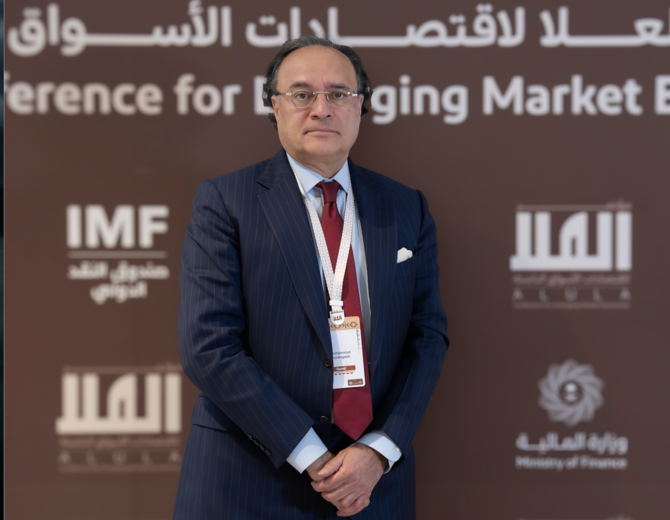
Pakistan’s Finance Minister Muhammad Aurangzeb. AN photo by Huda Bashatah
Short Url
Updated 08 February 2026
Follow

Saudi investment pipeline active as reforms advance, says Pakistan minister

ALULA: Pakistan’s Finance Minister Mohammed Aurangzeb described Saudi Arabia as a “longstanding partner” and emphasized the importance of sustainable, mutually beneficial cooperation, particularly in key economic sectors.

Speaking to Arab News on the sidelines of the AlUla Conference for Emerging Market Economies, Aurangzeb said the relationship between Pakistan and Saudi Arabia remains resilient despite global geopolitical tensions.

“The Kingdom has been a longstanding partner of Pakistan for the longest time, and we are very grateful for how we have been supported through thick and thin, through rough patches and, even now that we have achieved macroeconomic stability, I think we are now well positioned for growth.”

Aurangzeb said the partnership has facilitated investment across several sectors, including minerals and mining, information technology, agriculture, and tourism. He cited an active pipeline of Saudi investments, including Wafi’s entry into Pakistan’s downstream oil and gas sector.

“The Kingdom has been very public about their appetite for the country, and the sectors are minerals and mining, IT, agriculture, tourism; and there are already investments which have come in. For example, Wafi came in (in terms of downstream oil and gas stations). There’s a very active pipeline.”

He said private sector activity is driving growth in these areas, while government-to-government cooperation is focused mainly on infrastructure development.

Acknowledging longstanding investor concerns related to bureaucracy and delays, Aurangzeb said Pakistan has made progress over the past two years through structural reforms and fiscal discipline, alongside efforts to improve the business environment.

“The last two years we have worked very hard in terms of structural reforms, in terms of what I call getting the basic hygiene right, in terms of the fiscal situation, the current economic situation (…) in terms of all those areas of getting the basic hygiene in a good place.”

Aurangzeb highlighted mining and refining as key areas of engagement, including discussions around the Reko Diq project, while stressing that talks with Saudi investors extend beyond individual ventures.

“From my perspective, it’s not just about one mine, the discussions will continue with the Saudi investors on a number of these areas.”

He also pointed to growing cooperation in the IT sector, particularly in artificial intelligence, noting that several Pakistani tech firms are already in discussions with Saudi counterparts or have established offices in the Kingdom.

Referring to recent talks with Saudi Minister of Economy and Planning Faisal Alibrahim, Aurangzeb said Pakistan’s large freelance workforce presents opportunities for deeper collaboration, provided skills development keeps pace with demand.

“I was just with (Saudi) minister of economy and planning, and he was specifically referring to the Pakistani tech talent, and he is absolutely right. We have the third-largest freelancer population in the world, and what we need to do is to ensure that we upscale, rescale, upgrade them.”

Aurangzeb also cited opportunities to benefit from Saudi Arabia’s experience in the energy sector and noted continued cooperation in defense production.

Looking ahead, he said Pakistan aims to recalibrate its relationship with Saudi Arabia toward trade and investment rather than reliance on aid.

“Our prime minister has been very clear that we want to move this entire discussion as we go forward from aid and support to trade and investment.”


Argentina eyes deeper Saudi ties as multilateral trade landscape shifts, says minister  

Updated 08 February 2026
Follow

Argentina eyes deeper Saudi ties as multilateral trade landscape shifts, says minister  

ALULA: Shifting global trade patterns are creating new opportunities for bilateral cooperation between Argentina and Saudi Arabia, particularly in the energy sector, said Federico Sturzenegger, Argentina’s minister of deregulation and state transformation. 

Speaking to Arab News on the sidelines of the AlUla Conference for Emerging Market Economies, Sturzenegger expanded on his goals at the event, Argentina’s growing economic relationship with the Kingdom, and the country’s position as a third-party player amid geopolitical tensions. 

He said the forum provides a strong platform for collaboration because of the diversity of participants gathered in AlUla. Sturzenegger pointed to Argentina’s bilateral relationship with Saudi Arabia as an example of the type of cooperation the conference can facilitate, particularly in energy: 

“Definitely we could see some of the knowledge, experience, capital, know-how of this country to exploit those resources. It’s always an opportunity to talk and learn about those things and see how things are going in each country,” the minister told Arab News. 

Elaborating on the sector, he added: “I mean energy definitely, I mean this country is absolutely top tier, it’s a leader in the world. It has the engineers, it has the knowledge, it has the capital; Argentina is a potentially relevant hub in the world in this, in a very isolated place, and a very safe place from a geopolitical point of view.” 

After speaking on Paper Session 1: Resetting Global Trade — which also featured Faisal Alibrahim, Saudi minister of economy and planning; Eyob Tekalign, governor of the Ethiopian National Bank; and Pol Antras, professor of economics at Harvard University — Sturzenegger outlined the effects of geopolitical tensions on trade agreements and the role of third-party countries. 

He referred to a major trade deal recently signed between the US and Argentina as an example of how fragmentation in multilateralism has paradoxically created alternative avenues for cooperation, especially as such agreements historically took decades to finalize. 

Building on that example, he raised the question of whether the rupture of multilateralism might in some cases lead to more trade rather than less — a view that Antras challenged during the session. 

Geopolitical positioning remained a central theme in his remarks, particularly when discussing the importance of third-party countries during periods of tension. 

“Until three years ago we had this kind of multilateralism; it was very well established, everything was contained within that framework. Of course, the US had a prominent role in that framework. Now things are a little bit more uncertain, and that has led to the proliferation of many bilateral agreements,” he said. 

Despite that shift, Sturzenegger said the new environment is creating room for agreements that previously struggled to advance. 

“I’m seeing some opportunities for trade which perhaps were not explored before,” the minister added. 

He also referred to an increase in trade in Africa, emphasizing that there are different opportunities throughout the world that were previously unexplored under the contained sphere of earlier multilateralism. 

On Saudi-Argentine ties, he maintained an optimistic outlook, again emphasizing energy as a priority. 

“I know that Saudi companies have been visiting Argentina this year, and again, as I mentioned, you have the expertise, you have the know-how, it’s a business that you know, you have the global network of trade, so just adding an additional source of supply makes that network even more powerful, profitable, and resilient,” the minister said. 

As the Emerging Market Economies Conference wraps up its first day, it is evident that while discussions on implementation and the strengthening of long-term economic planning are at the forefront, relationships with the Kingdom continue to develop and support bilateral ties.