

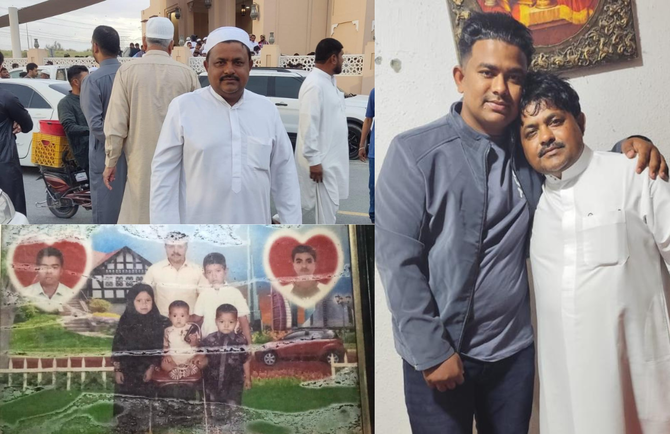

DHAKA: Saleh Ahmed worked alongside his younger brothers as a water delivery driver in the UAE for three decades, living more than 3,700 kilometers away from his home in northern Bangladesh to support his wife and four children.
The 48-year-old was killed on the first day of US-Israeli strikes on Iran while working in the city of Ajman, struck by debris that fell from an intercepted Iranian missile, according to a statement by the Bangladeshi foreign ministry.
Ahmed was killed 1.5 km away from his UAE apartment on Feb. 28, his younger brother Zakir Hossain said.
“My brother had just got out of the car and was about to start the water pump just behind his parked vehicle (when he was struck),” he told Arab News on Saturday.
Tehran has responded to the joint Israeli-US aggression by launching missile and drone attacks on neighboring countries in the Gulf. The air defense systems of several Gulf countries have intercepted missiles and drones in the skies above major cities.
When Ahmed last spoke with his wife, Minu Begum, on the phone they were discussing plans for his homecoming early next year. But those plans were shattered less than a day later, when the family received news of his death.
“The last time we spoke, it was a regular conversation. He told me to buy new Eid clothes for the children, and he already sent money for this,” Begum said.
Two of their children are still pursuing their studies and another suffers from the blood disorder thalassemia, which requires at least one transfusion a month.
“My husband was the sole breadwinner for our family. This devastating war has taken away everything from my life,” she said. “For my children, this Eid is going to be the worst of their lifetime. I have not seen any smiles on their faces for the last two weeks. We don’t know what is in store in our future … Everything is lost.”
Ahmed was one of more than 6 million Bangladeshis working in the six Gulf Cooperation Countries, part of a group of about 35 million foreign nationals that has formed the backbone of the region’s economy and is paying a high price amid the escalating conflict. At least 16 civilians have been killed by Iranian attacks across the UAE, Saudi Arabia, Kuwait, Qatar, Oman and Bahrain, most of whom were foreign nationals.
According to statements from Bangladesh’s Ministry of Foreign Affairs, at least four of those killed in the past two weeks were Bangladeshis.
In a statement issued on March 9, Bangladesh condemned “all such attacks that result in the loss of innocent lives” and called on all parties concerned to exercise “maximum restraint,” adding that the government “accords high priority to the safety and welfare of Bangladeshi nationals in the Middle East and is closely monitoring the evolving situation.”
Many migrant workers in the Middle East hold essential jobs as sanitation workers and delivery drivers, roles that require them to continue working even as other wealthier residents can take shelter.
In the Gulf, migrant communities not only number in the millions, they also make up the majority of the region’s population. Around one third of the Saudi population are foreign residents, while the proportion is an estimated 80 to 90 percent in the UAE and Qatar.
As the Middle East war escalates, Bangladeshis working in the region see no choice but to stay.
“Every now and then, we experience heavy bombing (and) many people are forced to relocate,” Milon Khan, who is working in northern Lebanon, which has been a target of Israeli bombing, told Arab News.
“(But) our family members are dependent on our income. That’s why our migrants don’t want to return home. Until the last moments, even with the utmost sacrifice, even amid ongoing war, our migrants are trying to survive here. We are all praying for the war to stop as soon as possible.”
-ENDS-


