

Drone debris injures 6 in Abu Dhabi, missiles target Qatar

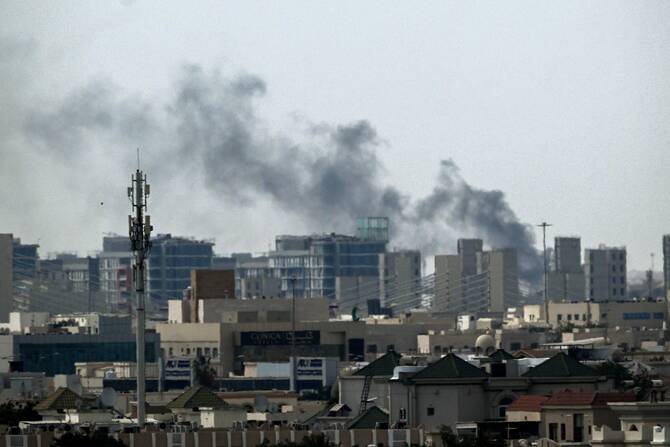
A plume of smoke rises over buildings in Doha on Thursday. (AFP)
Short Url
Updated 06 March 2026
Follow

Drone debris injures 6 in Abu Dhabi, missiles target Qatar

  • Pakistani and Nepalese nationals were injured when debris fell in two locations in an industrial area of the UAE capital
  • Bahrain says an Iranian missile hit a state-run oil refinery

ABU DHABI: Debris from a drone injured six people in an industrial area of the UAE capital on Thursday, while Dubai, Doha and Manama were subjected to missile attacks as Iran pressed on with a retaliation campaign.

The unprecedented attacks by Iran, targeting US military assets but also American embassies and civilian infrastructure across the Gulf, continued into their sixth day after US-Israeli air strikes that devastated Iran's leadership.

At least 13 people have been killed in the Gulf, including seven civilians, since Iran began its attacks on Saturday. Washington said six US servicemen were killed, including four in Kuwait.

"Authorities in the Emirate of Abu Dhabi responded to an incident involving falling debris at two locations in the ICAD 2 area, following the successful interception of a drone by air defenses," Abu Dhabi media office said.

"The incident resulted in six minor to moderate injuries to Pakistani and Nepalese nationals," it added.

The UAE defense ministry said shortly after 7pm local time that it was dealing with another "incoming missile and drone threat from Iran."

"The sounds heard are the result of the air defense systems intercepting missiles and drones," the ministry said. "The public are requested to adhere to the safety and security instructions issued."

The UAE has intercepted more than 1,000 drones, 181 ballistic missiles and 8 cruise missiles, the ministry said before the latest attack.

In Doha, AFP journalists saw a plume of smoke rising from the Qatari capital and reported loud blasts across the city and Qatar's defense ministry said its military was working to intercept an incoming missile.

Earlier, Qatari authorities said they were evacuating residents living near Doha's US embassy.

Residents in Dubai and Manama also heard explosions earlier in the day.

A fire ​broke out at a unit ‌of Bahrain's ‌Bapco ​Energies ‌refinery ⁠after ​an Iranian missile strike, ⁠but the blaze ⁠has ‌been contained, ‌with ​no ‌injuries reported ‌and refinery operations continuing, ‌Bahrain’s National Communication Centre ⁠said on ⁠Thursday.

Opinion

This section contains relevant reference points, placed in (Opinion field)

The statement came after explosions were heard in Bahrain's capital Manama earlier on Thursday.

The UK said it was "temporarily" withdrawing some staff and their dependents from its Bahrain embassy.

"Due to the ongoing security situation, the UK has taken the precautionary step of temporarily withdrawing some Embassy staff" and their families, it said in a statement.

"Our Embassy continues to operate," it said, adding that "the situation is serious and we do not expect it to end in the coming days”.

Elsewhere, a tanker was hit by a "large explosion" in waters off Kuwait, causing an oil spill, British maritime security agency UKMTO reported.

The fresh salvos came hours after Qatari premier Sheikh Mohammed bin Abdulrahman Al Thani lambasted his Iranian counterpart Abbas Araghchi, Iran's foreign minister during a call.

The conversation was the first high-level contact between Tehran and a Gulf leader since the start of the attacks.

The Qatari premier accused Iran of seeking to "harm its neighbours and drag them into a war that is not theirs", according to a statement from Qatar's foreign ministry.

*With AFP and Reuters


Iran war chokes aid corridors, obstructing global relief efforts

Updated 3 sec ago
Follow

Iran war chokes aid corridors, obstructing global relief efforts

  • “People in dire need of assistance ⁠will have to ⁠wait longer for food,” said Bauer
  • Tents, tarpaulins and lamps destined for Gaza and the West Bank have become stuck in the supply chain, the IOM said

GENEVA: Key humanitarian air, sea and land routes are being constricted by disruption from the war in the Middle East, delaying life-saving shipments to some of the world’s worst crises, 10 aid officials have told Reuters.
The US–Israeli war on Iran entered its seventh day on Friday, convulsing global markets and disrupting supply chains with airspace closures and the halt of shipping through the critical Strait of Hormuz.
Aid to Gaza and Sudan is grinding to a halt and costs are soaring for help to the hundreds of millions suffering hunger crises around the world.
“People in dire need of assistance ⁠will have to ⁠wait longer for food,” said Jean-Martin Bauer, Director of Food Security at the World Food Programme.
Already, tents, tarpaulins and lamps destined for the Israeli-occupied Palestinian territories of Gaza and the West Bank have become stuck in the supply chain, the International Organization for Migration said.

DUBAI AID HUB HOBBLED BY AIR AND SEA RESTRICTIONS
Aid groups say higher operational costs are straining budgets already facing massive donor cuts. The IOM said shipping firms were demanding emergency surcharges of approximately $3,000 per ⁠container.
Humanitarian groups stocking goods for rapid regional deployment at warehouses in Dubai’s Humanitarian Hub face challenges moving supplies onto transit routes.
The International Federation of Red Cross and Red Crescent Societies cannot move trauma kits to help the Iranian Red Crescent with search and rescue from its Dubai hub, where they sit in a estimated 1 million Swiss franc ($1.28 million) pre-positioned emergency stockpile, said Cecile Terraz, a director at the IFRC.
The group cannot move stock through Jebel Ali port — the region’s largest container terminal, which was set on fire by the debris of an intercepted missile — from where cargo normally moves onto planes or into the Strait of Hormuz.
The World Health Organization’s Dubai hub operations are also frozen, regional director Hanan Balkhy said, obstructing ⁠50 emergency requests from 25 ⁠countries and hampering operations such as polio vaccination.
Ripple effects farther afield are also likely.
Famine-struck Sudan is particularly exposed due to additional restrictions since February 28 on the Suez Canal and the Bab el-Mandeb Strait at the southern entrance to the Red Sea, the UNHCR said.
“We are particularly concerned about Africa,” said a spokeswoman, adding that some cargoes were being sent around the Cape of Good Hope. The route takes up to three weeks longer.
Costs for fuel, transportation and insurance are also rising, and Terraz said the IFRC may have to cut deliveries to the Iranian Red Crescent.
Emma Maspero, senior manager in Copenhagen of the supply division of the UN children’s body UNICEF, said she hoped flights carrying perishable humanitarian goods such as vaccines could be prioritized amid the airspace restrictions.