Saudi conservation now runs on data

https://arab.news/zxkfu
Along Saudi Arabia’s Red Sea coast, conservation is getting bigger and sharper.
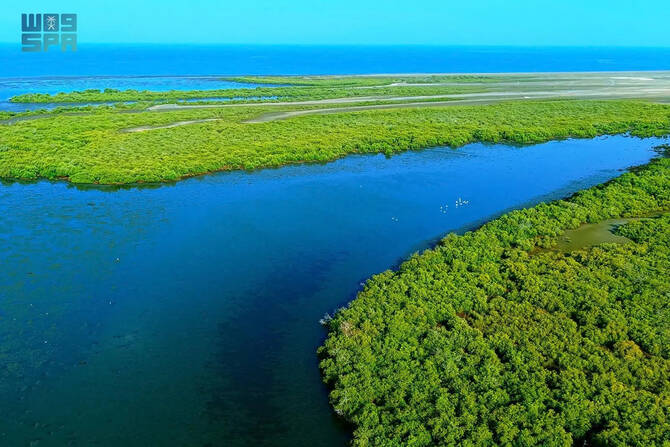
Mangrove nurseries are scaling up, and coral restoration is moving from pilot projects to full production. Inland, tree belts are being planned to cool cities and trap dust. All of this sits under the Saudi Green Initiative and its headline coastal pledge — 100 million mangroves by 2030.
On the ground, this momentum is real. Red Sea Global has established a purpose-built nursery and already transplanted more than a million mangroves, on its way to 50 million by 2030. Up the coast, Neom’s land-based coral nursery is producing stock for out-planting, with a second, larger facility planned as part of what is described as the world’s largest coral restoration effort in the Red Sea.
One may look at these as nature projects, sure. However, they are also data projects.
A single reef survey can generate terabytes of imagery. A mangrove program must track seed provenance, planting sites, and survival months later. Sensor networks provide temperature, salinity, and water-quality time series. Turning that sprawl into actionable decisions — what to plant, where, and when — depends on a disciplined pipeline that can ingest, store, govern, analyze (often with AI), and report with confidence.
Saudi Arabia has set the guardrails for that pipeline. Under the Saudi Data & AI Authority, the National Data Management Office defines how public data is classified, shared, and protected. That matters when satellite stacks, drone mosaics, and monitoring feeds must move between ministries, giga-projects, and universities without losing lineage or context.
Neom’s test case
The Neom Nature Reserve shows what program-scale restoration looks like when evidence is the organizing principle. The plan is to protect 95 percent of the area for nature, restore 1.5 million hectares, and plant 100 million native trees, shrubs, and grasses.
Rewilding began in mid-2025 with 1,100 animals across six species. Monitoring blends old and new approaches — camera traps for biodiversity baselines; AI analysis of drone footage to track dolphins, turtles, and dugongs; satellite tags for turtles and seabirds; and even artificial nesting platforms for raptors on offshore islands. The lesson is clear — scale the fieldwork, but scale the proof alongside it.
From fieldwork to sustainable intelligence
What holds many teams back isn’t data collection — it’s making the data useful. Efficiency matters by default. Duplicate copies of unstructured imagery burn money and power, especially where cooling costs dominate. Data-reduction and automated tiering policies keep active datasets fast while pushing colder material to lower-energy tiers.
Keeping data near compute is critical. AI is now routine — classifying coral species, flagging crown-of-thorns starfish, forecasting shoreline change from satellite histories. These tasks run best when datasets can reach GPUs without shuffling between silos across edge sites, data centers, and clouds.
And it must be auditable. Blue-carbon claims rise or fall on monitoring, reporting, and verification. Immutable histories — what was done, where, when, and what changed — build credibility with regulators, funders, and the public. National standards help by enforcing consistent classification and logging.
What this looks like on the coast
Mangrove teams match species to micro-habitats and time out-planting to tides and temperatures; survival is measured, not assumed. Nursery databases join with Global Navigation Satellite Systems site records, tide tables, water-quality readings, and field photos.
Teams resurvey the same shoreline by drone and dive, then line up images over time to see what has changed. With a smooth data flow, crews act faster, and program leads can present evidence that holds up.
There is a caveat. The digital estate that enables all this has a footprint of its own. Storage and AI consume electricity and produce heat; some facilities use water for cooling. If conservation is to claim climate benefits credibly, the IT behind it must be measured and optimized, consolidating workloads, tracking energy profiles for storage and compute, and choosing platforms that report their environmental impact rather than hiding it.
Why it matters now
Blue-carbon ecosystems such as mangroves and seagrass offer measurable carbon sequestration in Saudi waters and could support credit markets as methodologies mature.
That shifts data from a back-office chore to a financial necessity: no trusted time series, no durable climate value. The scale of SGI’s targets will generate sprawling datasets; bringing them under control is less about gadgets than architecture-governed access under SDAIA rules, efficient storage to reduce copies, and AI that speeds up science without inflating the footprint.
NetApp is one of the infrastructure providers engaged by organizations to tackle these challenges. The company’s climate targets are validated by the Science Based Targets initiative: a 50.8 percent cut in absolute Scope 1 and 2 emissions by 2030 (from 2020), and a 51.6 percent reduction in Scope 3 “use of sold products” emissions intensity per effective petabyte shipped by 2030 (from 2023).
The stance is simple: publish progress, align to a 1.5°C pathway, and make environmental reporting part of how the business is run — an approach that fits entities in the Kingdom seeking verifiable, standards-based goals in their supply chains.
The destination is straightforward. Restore at scale and prove it. The route runs through disciplined data: efficient storage, proximity to compute, strong governance, and visible IT footprints. Do that well, and Saudi Arabia’s mangrove and reef programs become easier to finance, easier to trust, and easier to scale.
• Saeed Alzahrani is general manager of NetApp Saudi Arabia.