

BBC criticizes news presenter for calling Hamas a ‘terror group’ amid ongoing Gaza coverage row

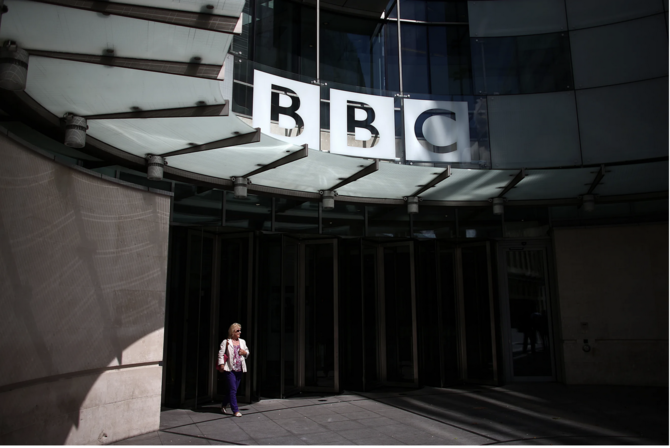
The BBC has faced accusations of bias from both pro-Israeli and pro-Palestinian groups for its coverage of the war in Gaza. (File/Getty images)
Short Url
Updated 12 September 2025
Follow

BBC criticizes news presenter for calling Hamas a ‘terror group’ amid ongoing Gaza coverage row

  • BBC says it avoids directly labeling Hamas as a terrorist group, instead using the term only with attribution or when in a quote

LONDON: The BBC has censured one of its news presenters for referring to Hamas as a “terror group” as the UK public broadcaster faces mounting scrutiny over its coverage of the Gaza war and pressure from officials to adopt the label.

The broadcaster’s Executive Complaints Unit said on Thursday that the use of “terror group” in reference to Hamas in a June 15 news broadcast was a “breach of the BBC’s editorial standards.”

It added: “The finding was reported to the management of BBC News and discussed with the editorial team responsible.”

The BBC has resisted pressure from British and Israeli officials to label Hamas as terrorists in its news coverage. The ECU said on Thursday that, for “reasons connected with due accuracy and impartiality,” the BBC avoids directly labeling Hamas as a terrorist group, instead using the term only with attribution or when in a quote. Hamas is designated a terrorist organization by the UK, US and EU.

The BBC has faced accusations of bias from both pro-Israeli and pro-Palestinian groups for its coverage of the war in Gaza.

Earlier in February, the BBC cancelled the scheduled broadcast of a documentary about Gaza’s children after discovering its 13-year-old narrator was the son of a Hamas official. The move, which was made following pressure from the UK government and pro-Israeli lobby groups, attracted widespread criticism from pro-Palestinian groups and activists.  

In June, the corporation decided not to broadcast a documentary about doctors working in Gaza due to “impartiality concerns.”


Jamal Banoon’s book to guide new generation of Saudi economic journalists

Updated 15 November 2025
Follow

Jamal Banoon’s book to guide new generation of Saudi economic journalists

  • Author aims to provide journalists with practical tools and insights to master and advance their skills

RIYADH: Jamal Banoon’s new book, “The Truth Behind the Numbers,” aims to guide economic journalists in the Kingdom in times of transformation. 

The book was accredited this week by the Higher Economic Council of the International Union for Press and Media as an official training curriculum.

The author aims to provide journalists with practical tools and insights to master and advance their skills in economic reporting. It delves into advice about data analysis, understanding global economic shifts, and how to deliver that news effectively. Banoon’s book reflects his goal to transform business journalists from mere reporters into a workforce that can analyze complexity, context and statistics in economics. 

The book addresses under-discussed themes in economic journalism, such as the importance of connecting economic issues to people’s lives and paying close attention to the threat of misinformation. 

Banoon is a prominent veteran business correspondent, with more than 40 years of experience, specializing in economic and business reporting in the Kingdom. 

Through his experience, he has seen economic journalism bloom in the Kingdom for years: “After more than 40 years in economic journalism, I felt there was a pressing need to document this experience and present it systematically to the new generation,” Banoon told Arab News. 

The Truth Behind the Numbers,’  was accredited by The Higher Economic Council of the International Union for Press and Media as an official training curriculum, aims to guide economic journalists in the Kingdom. (Supplied)

His work, in alignment with his book, has emphasized the need for economic journalists to play crucial roles in translating numbers, indicators and financial trends to the public. Given his mission to educate and aid aspiring journalists to perfect these skills, his work becomes increasingly important as the Kingdom undergoes fast change and evolution as it pursues Vision 2030. 

“I was inspired by the constant challenge journalists face in understanding and simplifying numbers for the public ... The biggest gap lies in simplifying without compromising accuracy. Many economic reports are written in highly technical language that the general public struggles to understand, or they are oversimplified to the point of distortion,” he said. 

“This book seeks to bridge that gap by offering tools and methods that enable journalists to translate economic complexity into accessible, meaningful content — without losing depth or credibility.”

On the importance of publishing the book in the current climate, Banoon said: “Saudi Arabia is witnessing remarkable progress in business reporting, especially amid the major economic transformations driven by Vision 2030. There is growing interest among media institutions in strengthening economic coverage, but we still need more specialization, training and development of analytical content.” 

Banoon’s book, in addition to being a fundamental tool, reflects what he calls “the fast-paced dynamics of the Saudi economy.” As the Kingdom expands its horizons to welcome being a global business hub, the media landscape is catching up to echo that change. 

Sidebar advice: 
“I consider the chapter ‘Verifying Economic Sources’ to be one of the most important for young journalists.”
“Credibility begins with accuracy — with the ability to distinguish between reliable and misleading data.”
“I advise them to combine professional curiosity with disciplined knowledge.”
“It’s not enough to report the news — you must understand the economic context surrounding it.”
“Learn how to read financial reports, how to ask the right questions to experts, and how to build a reliable network of sources.”
“Most importantly, never stop learning; the economic world is constantly changing, and successful journalists are those who keep pace with this change with awareness and skill.”