

Musa Al-Sadr family rejects BBC’s AI image claim in disappearance investigation

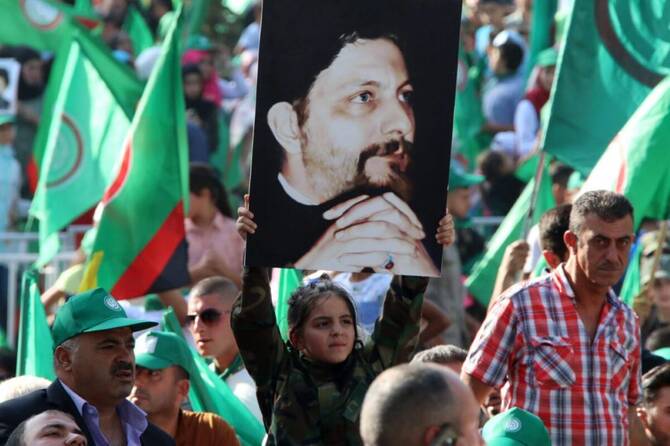
Amal movement supporters hold up pictures of Imam Musa Al-Sadr in Beirut, Lebanon, Aug. 31, 2018. (AFP)
Short Url
Updated 03 September 2025
Follow

Musa Al-Sadr family rejects BBC’s AI image claim in disappearance investigation

  • AI facial recognition analysis carried out by the BBC compared a 2011 photograph of a decomposed corpse from Tripoli’s Al-Zawiya hospital with archived images of Musa Al-Sadr, indicating a ‘high probability’ of resemblance
  • Leader of the Amal Movement, Al-Sadr disappeared on Aug. 31, 1978, in Libya alongside two companions, a week after they arrived to meet with then-Libyan leader Muammar Qaddafi

LONDON: The family of the missing Lebanese cleric Imam Musa Al-Sadr has dismissed a recent BBC documentary that suggested he died in Libya, condemning the use of an artificial intelligence-generated image claimed to be him.

In a statement released Tuesday by the Imam Musa Al-Sadr Research and Studies Center, the family said the BBC shared the AI facial recognition analysis — a comparison between a decomposed corpse photo from Tripoli’s Al-Zawiya hospital in 2011 and archival images of Al-Sadr and relatives — with them and Lebanon’s official follow-up committee without consent.

“During filming, as the Imam’s family and the follow-up committee, we confirmed that the image is not of the Imam due to evident differences in the shape of the face, hair color, and other obvious distinctions,” the family said, adding that they had the confirmation “the moment we saw the video clip.”

Al-Sadr, founder of the Amal Movement, disappeared on Aug. 31, 1978, in Libya alongside two companions, a week after they arrived to meet with Libyan government officials. They were last seen leaving a Tripoli hotel in a government vehicle.

Despite various claims, including Libyan assertions that he traveled to Rome — which have been widely disproved — his fate remains unknown.

Many Lebanese Shia believe that then-Libyan leader Muammar Qaddafi ordered Al-Sadr’s killing, a claim that Libya has consistently denied.

The case has fueled deep political tensions between Lebanon and Libya and remains a highly sensitive and unresolved matter.

Some experts contend that Al-Sadr, an influential Iranian-Lebanese cleric, was on the verge of using his influence to guide Iran — and by extension the region — toward a more moderate path when he vanished on the eve of the Iranian revolution.

The BBC film, part of its Eye Investigations series, centers on testimony from Swedish-Lebanese reporter Kassem Hamade, who during the uprising of the Arab Spring in 2011 claimed to have photographed a tall corpse in a secret Tripoli morgue resembling Al-Sadr. He argued that despite decomposition, the skin tone, hair and facial features the dead body still resembled Sadr’s — who stood at 1.98 meters.

He also took a hair sample reportedly handed to the office of Lebanese parliamentary speaker, Nabih Berri, but officials later said that he sample was lost due to a “technical error.”

With what the family described as “full cooperation” with the BBC by providing photos, documents and resources, the outlets submitted Hamade’s photograph for AI analysis.

According to Professor Ugail, the software indicated a “high probability” that the body was either Al-Sadr or a close relative, a claim firmly denied by Al-Sadr’s family.

His son, Sayyed Sadreddine Sadr, said the 2011 morgue photograph was “evident(ly)” not his father.

“It also contradicts the information we have after this date … that he is still alive, held in a Libyan jail,” he said — though no evidence was ever offered to support this claim.

To address further questions, Judge Hassan Shami, representing the official committee and the family, is scheduled to appear on BBC Arabic to provide clarification.


Iceland joins Eurovision boycott over Israel’s participation

Updated 10 December 2025
Follow

Iceland joins Eurovision boycott over Israel’s participation

  • Decision follows similar moves by Spain, the Netherlands, Ireland and Slovenia over the Gaza war
  • Iceland’s national broadcaster says it pulled out 'given the public debate' in the country

LONDON: Iceland’s national broadcaster said Wednesday it will boycott next year’s Eurovision Song Contest because of discord over Israel’s participation, joining four other countries in a walkout of the pan-continental music competition.
Broadcasters in Spain, the Netherlands, Ireland and Slovenia told contest organizer the European Broadcasting Union last week that they will not take part in the contest in Vienna in May after organizers declined to expel Israel over its conduct of the war against Hamas in Gaza.
The board of Iceland’s RÚV met Wednesday to make a decision.
At its conclusion the broadcaster said in a statement that “given the public debate in this country ... it is clear that neither joy nor peace will prevail regarding the participation of RÚV in Eurovision. It is therefore the conclusion of RÚV to notify the EBU today that RÚV will not take part in Eurovision next year.”
“The Song Contest and Eurovision have always had the aim of uniting the Icelandic nation but it is now clear that this aim cannot be achieved and it is on these program-related grounds that this decision is taken,” the broadcaster said.
Last week the general assembly of the EBU — a group of public broadcasters from 56 countries that runs Eurovision — met to discuss concerns about Israel’s participation. Members voted to adopt tougher contest voting rules in response to allegations that Israel manipulated the vote in favor of its competitor, but took no action to exclude any broadcaster from the competition.
The pullouts include some big names in the Eurovision world. Spain is one of the “Big Five” large-market countries that contribute the most to the contest. Ireland has won seven times, a record it shares with Sweden.
Iceland, a volcanic North Atlantic island nation with a population of 360,000, has never won but has the highest per capita viewing audience of any country.
The walkouts cast a cloud over the future of what’s meant to be a feel-good cultural party marked by friendly rivalry and disco beats, dealing a blow to fans, broadcasters and the contest’s finances.
The contest, which turns 70 in 2026, strives to put pop before politics, but has repeatedly been embroiled in world events. Russia was expelled in 2022 after its full-scale invasion of Ukraine.
It has been roiled by the war in Gaza for the past two years, stirring protests outside the venues and forcing organizers to clamp down on political flag-waving.
Opponents of Israel’s participation cite the war in Gaza, where more than 70,000 Palestinians have been killed, according to the territory’s Health Ministry, which operates under the Hamas-run government and whose detailed records are viewed as generally reliable by the international community.
Israel’s government has repeatedly defended its campaign as a response to the attack by Hamas-led militants on Oct. 7, 2023. The militants killed around 1,200 people — mostly civilians — in the attack and took 251 hostage.
A number of experts, including those commissioned by a UN body, have said that Israel’s offensive in Gaza amounts to genocide, a claim Israel has vigorously denied.
Wednesday marked the final day for national broadcasters to announce whether they planned to participate. More than two dozen countries have confirmed they will attend the contest in Vienna, and the EBU says a final list of competing nations will be published before Christmas.