

China accuses Philippine vessels of ‘dangerous maneuvers’ after its own ships collided

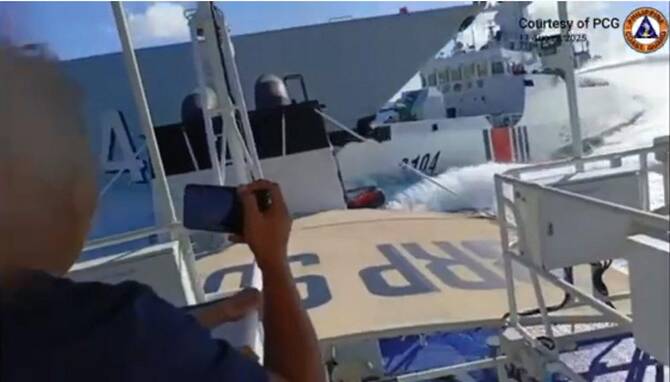
A video grab taken and released on Aug. 11, 2025 shows an incident between a Chinese Navy vessel, left, and a Chinese Coast Guard ship as seen from a Philippine fisheries boat near Scarborough Shoal in the disputed South China Sea. (Philippine Coast Guard/AFP)
Short Url
Updated 15 August 2025
Follow

China accuses Philippine vessels of ‘dangerous maneuvers’ after its own ships collided

  • The Philippine vessels’ actions ‘seriously endangered the safety of Chinese vessels and personnel’ – ministry spokesperson
  • Manila’s foreign minister Theresa Lazaro: ‘It was an unfortunate outcome, but not one caused by our actions’

BEIJING: China’s defense ministry accused Philippine Coast Guard vessels on Friday of “dangerous maneuvers” in response to reports of a collision earlier this week between two Chinese vessels near Scarborough Shoal in the disputed South China Sea.

The Philippine vessels’ actions “seriously endangered the safety of Chinese vessels and personnel,” ministry spokesperson Jiang Bin.

Jiang neither confirmed nor denied that there had been a collision involving two Chinese vessels on Monday.

“We demand that the Philippine side immediately stop its infringing and provocative rhetoric and actions,” Jiang said. “China reserves the right to take necessary countermeasures.”

The Scarborough Shoal has been a major source of tension in what is a strategic conduit for more than $3 trillion of annual ship-borne commerce.

Footage from the Philippine Coast Guard showed a Chinese coast guard ship trailing the PCG vessel before a Chinese navy ship suddenly cut across the path of the other Chinese ship, colliding with it and damaging the forecastle of the coast guard vessel.

It was the first known crash between Chinese vessels in the area.

The Philippines on Friday said it bore no responsibility for the collision.

“It was an unfortunate outcome, but not one caused by our actions,” Manila’s foreign minister Theresa Lazaro said in a statement.

The Philippine Coast Guard deployed three vessels on Monday to deliver supplies for Filipino fishermen in the Scarborough Shoal before the collision took place, Manila said on Tuesday.

The confrontation was the latest in a series of incidents amid a period of heightened tensions between Manila and Beijing over territorial disputes in the South China Sea.

A 2016 ruling of an international arbitral tribunal voided Beijing’s sweeping claims in the region, saying they had no basis under international law, a decision China rejects.


’Only a miracle can end this nightmare’: Eritreans fear new Ethiopia war

Updated 6 sec ago
Follow

’Only a miracle can end this nightmare’: Eritreans fear new Ethiopia war

  • Now the fractious Horn of Africa rivals have begun trading barbs and accusations of war-mongering once more
  • It is extremely difficult to gather testimonies from Eritrea, where dissidents often disappear to prison

ADDIS ABABA: Tewolde has fought multiple times for Eritrea, one of the most closed societies on Earth, and is now praying another war is not about to break out with neighboring Ethiopia.
“If the war starts, many people will go to the front and, as before, many children will lose their fathers, mothers will lose their husbands, parents will lose their children,” said Tewolde, who is in his 40s and lives in the Eritrean capital Asmara.
He fought first in the late 1990s during Eritrea’s horrific border war with Ethiopia, and more recently during clashes against rebels in the Ethiopian region of Tigray.
Now the fractious Horn of Africa rivals have begun trading barbs and accusations of war-mongering once more.
“We’ve already experienced this (before) and we know the losses are severe,” said Tewolde, who gave a false name to protect his identity in a country regularly described by rights groups as the North Korea of Africa.
It is extremely difficult to gather testimonies from Eritrea, where dissidents often disappear to prison. To obtain a few words from Tewolde, AFP had to pass questions and answers through an intermediary.

- ‘Incessant aggression’ -

Eritrea, a country of around 3.5 million, has been ruled by President Isaias Afwerki since independence from Ethiopia in 1993 and ranks near the bottom of every rights indicator.
Civilians are conscripted into the army for life or forced into a national service program that the United Nations has compared to slavery.
Ethiopian Prime Minister Abiy Ahmed won a Nobel Peace Prize in 2019 for signing a long-awaited peace deal with Eritrea shortly after coming to power and, in darkly ironic fashion, the two sides joined forces in the brutal war against the Tigrayans from 2020 to 2022.
Eritrea was not pleased that Ethiopia sued for peace without its input and has accused its landlocked neighbor of planning to seize its port at Assab.
For its part, Ethiopia has lately complained that Eritrea has been “actively preparing” for renewed conflict.
Ethiopian Foreign Minister Gedion Timothewos last month said that “Eritrean aggression and provocation is making further restraint more and more difficult.”

- ‘Fleeing en masse’ -

Mehari, an Eritrean in his 30s, fought in the Tigray war, where his army was accused of horrific war crimes.
“Young people are fleeing en masse to Ethiopia... and to Sudan to avoid a possible war,” he told AFP.
Another Eritrean, Luwan, left the country several years ago and now lives in an east African country, which she did not want to name for fear of reprisals against her family back home.
She says her family are terrified after a relative was summoned to a meeting and told to “prepare herself, her sons and daughters because she was told Abiy will start a war against her and the Eritrean people,” she said.
Some mothers at the meeting “still haven’t been informed about where their children are from the last war in Tigray, but still they are being asked to send their remaining children to the front,” Luwan added.
Eritrean Information Minister Yemane Ghebremeskel did not respond to a request for comment from AFP.
A former independence activist now in exile, researcher Mohamed Kheir Omer, said young people are split between their fear of conflict and of being overrun by Ethiopia, whose wartime atrocities are still in recent memory.
“We are torn between Isaias who does not care about his population, and Abiy who thinks only of his own legacy,” he said.
Luwan said she was desperate.
“Only a miracle can end this nightmare.”