

Festival film shows Gaza circus yearning for ‘one more show’

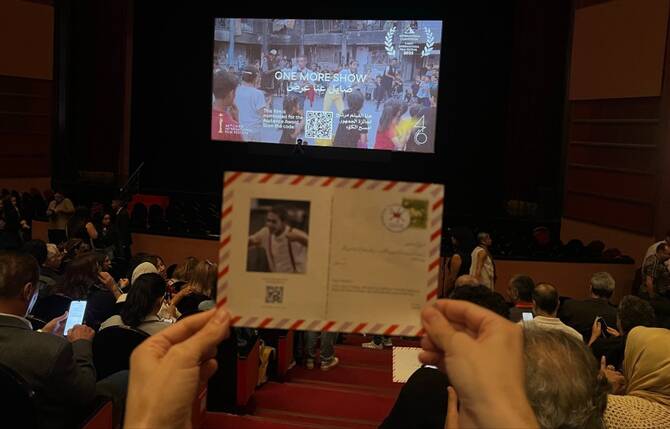
Amid bombed-out buildings, Palestinian circus performers juggled and cartwheel and tried to spread joy despite war and famine, as shown in a documentary screened at the Cairo International Film Festival. (X/@farghaly76)
Short Url
Updated 05 December 2025
Follow

Festival film shows Gaza circus yearning for ‘one more show’

  • Shot during the summer of 2024, as war raged in Gaza, “One More Show,” co-directed by Egyptian Mai Saad and Palestinian Ahmed el-Danaf, followed the daily life of the Free Gaza Circus
  • “It was the first time I heard someone want to make a film about daily life, not just the bombing and the suffering,” Danaf told AFP

CAIRO: Amid bombed-out buildings, Palestinian circus performers juggled and cartwheel and tried to spread joy despite war and famine, as shown in a documentary screened at the Cairo International Film Festival.
Shot during the summer of 2024, as war raged in Gaza, “One More Show,” co-directed by Egyptian Mai Saad and Palestinian Ahmed el-Danaf, followed the daily life of the Free Gaza Circus.
Danaf, 26 — who is still in the devastated Palestinian enclave — recorded footage of the clowns, jugglers and stilt walkers to bring Saad’s idea to life.
“It was the first time I heard someone want to make a film about daily life, not just the bombing and the suffering,” he told AFP, in a text message.
“The obstacles in front of me were quite clear: communications down, difficulties moving around, constant danger and the lack of equipment. But I felt we had to see it through.”
Slowly but surely, the footage was fed to Saad in Cairo, who put the film together over the course of a year.
“Everything we see in the news is from above — you only see people as these numbers, numbers, numbers... I wanted to make a film from below, from among the people,” the 41-year-old director told AFP.
The result is a heartfelt film in which humor, fatigue and the innocence of childhood are woven together, all under the incessant fear of Israeli air strikes.

- Helping each other -
Performers are seen taking turns scraping what little face paint they have left, helping each other prepare for a show in a school-turned-shelter.
Dozens of children gather around a clown with a bright red nose, singing, laughing and clapping along.
The point “was for these kids to see something besides the war and destruction that surrounds them all the time,” troupe founder Youssef Khedr told AFP by phone from Gaza.
A few weeks into filming, Israeli forces separated north Gaza from the rest of the tiny Palestinian territory.
Short distances became impassable, and the directors had to rely on footage shot by the performers themselves as they escaped to shelters, scrambled to put any kind of show together, or spent terrifying nights under air strikes.
Khedr — who specializes in gymnastics and parkour — fled the circus tent in Gaza City and headed south.
From his tent in southern Gaza, he told AFP he “did his best to keep training” so he could continue performing.
But, as the humanitarian conditions in Gaza worsened, the potatoes and eggs that some performers are seen preparing soon became a luxury.
In July, the circus announced it was suspending activities because of “the severe famine,” saying they could not “offer psychological support to those who haven’t had a bite to eat to ease their hunger.”

- ‘Exhausted by hunger’ -
By August, the United Nations confirmed that famine had set in in Gaza City, the main urban hub in the territory, where the health ministry says 157 children have starved to death.
“Even we as artists have been exhausted by hunger,” Khedr said.
“There were days when we couldn’t find anything to eat. I would buy 20 grams of sugar for $15, and sometimes all we had was formula milk,” he added.
The war was unleashed after Hamas’s unprecedented October 7, 2023 attack on Israel, which resulted in the deaths of 1,221 people.
More than 70,000 people have since been killed in Gaza by the Israeli military, according to the Hamas-run territory’s health ministry.
Since the war began, two of the troupe’s performers have been killed and three injured in strikes. The building in northern Gaza where they used to rehearse and host workshops was destroyed.
After a fragile truce went into effect in October, the circus performances began again, but with far fewer resources than before.
Danaf spent months shuttling from shelter to shelter to find an Internet connection so he could send Saad the footage.
He could not make it in person to the premiere, as Palestinians are not permitted to leave Gaza.
But, in a way, he did make it to the red carpet. Saad carried a tablet with a video call through the premiere and onto stage when the film won the Youssef Cherif Rizkallah Audience Award.
The award’s $20,000 prize money will go toward rebuilding a center for the circus in Gaza, Saad told AFP.


How succession works in Iran and who will be the country’s next supreme leader?

Updated 5 sec ago
Follow

How succession works in Iran and who will be the country’s next supreme leader?

DUBAI: The death of Iran’s Supreme Leader Ayatollah Ali Khamenei after almost 37 years in power raises paramount questions about the country’s future. The contours of a complex succession process began to take shape the morning after Khamenei’s assassination.
Here is what to know:
A temporary leadership council assumes duties
As outlined in its constitution, Iran on Sunday formed a council to assume leadership duties and govern the country.
The council is made up of Iran’s sitting president, the head of the country’s judiciary and a member of the Guardian Council chosen by Iran’s Expediency Council, which advises the supreme leader and settles disputes with parliament.
Iran’s reformist President Masoud Pezeshkian and hard-line judiciary chief Gholamhossein Mohseni Ejei are its members who will step in and “temporarily assume all the duties of leadership.”
A panel of clerics selects a new supreme leader
Though the leadership council will govern in the interim, an 88-member panel called the Assembly of Experts “must, as soon as possible” pick a new supreme leader under Iranian law.
The panel consists entirely of Shiite clerics who are popularly elected every eight years and whose candidacies are approved by the Guardian Council, Iran’s constitutional watchdog. That body is known for disqualifying candidates in various elections in Iran and the Assembly of Experts is no different. The Guardian Council barred former Iranian President Hassan Rouhani, a relative moderate whose administration struck the 2015 nuclear deal with world powers, from election for the Assembly of Experts in March 2024.
Khamenei’s son could be a possible contender
Clerical deliberations about succession and machinations over it take place far from the public eye, making it hard to gauge who may be a top contender.
Previously, it was thought Khamenei’s protégé, hard-line President Ebrahim Raisi, may try to take the mantle. However, he was killed in a May 2024 helicopter crash. That has left one of Khamenei’s sons, Mojtaba, a 56-year-old Shiite cleric, as a potential candidate, though he has never held government office. But a father-to-son transfer in the case of a supreme leader could spark anger, not only among Iranians already critical of clerical rule, but also among supporters of the system. Some may see it as un-Islamic and in line with creating a new, religious dynasty after the 1979 collapse of the US-backed Shah Mohammad Reza Pahlavi’s government.
A transition like this has happened only once before
There has been only one other transfer of power in the office of supreme leader of Iran, the paramount decision-maker since the country’s 1979 Islamic Revolution.
In 1989, Grand Ayatollah Ruhollah Khomeini died at age 86 after being the figurehead of the revolution and leading Iran through its bloody eight-year war with Iraq. This transition now comes after Israel launched a 12-day war against Iran in June 2025 as well.
The vast powers of a supreme leader
The supreme leader is at the heart of Iran’s complex power-sharing Shiite theocracy and has final say over all matters of state.
He also serves as the commander-in-chief of the country’s military and the powerful Revolutionary Guard, a paramilitary force that the United States designated a terrorist organization in 2019 and which Khamenei empowered during his rule. The Guard, which has led the self-described “Axis of Resistance,” a series of militant groups and allies across the Middle East meant to counter the US and Israel, also has extensive wealth and holdings in Iran.