Modi, Putin agree to deepen economic ties despite US pressure

1 / 2
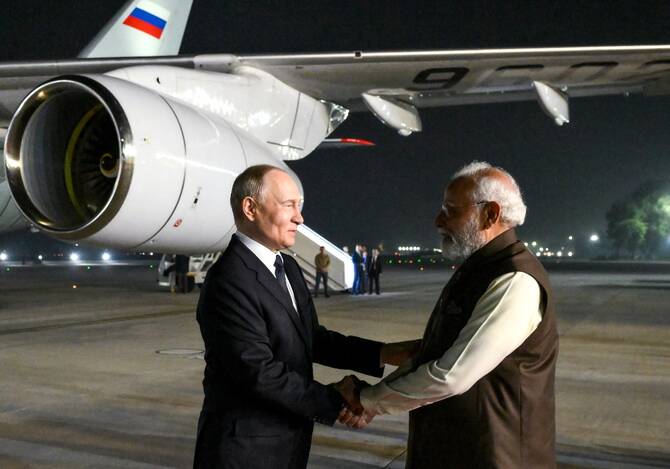
Russian President Vladimir Putin shakes hands with Indian Prime Minister Narendra Modi during his ceremonial reception at India's presidential palace, Rashtrapati Bhavan, in New Delhi on Dec. 5, 2025. (AFP)
2 / 2
Russian President Vladimir Putin is welcomed by Indian Prime Minister Narendra Modi upon arrival at the Palam Air Base in New Delhi, India. (Reuters)
Short Url
Updated 05 December 2025
Follow

Modi, Putin agree to deepen economic ties despite US pressure

  • India-Russia relations ‘have always stood the test of time,’ Modi says 
  • They signed 16 agreements, agreed to boost energy, connectivity ties

NEW DELHI: Indian Prime Minister Narendra Modi and Russian President Vladimir Putin agreed to scale up and diversify economic cooperation during talks in New Delhi on Friday, showcasing deepening ties despite pressure from US President Donald Trump. 

Putin was on a two-day visit to India to co-chair with Modi the 23rd India-Russia Annual Summit, a key platform of their 25-year-Special and Privileged Strategic Partnership. 

The trip takes place amid Washington’s intensifying pressure on Russia to end the war in Ukraine and tense relations between the US and India, after Trump imposed hefty tariffs on Delhi and threatened sanctions over its historic ties with Moscow and its imports of Russian oil. 

In a joint press briefing following the Friday summit, Modi said India’s ties with Russia “have always stood the test of time” and had remained a “guiding star” for the past eight decades. 

“Today, we discussed all aspects of cooperation to further strengthen this foundation. Taking economic cooperation to new heights is our shared priority,” he said. 

“To realize this, today we have agreed on an Economic Cooperation Program until 2030. This will make our trade and investment diversified, balanced and sustainable, and will also add new dimensions to areas of cooperation.” 

Defense has traditionally been the main pillar of India-Russia ties, as Moscow is India’s largest defense supplier, accounting for an estimated 36 percent of arms imports and more than half of its military hardware.

But bilateral trade has been on the rise for the past two years, reaching $68.7 billion in 2024-25 fiscal year and dominated by Indian imports of Russian goods, particularly crude oil and petroleum products, government data showed. 

The two countries are now working to reach $100 billion by 2030 and to conclude a free trade agreement with the Eurasian Economic Union, as their leaders also agreed on Friday to strengthen collaboration across other areas, especially energy and connectivity. 

“Both the countries are trying to convey a message to the West, that they’ll not come under Western pressure,” said Prof Rajan Kumar of the School of International Studies at the Jawaharlal Nehru University. 

“India believes in the strategic economy, policy of multi-alignment. It will not come under any pressure from the West. So Putin’s visit is very important, India-Russia friendship is very important from that perspective.” 

For Russia, the visit was intended to show “the world that it remains a global power,” Prof. Harsh V. Pant, vice president of the Observer Research Foundation, told Arab News.

“It remains a power that has friends, that it is not as isolated as what the West might be trying to project Russia,” he said. 

“For India, this is a case of projecting its own sense of strategic autonomy in deciding how it wants to engage Russia, that despite American pressure, it has no intention of abandoning Russia, and it will continue to invest in its relationship with Russia.” 

India and Russia signed 16 agreements and memoranda of understanding on Friday, including one on labor mobility that would facilitate the movement of skilled and semi-skilled workers to and from the two countries. 

The Indian government also announced the launch of a free 30-day e-tourist visa for Russian nationals. 

“We are undoubtedly satisfied with the results of the negotiation we just had,” Putin said during the joint press briefing. 

“I can express my confidence that the current visit and the agreements will help the further deepening of the Russian-Indian strategic partnership for the benefit of our countries and the people, the peoples of India and Russia.”


Lufthansa adds more flights to Asia, Africa as Middle East war reshapes air travel

Updated 06 March 2026
Follow

Lufthansa adds more flights to Asia, Africa as Middle East war reshapes air travel

  • Airlines across Europe have been redirecting capacity after suspending services in the Middle East
  • Lufthansa said the move also helps meet demand on long-haul routes that Middle Eastern carriers cannot currently serve

LONDON: Lufthansa said on Friday it was shifting capacity from 10 canceled Middle Eastern destinations to routes such as Singapore and Bangkok as it contends with disruption from the US-Israeli war on Iran.
Airlines across Europe, including budget carrier Wizz Air , have been redirecting capacity after suspending services in the Middle East.
Lufthansa said the move also helps meet demand on long-haul routes that Middle Eastern carriers cannot currently serve.
Airline stocks have slumped this week as US and Israeli airstrikes on Iran — and retaliatory strikes by Iran across the Middle East — have disrupted long-haul flights and sent oil prices soaring.
“The war in the Middle East proves once again how exposed air traffic is and ⁠how vulnerable it ⁠remains,” Lufthansa CEO Carsten Spohr said in a statement. He added the outlook was uncertain, particularly for jet fuel costs.
The schedule changes came as the German group reported better-than-expected 2025 results, saying stricter financial management and fleet renewal had helped contain costs and lift profits. Its shares rose as much as 4 percent, before reversing to trade down 1.2 percent at 1246 GMT.
The company said demand on routes to and from Asia and Africa had risen strongly since the conflict began ⁠on Saturday, and it would stick with its focus on expanding long-haul services. Spohr said new flights to Asia would launch in days.
Lufthansa did say how many services it had canceled because of the conflict.
While carriers face costs for rescheduling and rerouting, the biggest impact for those outside the Middle East is expected from surging fuel prices. Brent crude futures have jumped more than 20 percent this week.
Spohr said Lufthansa was well hedged in the short term. The group hedges fuel up to 24 months ahead and was 85 percent hedged as of December 31, according to its annual report.
RESILIENCE
European carriers, including Lufthansa, benefited from slightly lower fuel bills in 2025. Lufthansa’s fuel bill fell 7 percent, helping support earnings as passenger demand stayed firm.
“Last ⁠year we were able ⁠to significantly increase the Group’s operating profit and achieved the highest revenue in our history. Our results demonstrate the resilience and stability of the Group,” Spohr said.
Lufthansa reported an adjusted operating profit of 2 billion euros ($2.3 billion), compared with 1.9 billion euros forecast in a company-compiled analyst poll and up from 1.6 billion euros in 2024. The group also posted an operating margin of 4.9 percent, up from 4.4 percent a year earlier.
Lufthansa aims to lift operating margins to 8 percent-10 percent between 2028 and 2030 from 4.4 percent in 2024, but strikes by workers, including the most recent on February 12, have made it harder to boost profitability.
Bernstein analyst Alex Irving said ongoing weakness in the passenger airline segment persisted, but that strong performances in Cargo and Lufthansa Technik helped lift profits.
The carrier said the outlook for 2026 was unclear due to geopolitical uncertainty. It projected capacity growth of 4 percent, alongside increased revenue and profit margin.