

Pakistan military says ex-PM Khan’s narrative has become ‘threat to national security’

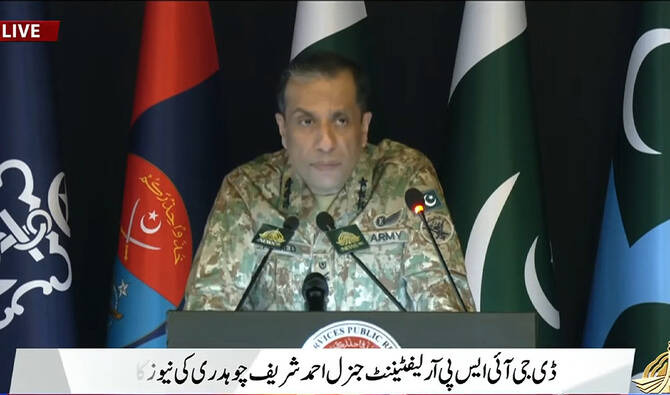
A screengrab from live transmission of Pakistan's state television showing Director General of Army's media wing, ISPR, Lt. Gen. Ahmed Sharif Chaudhry adressing a press conference in Islamabad, Pakistan, on December 5, 2025. (PTV)
Short Url
Updated 05 December 2025
Follow

Pakistan military says ex-PM Khan’s narrative has become ‘threat to national security’

  • Military spokesperson responds to Khan’s fresh criticism of Pakistan’s powerful army chief, whom he accuses of denying him basic rights
  • Lt. Gen. Ahmed Sharif Chaudhry warns army will “come bare knuckle” if Khan and his party do not desist from attacking military leadership

ISLAMABAD: Pakistan military spokesperson Lt. Gen. Ahmed Sharif Chaudhry said on Friday that former prime minister Imran Khan’s narrative against the armed forces has become a “national security threat,” warning him and his party to keep the army out of political statements. 

Chaudhry’s criticism comes in response to Khan’s latest statement, released by his account on social media platform X on Thursday, in which he blamed Chief of Defense Forces Field Marshal Asim Munir for “the complete collapse of the constitution and rule of law in Pakistan.”

Khan, who was ousted via a parliamentary vote in April 2022, blames the country’s powerful army for colluding with his political rivals to keep him away from power. He blames the military and the incumbent government for keeping him in solitary confinement in a central prison in Rawalpindi. Pakistan’s military and the government have strongly rejected his claims. 

“It may seem to you a bit strange coming from me this because that person [Khan] and the narrative he is pushing, it has become a national security threat,” Chaudhry told reporters at a news conference. 

“And that is why it is very important that we come clear, without any ambiguity, without any doubt. We need to come clear and we need to say what needs to be said,” he added. 

Throughout the press conference, Chaudhry kept referring to the former prime minister as a “mentally ill” person. He played video clips of Indian news channels and Afghanistan’s social media accounts promoting Khan’s statements against the military. 

“Why would they not do it? Because sitting in your country, a mindset, a mentally ill person sitting here is saying these things against the military and its leadership,” he said. 

The military spokesperson warned Khan and his party against criticizing the military. He added that while the military welcomes constructive criticism, it should be kept away from political statements. 

“If someone for the sake of his own self, his delusional mindset and narcissistic thinking attacks this armed forces and its leadership, then we will also come bare knuckle,” he warned. 

“There should be no doubt on that.”

Khan, who remains in prison on a slew of charges that he says are politically motivated, continues to be popular among the masses. 

His Pakistan Tehreek-e-Insaf (PTI) party has frequently led rallies to demand his release from jail, including one in May 2023 and another in November 2024 that saw clashes with law enforcement personnel. 

While the former prime minister continues to remain behind bars, rallies organized by the PTI still draw thousands of people across the country and his party still enjoys a sizable following on social media platforms.


China, Pakistan sign livestock tech agreements under second phase of economic corridor

Updated 6 sec ago
Follow

China, Pakistan sign livestock tech agreements under second phase of economic corridor

  • Agreements signed on sheep IVF, dairy cow breeding and joint research and development 
  • Initiative aligns with shift from infrastructure to industrial, agricultural collaboration under CPEC

ISLAMABAD: China and Pakistan are expanding cooperation in livestock technology and agricultural research, with new agreements signed during a recent Chinese delegation’s visit to Pakistan, Radio Pakistan reported on Thursday, as both sides seek to deepen economic collaboration under the second phase of the China-Pakistan Economic Corridor (CPEC).

The collaboration follows a visit by Jinan Animal Husbandry Industry Craftsman College to Pakistan in January during the 2026 China-Pakistan Agriculture Investment Conference, where multiple cooperation documents were signed.

CPEC, launched in 2015 as part of China’s Belt and Road Initiative, initially focused on large-scale infrastructure projects including highways, energy plants and the development of Gwadar port. In recent years, the corridor has entered what officials describe as “CPEC 2.0,” aimed at shifting toward industrial cooperation, agriculture modernization, technology transfer and private-sector partnerships.

Agriculture and livestock are central to Pakistan’s rural economy, employing millions and contributing significantly to agricultural output. Expanding technical cooperation in breeding, veterinary sciences and value-added production is seen as part of broader efforts to diversify bilateral economic ties beyond infrastructure.

“The collaboration injects new impetus into bilateral livestock industry development, aligning with the advancement of China-Pakistan Economic Corridor (CPEC) 2.0,” Radio Pakistan reported on a visit by Jinan Animal Husbandry Industry Craftsman College to Pakistan from Jan. 19-24.

During the visit, two key cooperation documents were signed. A Framework Agreement on Industrial and Technological Cooperation and Talent Training was concluded with the Pak-China Joint Chamber of Commerce & Industry (PCJCCI) to establish a China-Pakistan Animal Husbandry and Veterinary Industry Technology Cooperation Center. The center is expected to focus on technological research and development, standard-setting and customized training programs.

In addition, a Memorandum of Understanding was signed with GO DAIRY Private Limited covering the transfer of sheep in vitro fertilization technology and dairy cow breeding techniques, alongside technical guidance to address production bottlenecks.

Radio Pakistan reported that consensus was also reached with the University of Veterinary & Animal Sciences (UVAS) on curriculum collaboration and the development of a joint training base.

The report added that Chinese and Pakistani experts would focus on three areas of cooperation — Himalayan pink salt application, sheep in vitro fertilization and dairy cow breeding — and plan to establish a joint laboratory to support technology localization.