Ethiopia calls for international mediation with Eritrea over sea access

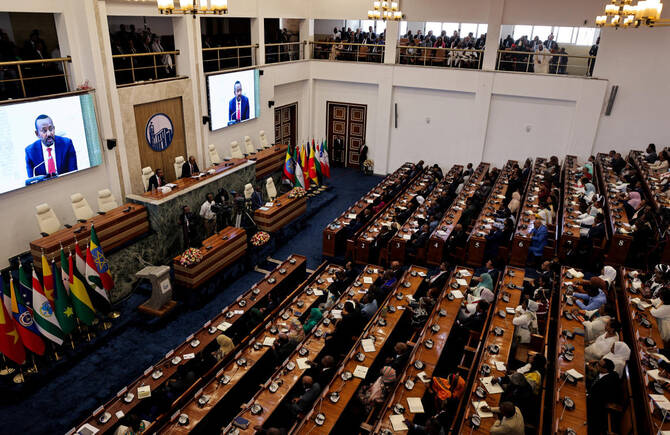
Ethiopia’s Prime Minister Abiy Ahmed addresses parliament members on the current situation of the country, at the parliament building, in Addis Ababa, Ethiopia, Oct. 28, 2025. (Reuters)
Short Url
Updated 28 October 2025
Follow

Ethiopia calls for international mediation with Eritrea over sea access

  • Abiy Ahmed: ‘Ethiopia’s request for access to the sea is irreversible. We have no intention of going to war with Eritrea. On the contrary, we are convinced that this issue can be resolved peacefully’
  • Sparsely populated Eritrea, home to some 3.5 million people, has moved closer to Egypt, which also has strained relations with Ethiopia

ADDIS ABABA: Ethiopia’s leader called Tuesday for international “mediation” with Eritrea over access to the sea, insisting on an “irreversible” claim to the coastline as tensions rise between the Horn of Africa neighbors.
Relations are once again strained more than 30 years after Eritrea gained independence and left Ethiopia landlocked.
Ethiopian Prime Minister Abiy Ahmed won a Nobel Peace Prize for forging a peace deal with Eritrea in 2018.
But his insistent demands on sea access have provoked anger in Eritrea, which says Ethiopia covets its southeastern port city of Assab on the Red Sea.
“Ethiopia’s request for access to the sea is irreversible. We have no intention of going to war with Eritrea. On the contrary, we are convinced that this issue can be resolved peacefully,” Abiy told parliament on Tuesday.
Abiy said he had held discussions on the issue with the United States, Russia, China, African Union and European Union.
“We... have requested their mediation to find a lasting solution,” he said.
Eritrean Information Minister Yemane Ghebremeskel did not immediately respond to a request for comment from AFP.
After Eritrean independence in 1993, the two countries fought a bloody border war from 1998 to 2000, leaving tens of thousands dead.
Relations improved when Abiy came to power in 2018 and signed the peace deal with President Isaias Afwerki, who has ruled Eritrea with an iron fist since independence.
Eritrean troops backed Ethiopian federal forces during a civil war in the Tigray region between 2020 and 2022, which left an estimated 600,000 people dead, according to the African Union.
But since the end of the conflict relations have turned frosty.
In October, Ethiopia accused Eritrea of financing armed groups on its territory, which Asmara labelled “a false charade.”
Sparsely populated Eritrea, home to some 3.5 million people, has moved closer to Egypt, which also has strained relations with Ethiopia.


Report highlights role of British Muslim charitable giving in supporting UK public services

Updated 7 sec ago
Follow

Report highlights role of British Muslim charitable giving in supporting UK public services

  • The study, “Building Britain: British Muslims Giving Back,” finds that donations from British Muslims are helping to bolster overstretched service

LONDON: British Muslim charitable giving is playing an increasingly significant role in supporting frontline public services across the UK, according to a new report by policy and research organization Equi.

The study, “Building Britain: British Muslims Giving Back,” finds that donations from British Muslims are helping to bolster overstretched services, including local councils, the NHS and welfare systems, at a time of growing financial pressure.

The report estimates that Muslim donors contribute around £2.2 billion ($2.9 billion) annually, making them the UK’s most generous community.

This figure is around four times the national giving average and rises to almost 10 times the average among higher earners.

According to the findings, Muslim-led charities are providing a wide range of support, including housing assistance, emergency cash grants, food provision and mental health services, easing demand on statutory services.

Equi points to evidence from 2023 showing that housing support delivered by the National Zakat Foundation helped prevent evictions that would have cost councils an estimated £28.8 million, with every £1 of charitable spending generating £73 in public sector savings.

The report also highlights a generational shift, with younger British Muslims increasingly directing their donations toward domestic causes such as homelessness, child poverty and mental health challenges.

Despite their growing impact, Muslim charities face a number of barriers, including de-banking, restrictive funding rules, securitization measures and what the report describes as limited recognition from government. Equi argues that these challenges are constraining the sector’s ability to maximize its contribution.

“British Muslim giving is not just generosity but a lifeline for public services that needs recognizing,” said Equi Managing Director Prof. Javed Khan.

“From preventing evictions to supporting mental health, these donations are saving millions for the taxpayer and strengthening communities across Britain. The evidence is clear that Muslim-led action is delivering frontline support where the state is struggling,” he added.

Equi is calling on policymakers to engage more closely with Muslim-led charities and to move beyond what it describes as symbolic recognition.

The report recommends measures such as UK-based match-funding schemes and greater faith literacy within policymaking, which it says could unlock billions of pounds in additional domestic spending while maintaining the UK’s global humanitarian commitments.

The study concluded that with greater collaboration between government and Muslim charities, charitable giving could play an even more transformative role in strengthening public services and social cohesion across the country.