

Saudi Arabia’s $2.5tn mineral reserves fuel industrial push

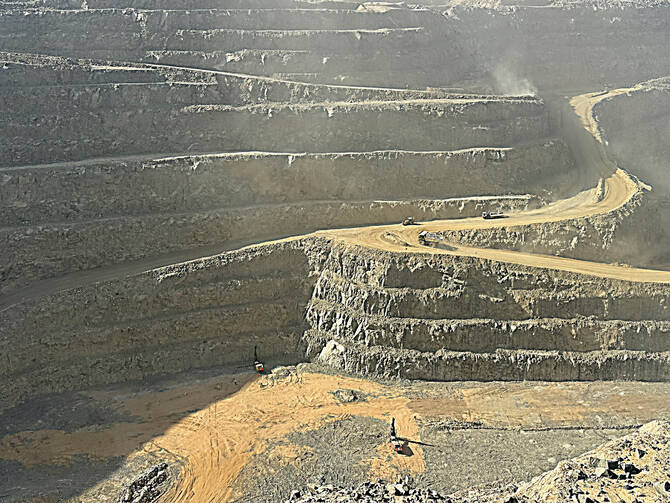
Saudi Arabia is prioritizing domestic resources and talent, promoting public-private partnerships, and adopting Fourth Industrial Revolution technologies to drive sustainable, long-term growth. (Getty)
Short Url
Updated 06 July 2025
Follow

Saudi Arabia’s $2.5tn mineral reserves fuel industrial push

  • Mining sector projected to boost its GDP contribution from $17 billion in 2024 to $75 billion by 2030

JEDDAH: Saudi Arabia is accelerating the development of its mining sector as a central pillar of economic diversification, with the Kingdom’s mineral wealth now estimated at SR9.4 trillion ($2.5 trillion). 

The surge in value is driven by discoveries of rare earth elements, base metals, gold, phosphate, and titanium — a strong, lightweight metal with high-value applications in aviation and turbine manufacturing. 

A major catalyst for this growth is the Northern Borders region, home to SR4.6 trillion in resources and a key hub for phosphate production. Developments in Waad Al-Shamal have helped position the Kingdom among the world’s top phosphate exporters. 

In alignment with Vision 2030 and the National Industrial Development and Logistics Program, the mining sector is projected to boost its contribution to gross domestic product from $17 billion in 2024 to $75 billion by 2030. It generated $400 million in revenue in 2023 and is now backed by a $100 billion investment plan targeting critical minerals by 2035. 

Speaking to Arab News, Saurabh Priyadarshi, a geologist and adviser for mining and metals at Geoxplorers Consulting Services, highlighted that Saudi Arabia’s substantial reserves of gold, copper, phosphate, rare earth elements, and lithium position it as a potential global leader in the industry.

“Saudi Arabia can foresee itself becoming a key player in the global minerals supply chain. Calling these minerals critical is a different matter altogether,” he said. 

Priyadarshi added that one of the strongest diversification drivers is rising global demand for battery metals and industrial minerals that power electric vehicles and renewable energy infrastructure. 

“As global markets push toward decarbonization, Saudi Arabia, too, can and should leverage its $2.5 trillion mineral resource base to power the next phase of industrial growth,” Priyadarshi said. 

Saudi Arabia is also prioritizing domestic resources and talent, promoting public-private partnerships, and adopting Fourth Industrial Revolution technologies to drive sustainable, long-term growth. 

Minerals central to 2030 plan 

Mansour Ahmed, an independent economic adviser, described mineral development as a strategic cornerstone of Vision 2030. He said Saudi Arabia’s untapped reserves are “critical to the global energy transition.” 

Ahmed stressed that growing the sector would expand non-oil GDP, generate employment, and drive regional development. He highlighted the importance of mining cities and downstream hubs “to maximize local value and build integrated, resilient supply chains.” 

Both Priyadarshi and Ahmed noted Saudi Arabia’s alignment of mining with advanced manufacturing and innovation. 

Priyadarshi pointed to Ras Al-Khair’s aluminum smelter and the planned battery chemicals complex in Yanbu, developed in partnership with EV Metals Group, as examples of the Kingdom’s industrial leap forward. 

Investments in automated mining technologies, AI-driven exploration, and ESG-focused practices reflect Saudi Arabia’s ambitions to become a global hub for sustainable resource extraction.

Saurabh Priyadarshi, geologist and adviser for mining and metals at Geoxplorers Consulting Services

Saudi Arabia has also secured lithium processing capabilities, becoming the first Middle Eastern country to establish a battery materials supply pipeline. 

“The government is leveraging its Public Investment Fund to finance mining and battery production, ensuring long-term supply chain resilience,” Priyadarshi said. 

He also cited strategic global moves, such as acquiring stakes in Vale’s base metals division and developing domestic copper smelting, as reinforcing the Kingdom’s ambitions in critical minerals. 

According to the Vision 2030 Annual Report for 2024, mining has been prioritized as a key sector for economic diversification. The report highlights significant reforms introduced to support this strategic shift, including the Comprehensive Mining Strategy and the Mining Investment Law — both designed to create a more attractive and transparent regulatory environment. 

Institutional support was reinforced through the establishment of the Ministry of Industry and Mineral Resources. Furthermore, the Saudi Geological Survey and the National Geological Database were launched to strengthen geological mapping and resource assessment capabilities. 

New entities such as Manara Minerals, the Mining Fund, and the Nuthree Exploration Incubator were also created to stimulate investment, innovation, and entrepreneurship in the sector.

ESG and AI integration 

Priyadarshi emphasized that sustainability is integral to this transformation, with AI-driven exploration minimizing environmental impact, automation improving productivity and energy efficiency, and blockchain tools ensuring compliance with ethical, environmental, social, and governance standards. 

Saudi Arabia is also investing heavily in renewables to power its industrial base. Priyadarshi pointed to the Kingdom’s $235 billion commitment to solar, wind, and hydrogen, including NEOM’s $5 billion green hydrogen facility and a $35 billion phosphate and bauxite processing expansion at Ras Al-Khair. 

Ras Al-Khair Industrial City is home to Maaden’s phosphate and ammonia plants, aluminum smelters, and steel
production facilities such as Hadeed — showcasing the Kingdom’s ability not only to extract, but also to process and add value to its mineral resources. The city is rapidly emerging as a strategic node in global supply chains. 

Priyadarshi noted that the Kingdom’s strategy extends beyond resource extraction. He underscored the importance of integrating mining with downstream industries such as aluminum smelting, phosphate processing, and electric vehicle battery production to reinforce supply chains and develop high-value sectors that move beyond the export of raw minerals. 

“Investments in automated mining technologies, AI-driven exploration, and ESG-focused practices reflect Saudi Arabia’s ambitions to become a global hub for sustainable resource extraction,” he said. 

When asked about the most strategically important minerals for the Kingdom, Ahmed identified phosphate, rare earth elements, and gold as critical. 

He explained that phosphate is essential for food security and serves as a key driver of industrial exports, while rare earth elements such as neodymium, praseodymium, and dysprosium are vital for manufacturing EVs, wind turbines, defense technologies, and high-tech electronics — making them central to future-proofing the clean energy economy. 

“Gold continues to hold significant financial value and remains an important mineral for the Kingdom. Copper and bauxite closely follow, given their growing importance in global electrification,” Ahmed added. 

Global rankings 

According to the Vision 2030 report, Saudi Arabia has achieved top international rankings in the mining sector. 

The Kingdom secured first place for mining investment growth, as reported by MineHutte and the Mining Journal. It also ranks among the top 10 countries for mining financial policies and holds the second position globally for efficient license issuance — taking approximately 90 days to issue a mining license. 

The report adds that Saudi Arabia’s advanced legislative framework has attracted significant interest, with 290 local and international companies operating in the sector as of 2024. 

The National Geological Database has dramatically expanded its coverage from just 1.7 percent in 2021 to 51 percent by last year, enabling better resource identification. 

Investor confidence remains high, with 30 proposals submitted for the Kingdom’s largest-ever mining tender in 2024, covering valuable mineral sites containing gold, silver, copper, and zinc.


Saudi Arabia looks to Swiss-led geospatial AI breakthroughs

Updated 12 December 2025
Follow

Saudi Arabia looks to Swiss-led geospatial AI breakthroughs

  • IBM’s Zurich lab is shaping tools policymakers could use to protect ecosystems

ZURICH: For Gulf countries such as Saudi Arabia, AI-powered Earth observation is quickly becoming indispensable for anticipating climate risks, modeling extreme weather and protecting critical national infrastructure. 

That reality was on display inside IBM’s research lab in Zurich, where scientists are advancing geospatial AI and quantum technologies designed to help countries navigate a decade of accelerating environmental volatility.

The Zurich facility — one of IBM’s most sophisticated hubs for climate modeling, satellite analytics and quantum computing — provides a rare look into the scientific foundations shaping how nations interpret satellite imagery, track environmental change and construct long-term resilience strategies. 

Entrance to IBM Research Europe in Zurich (left); inside IBM’s hardware development lab, (top, right); and IBM’s Diamondback system. (AN Photos by Waad Hussain)

For Saudi Arabia, where climate adaptation, space technologies and data-driven policy align closely with Vision 2030 ambitions, the lessons emerging from this work resonate with growing urgency.

At the heart of the lab’s research is a shift in how satellite data is understood. While traditional space programs focused largely on engineering spacecraft and amassing imagery, researchers say the future lies in extracting meaning from those massive datasets. 

As Juan Bernabe-Moreno, director of IBM Research Europe for Ireland and the UK, notes, satellites ultimately “are gathering data,” but real impact only emerges when institutions can “make sense of that data” using geospatial foundation models.

r. Juan Bernabe Moreno, Director of IBM Research Europe for Ireland and the UK/(AN Photo by Waad Hussain)

These open-source models allow government agencies, researchers and local innovators to fine-tune Earth-observation AI for their own geography and environmental pressures. Their applications, Bernabe-Moreno explained, have already produced unexpected insights — identifying illegal dumping sites, measuring how mangrove plantations cool cities, and generating flood-risk maps “for places that don’t usually get floods, like Riyadh.”

The relevance for Saudi Arabia is clear. Coastal developments require precise environmental modeling; mangrove restoration along the Red Sea is a national priority under the Saudi Green Initiative; and cities such as Riyadh and Jeddah have recently faced severe rainfall that strained existing drainage systems. 

Opinion

This section contains relevant reference points, placed in (Opinion field)

The ability to simulate these events before they unfold could help authorities make better decisions about zoning, infrastructure and emergency planning. Today’s satellites, Bernabe-Moreno said, provide “an almost real-time picture of what is happening on Earth,” shifting the challenge from collecting data to interpreting it.

This push toward actionable intelligence also reflects a larger transformation in research culture. Major advances in Earth observation increasingly depend on open innovation — shared data, open-source tools and transparent models that allow global collaboration. “Open innovation in this field is key,” Bernabe-Moreno said, noting that NASA, ESA and IBM rely on openness to avoid the delays caused by lengthy IP negotiations.

Scientific posters inside IBM’s research facility showcasing decades of breakthroughs in atomic-scale imaging and nanotechnology. (AN Photo by Waad Hussain)

Saudi Arabia has already embraced this direction. Through SDAIA, KAUST and national partnerships, the Kingdom is moving from consuming global research to actively contributing to it. Open geospatial AI models, researchers argue, give Saudi developers the ability to build highly localized applications adapted to the region’s climate realities and economic priorities.

Beyond Earth observation, IBM’s Zurich lab is pushing forward in another strategic frontier: quantum computing. Though still in its early stages, quantum technology could reshape sectors from logistics and materials science to advanced environmental modeling. 

Alessandro Curioni, IBM Research VP for Europe and Africa and director of the Zurich lab, stressed that quantum’s value should not be judged by whether it produces artificial general intelligence. Rather, it should be viewed as a tool to expand human capability. 

 Dr. Alessandro Curioni, VP of IBM Research Europe and Africa & Director of IBM Research Zurich/ (AN Photo by Waad Hussain)

“The value of computing is not to create a second version of myself,” he said, “it’s to create an instrument that allows me to be super-human at the things I cannot do.”

Curioni sees quantum not as a replacement for classical computing but as an extension capable of solving problems too complex for traditional machines — from simulating fluid dynamics to optimizing vast, interdependent systems. But he cautioned that significant challenges remain, including the need for major advances in hardware stability and tight integration with classical systems. Once these layers mature, he said, “the sky is the limit.”

DID YOU KNOW?

• Modern satellites deliver near real-time views of Earth’s surface.

• Geospatial foundation models transform vast satellite datasets into clear, actionable insights.

• These tools can produce flood-risk maps for cities such as Riyadh, analyze how mangroves cool urban areas, and even detect illegal dumping sites.

Saudi Arabia’s investments in digital infrastructure, sovereign cloud systems and advanced research institutions position the Kingdom strongly for the quantum era when enterprise-ready systems begin to scale. Curioni noted that Saudi Arabia is already “moving in the right direction” on infrastructure, ecosystem development and talent — the three essentials he identifies for deep research collaboration.

His perspective underscores a broader shift underway: the Kingdom is building not only advanced AI applications but a scientific ecosystem capable of sustaining long-term innovation. National programs now include talent development, regulatory frameworks, high-performance computing, and strategic partnerships with global research centers. Researchers argue that this integrated approach distinguishes nations that merely adopt technology from those that ultimately lead it.

Inside IBM’s hardware development lab, where researchers prototype and test experimental computing components. (AN Photo by Waad Hussain)

For individuals as much as institutions, the message from Zurich is clear. As Curioni put it, those who resist new tools risk being outpaced by those who embrace them. Generative AI already handles tasks — from literature reviews to data processing — that once required days of manual analysis. “If you don’t adopt new technologies, you will be overtaken by those who do adopt them,” he said, adding that the goal is to use these tools “to make yourself better,” not to fear them.

From geospatial AI to emerging quantum platforms, the work underway at IBM’s Zurich lab reflects technologies that will increasingly inform national planning and environmental resilience. 

For a country like Saudi Arabia — balancing rapid development with climate uncertainty — such scientific insight may prove essential. As researchers in Switzerland design the tools of tomorrow, the Kingdom is already exploring how these breakthroughs can translate into sustainability, resilience and strategic advantage at home.