Pakistan says illegal immigration to Europe down 47 percent amid major crackdown

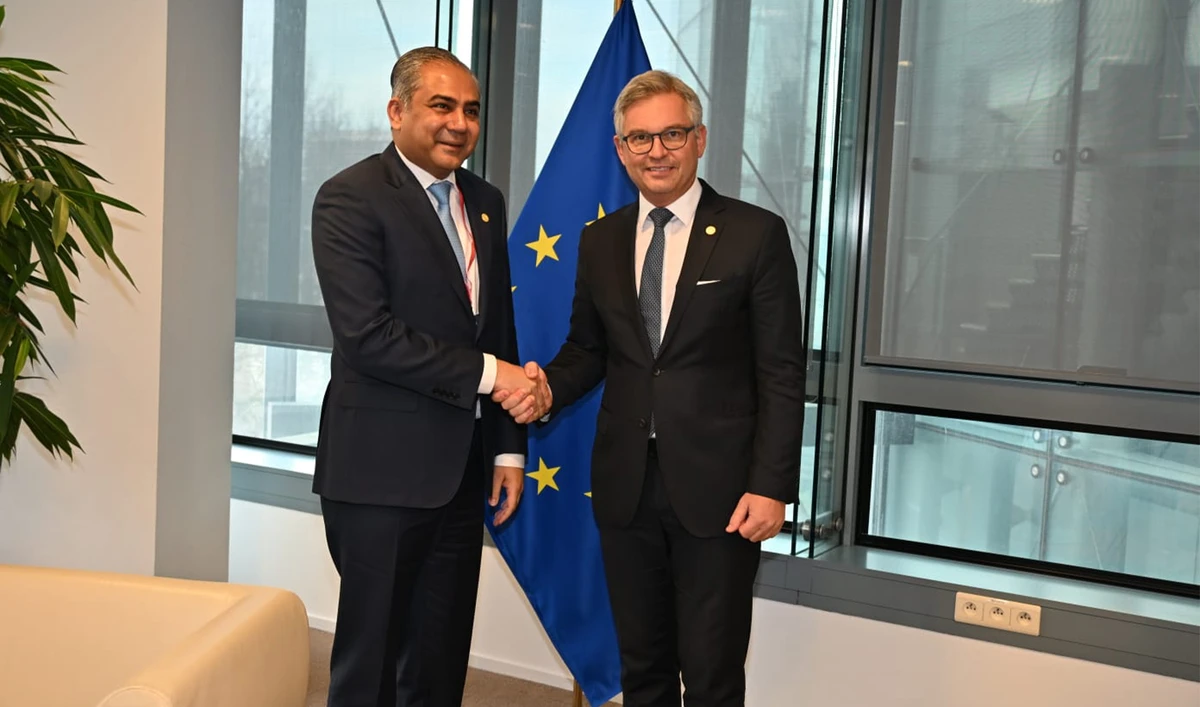
Pakistan Interior Minister Mohsin Naqvi meets European Union Commissioner for Home Affairs and Migration Magnus Brunner in Brussels on December 11, 2025. (Pakistan Interior Ministry)
Short Url
Updated 12 December 2025
Follow

Pakistan says illegal immigration to Europe down 47 percent amid major crackdown

  • Over 1,700 human smugglers arrested nationwide this year, interior ministry says
  • EU praises Pakistan’s efforts as Brussels, Islamabad agree to deepen cooperation 

ISLAMABAD: Pakistan has achieved a 47 percent drop in illegal immigration to Europe this year, with more than 1,700 human smugglers arrested as part of an expanded nationwide crackdown, the interior ministry said on Thursday. 

The announcement followed Interior Minister Mohsin Naqvi’s meeting in Brussels with European Union Commissioner for Home Affairs and Migration Magnus Brunner, where both sides discussed efforts to curb human smuggling and strengthen migration cooperation.

Pakistan intensified action against illegal migration in 2023 after hundreds of migrants, including 262 Pakistanis, drowned when an overcrowded vessel sank off the Greek town of Pylos, one of the deadliest boat disasters in the Mediterranean. Authorities say they continue to target networks sending citizens abroad through dangerous routes, following heightened scrutiny at airports and a series of arrests involving forged documents.

“Commissioner Magnus Brunner paid strong tribute to the Government of Pakistan for achieving a 47 percent reduction in attempts to reach Europe through illegal ‘dunki’ routes during the past year and described Pakistan’s measures as exemplary,” the interior ministry said in a statement.

“Dunki routes” refer to irregular migration paths used by smugglers to move people across multiple borders toward Europe, the United Kingdom and the United States.

Pakistani authorities say the routes are controlled by transnational criminal networks that also engage in document fraud and other illicit activities.

“Mohsin Naqvi stated that 1,770 human smugglers and their agents have been arrested in Pakistan this year, which clearly reflects the government’s zero-tolerance policy against illegal immigration,” the interior ministry said. 

It added that Pakistan and the EU agreed to coordinate future strategies against illegal immigration, human smuggling and drug trafficking, including deeper information-sharing between law enforcement bodies. Brunner would soon visit Pakistan to acknowledge the country’s efforts and discuss next steps in reducing irregular migration flows, the statement said. 

It also quoted Naqvi as saying that the nexus between smuggling networks, drug mafias and militant groups posed a major challenge to Pakistan and required “international cooperation to confront it.”

Earlier in December, Pakistan announced it would roll out an AI-based immigration screening system in Islamabad from January next year to detect forged travel documents and prevent illegal departures.

In September, Pakistan’s Federal Investigation Agency released a list of more than 100 of the country’s “most wanted” human smugglers as part of its ongoing nationwide operation, identifying major hubs of trafficking activity across Punjab and the capital.

At ECO meeting, Pakistan proposes ‘Regional Innovation Hub’ to curb natural disasters

Updated 21 January 2026
Follow

At ECO meeting, Pakistan proposes ‘Regional Innovation Hub’ to curb natural disasters

  • Pakistan hosts high-level 10th ECO Ministerial Meeting on Disaster Risk Reduction in Islamabad
  • Innovation hub to focus on early warning technologies, risk informed infrastructure planning

ISLAMABAD: Pakistan has proposed to set up a “Regional Innovation Hub on Disaster Risk Reduction” that focuses on early warning technologies and risk informed infrastructure planning, the Press Information Department (PID) said on Wednesday, as Islamabad hosts a high-level meeting of the Economic Cooperation Organization (ECO).

The ECO’s 10th Ministerial Meeting on Disaster Risk Reduction (DRR) is being held from Jan. 21-22 at the headquarters of the National Disaster Management Authority (NDMA) in Pakistan’s capital. 

The high-level regional forum brings together ministers, and senior officials from ECO member states, representatives of the ECO Secretariat and regional and international partner organizations. The event is aimed to strengthen collective efforts toward enhancing disaster resilience across the ECO region, the PID said. 

“Key agenda items include regional cooperation on early warning systems, disaster risk information management, landslide hazard zoning, inclusive disaster preparedness initiatives, and Pakistan’s proposal to establish a Regional Innovation Hub on Disaster Risk Reduction, focusing on early warning technologies, satellite data utilization, and risk-informed infrastructure planning,” the statement said. 

The meeting was attended by delegations from ECO member states including Pakistan, Türkiye, Azerbaijan, Iran, Kyrgyzstan, Tajikistan, Turkmenistan and Uzbekistan. Representatives of regional and international organizations and development partners were also in attendance.

Discussions focused on enhancing regional coordination, harmonizing disaster risk reduction frameworks, and strengthening collective preparedness against transboundary and climate-induced hazards impacting the ECO region, the PID said. 

ECO members states such as Pakistan, Türkiye, Afghanistan and others have faced natural calamities such as floods and earthquakes in recent years that have killed tens of thousands of people. 

Heavy rains triggered catastrophic floods in Pakistan in 2022 and 2025 that killed thousands of people and caused damages to critical infrastructure, inflicting losses worth billions of dollars. 

Islamabad has since then called on regional countries to join hands to cooperate to avert future climate disasters and promote early warning systems to avoid calamities in future.