
RIYADH: King Saud University’s College of Engineering is positioning itself as a proving ground for a new kind of Saudi engineer — one who treats AI not as a mere software tool, but as an engineering layer that redefines how the Kingdom designs infrastructure, energy systems, defense technologies, communications networks, and smart materials.
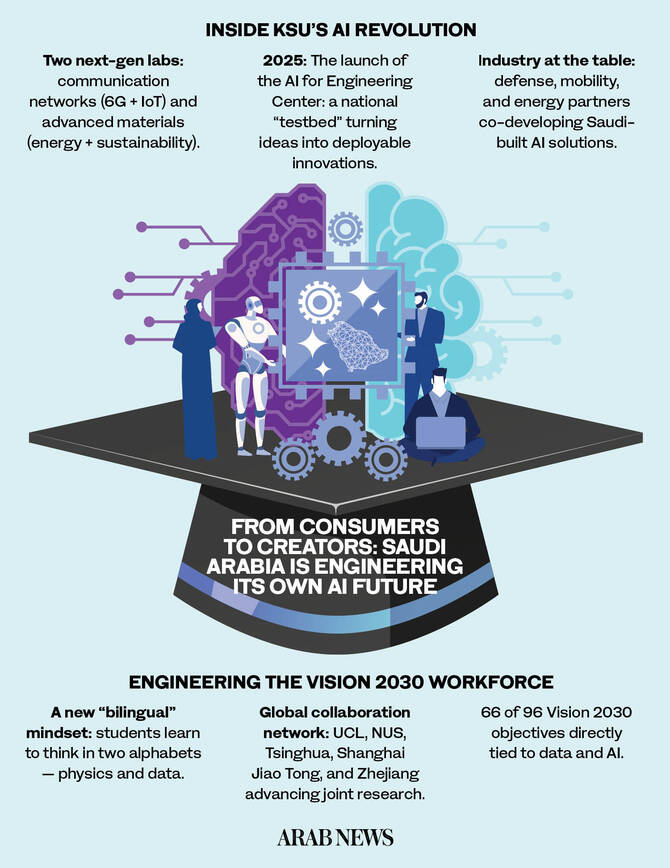
This transformation is not cosmetic. It is structural, embedded deep in the curriculum, linked with industry, and aligned with a national mandate. “KSU’s College of Engineering is aligning its AI push squarely with Vision 2030 toward building a talent base to deliver on the 66 of 96 national objectives linked to data and AI,” said Abdulelah Alshehri, assistant professor of chemical engineering at the college.
“The result would be engineers who do not just adopt tools, but create local and superior technologies that boost competitiveness, security, and a knowledge economy.”
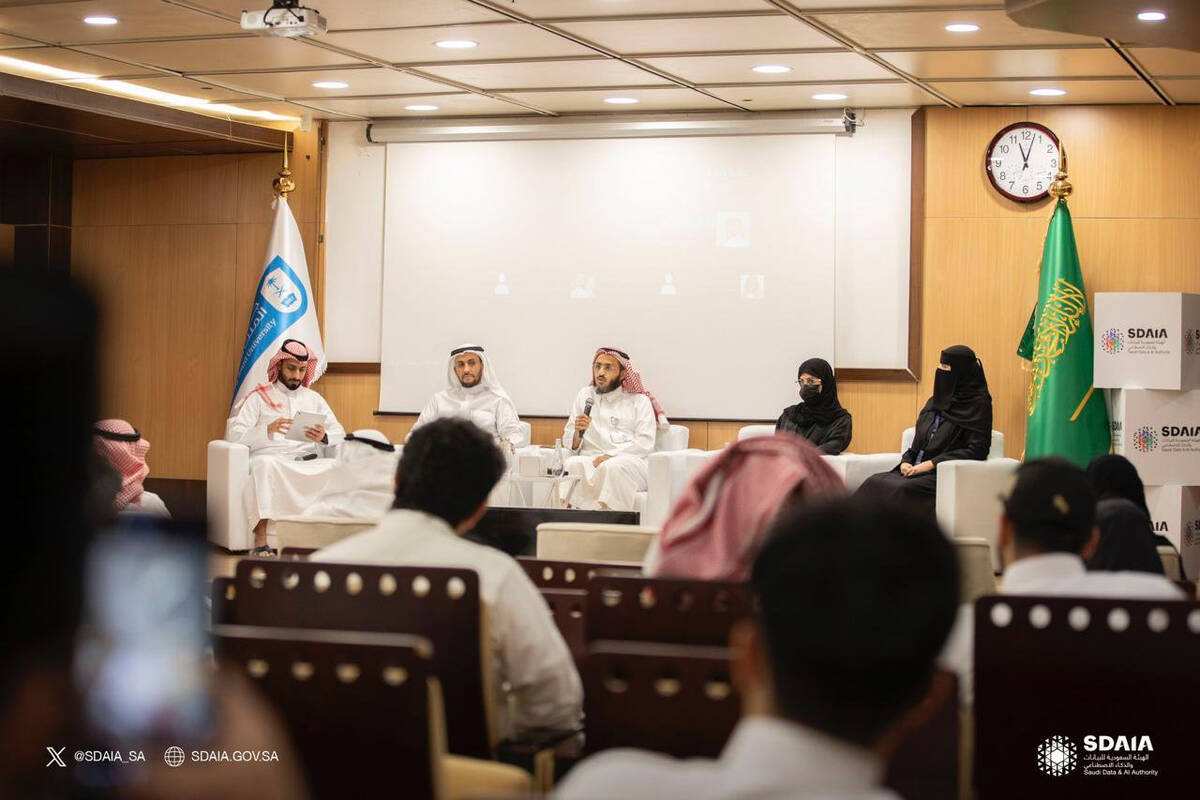
King Saud University and Saudi Data & AI Authority unite to advance AI-driven education. (Supplied)
The shift reflects a broader reality: AI is no longer an isolated discipline buried inside computer science departments. It has become a force multiplier shaping which nations lead in defense autonomy, manufacturing localization, space systems, medical devices, energy optimization, and the next generation of 6G networks. To lead, engineers must understand physics, hardware, data, and algorithms as a unified system, not as separate domains.
“Future engineers should not be just AI users; they would architect the systems within which AI is implemented,” said Alshehri. “They would frame the problem and data, build and test AI models, and finally fuse algorithms with hardware, safety and regulation so systems act responsibly in the real world.”
Opinion
This section contains relevant reference points, placed in (Opinion field)
This vision is being formalized through KSU’s flagship AI for Engineering Center, approved for launch in 2025. The center merges academic research with real-world application, acting as a living testbed where students and researchers develop and test AI-driven solutions for energy, autonomous mobility, national defense, and environmental analytics. By connecting university labs directly with industry needs, the center accelerates prototyping, real-data validation, and faster deployment for sectors such as energy and mobility.
The transformation also reaches classrooms. The college has introduced a new bilingual AI and Engineering curriculum that treats AI and engineering as one language with two alphabets: physics and data. “Unlike traditional programs where AI is a late-stage elective, KSU’s bilingual model teaches engineering students to think in two languages from day one,” Alshehri said.
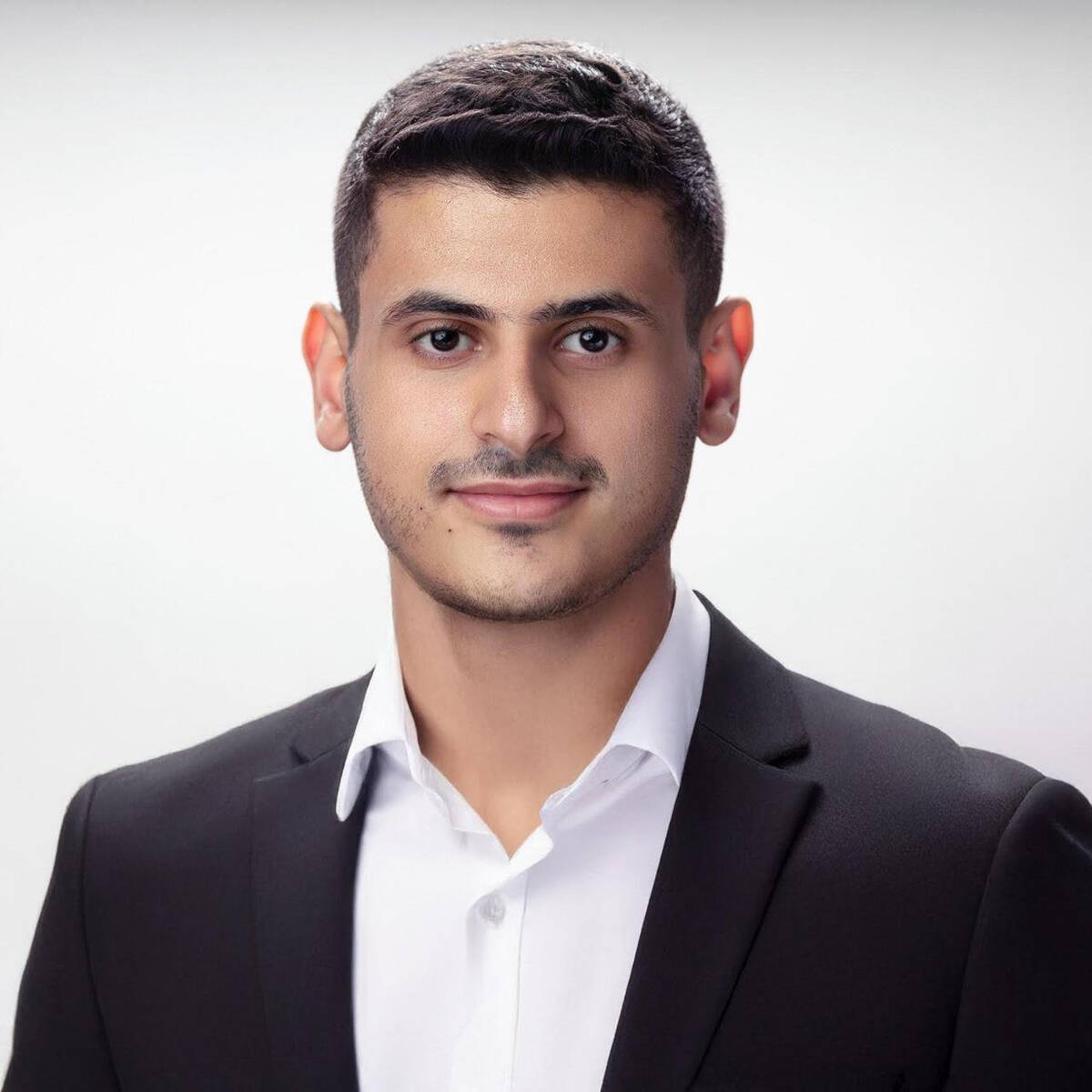
Abdulelah Alshehri, assistant professor of chemical engineering. (Supplied)
Graduates will leave with AI literacy embedded in labs, capstones, and industry projects — not as a certificate, but as a default competency.
Majid Altamimi, dean of the College of Engineering, describes this decision as a response to the speed of global change.
“We realized that artificial intelligence is transforming every field of engineering. It is becoming the key to building smarter systems, complex automation, and creating more sustainable designs,” he said. “By weaving AI into everything we teach and research, we are ensuring our graduates are not just ready for the future, they are ready to shape it.”

Majid Altamimi, dean of KSU's College of Engineering. (Supplied)
That ambition is already taking physical form. The KSU college has inaugurated two AI-driven specialized labs, one focused on communication networks and the other on advanced materials, both aligned with national industrial priorities. “Our new labs in communication networks and advanced materials are designed to turn great ideas into real-world products,” Altamimi said.
“In one lab, we’re working on the next wave of connectivity like 6G and IoT. In the other, we’re creating new, smarter materials for energy and sustainability. Crucially, we work hand-in-hand with industry partners to prototype and test these innovations, ensuring our research makes a tangible impact on Saudi Arabia’s technological competitiveness,” he added.
DID YOU KNOW?
• KSU’s College of Engineering trains Saudi engineers to design AI systems, not just use them. The college is aligning its AI push squarely with Vision 2030 toward building a talent base. It is ensuring that its graduates are not just ready for the future, they are ready to shape it.
• The college is aligning its AI push squarely with Vision 2030 toward building a talent base.
• It is ensuring that its graduates are not just ready for the future, they are ready to shape it.
KSU is also expanding its international footprint through deep collaboration with leading global universities. The College has signed five two-year partnerships with UCL, NUS, Tsinghua, Shanghai Jiao Tong, and Zhejiang University to advance joint research, faculty exchange, and dual-degree programs. These collaborations provide students and researchers access to world-class expertise, strengthening KSU’s research capacity and reinforcing Saudi Arabia’s position as an emerging global innovation hub.
Yet the most strategic value of the College’s pivot may not lie in its labs or partnerships, but in its timing. Saudi Arabia has already built the infrastructure for an AI economy through sovereign cloud platforms, national data policies, and hyperscale compute deals. The next bottleneck is talent. The Kingdom needs engineers capable of building 6G-secure networks, autonomous defense systems, AI-guided energy grids, and locally designed materials — not just operating imported software.

AI-driven communication research at KSU explores next-generation 6G and IoT connectivity to power Saudi Arabia’s smart cities. (CCNull image)
“Tomorrow’s engineering is AI-defined from grids that self-optimize, materials discovered by algorithms, to autonomous systems coordinating at city scale,” Alshehri said. “Future engineering graduates who can architect these agentic, trustworthy systems will power Vision 2030’s diversification.”
This is the quiet race beneath the AI headlines: not who installs AI, but who engineers it. Not who consumes compute, but who designs the systems that require it. Not who imports models, but who trains the minds that build sovereign ones.

A 3D printing and prototyping lab at King Saud University supports hands-on AI engineering projects and technology localization under Vision 2030. (Supplied)
Alshehri believes the coming decade will belong to Saudi engineers ready to lead with curiosity, ethics, and skill. “The nation is investing and offering tremendous opportunities and the world is watching, so be curious, ethical, hands-on so we can lead the shift from using engineering tools to creating them in the new era of AI-driven engineering,” he said.
KSU’s bet is that the next great Saudi breakthrough will not come from a cloud console, but from a lab table where equations, code, and national strategy meet.