

More large mammals once roamed Saudi Arabia than previously thought

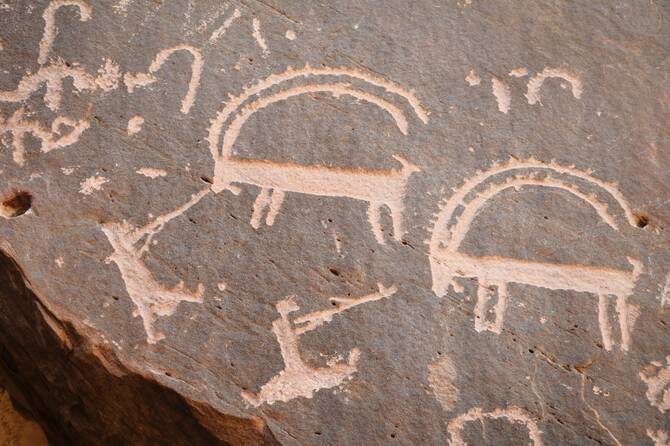
Ancient petroglyphs were among the sources studied by scientists to determine which species once roamed the Arabian peninsula. (Supplied)
Short Url
Updated 12 May 2025
Follow

More large mammals once roamed Saudi Arabia than previously thought

RIYADH: Three times more large mammal species once roamed Saudi Arabia than previously thought, according to a new study.

The research, conducted in Thuwal, identifies 15 large mammal species that inhabited the Arabian Peninsula over the last 10,000 years.

It was published on May 12 in the Journal of Biogeography by researchers from King Abdullah University of Science and Technology and Taibah University.

The findings have potential implications for rewilding efforts in the Kingdom, KAUST said in a statement.

Among the identified species, the majority hail from Africa, including notable predators like lions and cheetahs.

The study also highlights two new species previously unrecognized in the region: the greater kudu and the Somali wild ass.

Currently, the Arabian Peninsula has successfully reintroduced the Arabian oryx and has plans to reintroduce the cheetah.

However, the other 13 species will require careful evaluation to determine their potential for reintroduction.

“Restoration efforts extend beyond vegetation; animals are essential to maintaining healthy ecosystems,” emphasized Christopher Clarke, senior project manager at KAUST and a key contributor to the study.

“By identifying the large mammals that have gone extinct, we provide crucial data for governments to consider which species could be reintroduced in the future.”

To reach their findings, Clarke and his colleague, Sultan M. Al-Sharif, an associate professor at Taibah University, meticulously analyzed thousands of petroglyphs — ancient rock carvings — gathered from scientific expeditions, published resources, and even social media, where amateur archaeologists have shared their discoveries.

This approach enabled the researchers to access a wealth of petroglyphs previously unknown to the scientific community.

“Our research reveals that the Arabian Peninsula was far more diverse in large mammals than previously imagined,” said Al-Sharif.


Children’s Theater Festival opens in Qassim region

Updated 27 January 2026
Follow

Children’s Theater Festival opens in Qassim region

  • To develop future ‘cultural architects,’ says CEO Khaled Al-Baz
  • ‘Nurture creativity, aesthetic awareness and sense of belonging’

BURAIDAH: The Qassim Children’s Theater Festival opened on Tuesday bringing together professionals from across Saudi Arabia and the Gulf.

The event is being held under the patronage of Prince Dr. Faisal bin Mishaal bin Saud bin Abdulaziz, governor of Qassim, at the Science Center in Unaizah governorate.

It has been Organized by the Theater and Performing Arts Association and executed by the Unaizah Theater Association, the Saudi Press Agency reported.

Running until Jan. 31, it features shows, panel discussions, as well as training workshops to develop children’s theater and strengthen professional skills in the field.

Khaled Al-Baz, CEO of the Theater and Performing Arts Association, told the SPA the festival forms part of a broader strategy to position children’s theater as a distinct cultural sector.

“Children today constitute genuine audiences — tomorrow’s cultural architects,” Al-Baz said.

Ahmed Al-Humaimidi, president of the Unaizah Theater Association, said it was an investment in young people, noting that it extends beyond performances to include cultural and educational programming.

He said the initiative aims to nurture creativity, aesthetic awareness and a sense of belonging, while also identifying emerging talent and encouraging knowledge exchange among theater practitioners.

“Our association recognizes children’s theater as foundational to cultivating aware, creative character,” he said.

The festival serves as both an artistic showcase and a platform for professional dialogue, reflecting the Kingdom’s expanding cultural landscape and growing focus on children’s theater as an educational and cultural tool, the SPA noted.

This occurs alongside support for signature initiatives and performing arts promotion as quality-of-life enhancement.