

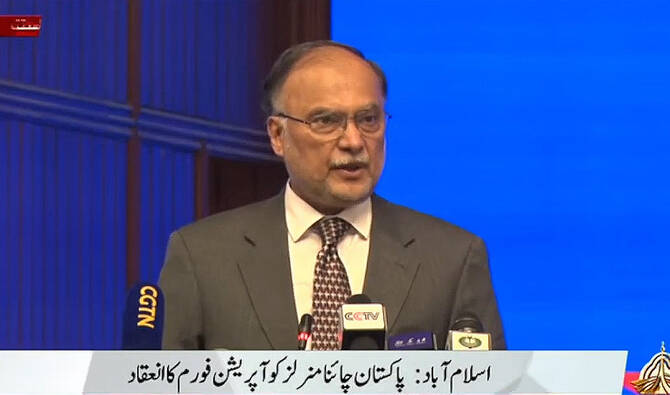

ISLAMABAD: Pakistan on Wednesday said it was seeking Chinese investment to develop its vast but underexploited mineral resources, pitching a strategy focused on value addition, processing and export-oriented industrial clusters as it looks to turn mining into a pillar of long-term economic growth.
At the Pakistan–China Mineral Cooperation Forum in Islamabad, senior ministers said the government’s priority was to move beyond the export of raw minerals by developing processing plants, smelters and mineral-based industrial clusters linked to Special Economic Zones (SEZs), according to reports in state-run Radio Pakistan and the Associated Press of Pakistan (APP).
Pakistan holds significant reserves of copper, gold, coal and other critical minerals, but its mining sector has historically been constrained by limited infrastructure, regulatory complexity and a lack of downstream processing capacity. The government has identified mining as a potential source of foreign exchange and industrial development as it seeks international investment amid broader economic reforms.
The flagship of that strategy is the Reko Diq copper-and-gold project in Balochistan, one of the world’s largest undeveloped copper deposits, which officials see as a test case for attracting large-scale foreign capital and integrating Pakistan into global mineral supply chains.
Speaking at the forum, Planning and Development Minister Ahsan Iqbal said Pakistan’s mineral exports could rise substantially if value was added domestically rather than through raw material exports, stressing the importance of Chinese partnership in achieving that shift.
“Pakistan’s mineral exports have the potential to reach $6-8 billion dollars annually within this decade through value addition,” Ahsan Iqbal said, according to a Radio Pakistan report.
He said Pakistan’s objective was to develop mineral processing plants, smelters and refining facilities, adding that “transformation of Pakistan’s mineral economy cannot happen without strategic partners and China’s role is central in this regard.”
Ahsan Iqbal also linked the minerals push to the second phase of the China–Pakistan Economic Corridor (CPEC), saying it aimed to translate infrastructure connectivity into productivity, exports and jobs, while reaffirming that the security of Chinese nationals and investments remained a top national priority.
Separately, Board of Investment Minister Qaiser Ahmed Sheikh said at the forum Pakistan and China were expanding cooperation in the minerals sector alongside broader economic engagement, citing growing business-to-business activity, according to an APP report.
He said more than 300 Pakistani companies visited China in September 2025 alone and that 167 memorandums of understanding were signed at a Pakistan–China business-to-business conference, with the Board of Investment working on their implementation.
Petroleum Minister Ali Pervaiz Malik invited Chinese firms to participate in the Pakistan Minerals Investment Forum 2026, scheduled for April 8–9, describing it as a platform for structured engagement with policymakers, regulators and project sponsors, according to APP.
He said China’s experience in rare earth elements, copper smelting and refining offered lessons for Pakistan as global demand accelerates for critical minerals linked to the energy transition, adding that Pakistan, with China’s support, was positioning itself as a long-term partner in global mineral supply chains.


