

Jordan’s capital spending hits $1.97bn in 2025, achieves record budget execution rate

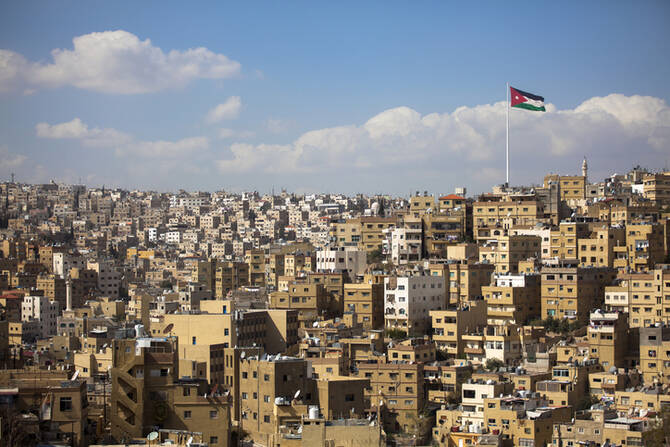
Jordan’s record 2025 capital spending supports its Economic Modernization Vision. Getty
Short Url
Updated 28 January 2026
Follow

Jordan’s capital spending hits $1.97bn in 2025, achieves record budget execution rate

JEDDAH: Jordan’s capital spending surged 20 percent in 2025 to 1.4 billion dinars ($1.97 billion), achieving a record 96 percent execution rate as the government boosted growth, infrastructure, and development projects nationwide.

This aligns with government directives to implement capital projects funded under the General Budget Law, aimed at stimulating economic growth and accelerating economic activity, according to Jordan News Agency, Petra.

Jordan’s record 2025 capital spending supports its Economic Modernization Vision, funding strategic infrastructure, energy, and industrial projects to drive growth, create jobs, and strengthen fiscal and economic resilience.

The increase also reflects the government’s strategy to encourage private sector participation while enhancing public services and infrastructure across the Kingdom.

“According to preliminary financial data, capital spending increased by approximately 230 million dinars by the end of 2025, or 20 percent, compared with 2024,” Petra reported.

It added: “With this increase, the ratio of actual capital spending to targeted allocations under the 2025 General Budget Law reached about 96 percent, marking the highest execution rate on record, compared with an average of 82 percent in previous years.”

Detailed figures show that approximately 333 million dinars were spent on projects under the Economic Modernization Vision, while around 180 million dinars were allocated to municipal development and 123 million dinars to decentralization initiatives in the governorates.

An additional 55 million dinars supported projects of the Jordan Tourism Board, as per the same source.

Capital funding also targeted major initiatives, including 50 million dinars for initial works on the National Carrier Project, part of the government’s planned 250 million dinars investment. 

A further 29 million dinars went toward completing Princess Basma Hospital, supplying natural gas to industrial zones, maintaining school buildings, and rehabilitating roads nationwide.

Allocations were also directed to upgrading computer systems and advancing the digital transformation of services across several ministries.

Looking ahead, Jordan’s 2026 budget is set to build on the momentum of 2025 by prioritizing the second phase of the Economic Modernization Vision.

With capital spending estimated at 1.6 billion dinars, including 400 million dinars for EMV projects, the government plans over $10 billion in strategic investments across water, energy, and transport, health, as well as infrastructure, largely in partnership with the private sector and funded primarily from external sources.

Flagship projects such as the National Water Carrier, the Aqaba–Shidiyah/Maan–Ghor Al-Safi railway, and the Risheh gas pipeline are expected to spur growth, create jobs, and enhance public services, while fiscal discipline and transparent oversight seek to maintain macroeconomic stability and expand reliance on domestic revenue for public spending.

PIF-backed AviLease achieves revenue of $664m and 19% growth in 2025

Updated 27 February 2026
Follow

PIF-backed AviLease achieves revenue of $664m and 19% growth in 2025

RIYADH: Saudi Arabia’s Public Investment Fund-backed AviLease achieved exceptional performance and sustainable business growth during 2025, supported by the strategic expansion of its global platform.

According to its financial results for 2025, AviLease recorded total revenues of $664 million, an annual increase of 19 percent, driven by disciplined growth in its asset portfolio and strong performance in aircraft remarketing amid sustained global demand for modern, fuel-efficient aircraft, the Saudi Press Agency reported.

Profit before tax doubled compared to the previous year, reaching $122 million. The year witnessed an expansion in AviLease’s portfolio, reaching 202 owned and managed aircraft, leased to over 50 airline companies in more than 30 countries. 

The total value of the company’s assets stabilized at $9.3 billion. AviLease maintained a 100 percent fleet utilization rate, reflecting the resilience of its business model, the efficiency of its asset management, and the strength of its strategic relationships with airlines around the world.

AviLease concluded purchase agreements for aircraft from Airbus, including the A320neo family and A350F, and Boeing 737 aircraft, aiming to enhance its future asset portfolio with modern, fuel-efficient aircraft. This step will contribute to supporting future growth and meeting increasing customer demand for the latest aircraft, aligning with the Kingdom’s ambitions to become a leading global aviation hub.

AviLease strengthened its prestigious credit standing by obtaining a strong Baa2 credit ratings from Moody’s and BBB from Fitch, reflecting its financial solidity, managerial discipline, and efficiency in managing leverage. The company also successfully issued senior unsecured bonds worth $850 million last November under Regulation 144A/RegS. This issuance contributed to diversifying its funding sources and enhancing its financial flexibility.

Commenting on the results, AviLease CEO Edward O’Byrne said: “This exceptional performance reflects the quality of the company’s investment portfolio, the strength of its partnerships with airlines, and its strategic focus on responsibly deploying capital into highly sought-after, efficient, modern aircraft assets.”

He added: “As aviation markets continue to grow, AviLease is strategically positioned to continue its expansion plans and deliver sustainable long-term value for shareholders, contributing to the Kingdom’s ambitions.”

Throughout 2025, AviLease continued to play a pivotal role in the Kingdom’s growing aviation sector and contributed directly to the launch and scaling of the new national carrier, Riyadh Air, by completing a sale and leaseback transaction for a Boeing 787-9 aircraft, which thereby became the first aircraft to join the airline’s fleet.

AviLease also established a strategic partnership with Hassana Investment Co. This partnership aims to provide an opportunity for local and international investors to enter the aircraft financing asset class and benefit from AviLease’s technical expertise and operational capabilities to support partnership growth and enhance performance. 

Hassana Investment Co. has agreed to acquire an initial portfolio of 10 modern aircraft from AviLease.