

Canada PM Carney condemns Israeli blockade on food, says WFP must be allowed to work in Gaza

1 / 3
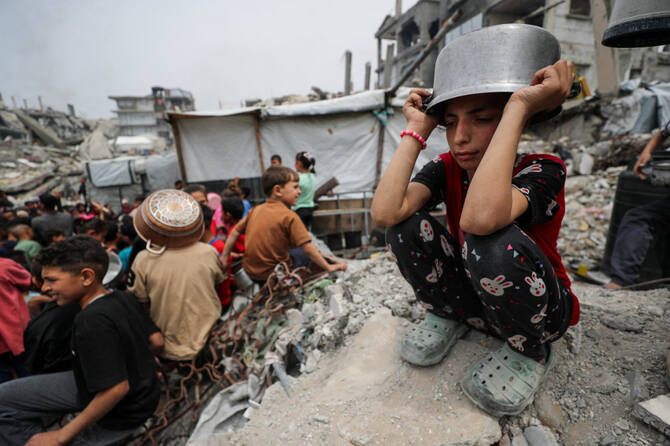
Children react as Palestinians wait to receive food cooked by a charity kitchen in Beit Lahia, northern Gaza Strip, on April 24, 2025. (REUTERS)
2 / 3
Palestinians wait to receive food cooked by a ccharity kitchen in Beit Lahia, northern Gaza Strip, on April 24, 2025. (REUTERS)
3 / 3
Palestinians wait to receive food cooked by a ccharity kitchen in Beit Lahia, northern Gaza Strip, on April 24, 2025. (REUTERS)
Short Url
Updated 26 April 2025
Follow

Canada PM Carney condemns Israeli blockade on food, says WFP must be allowed to work in Gaza

  • Food must not be used as a ‘political tool’, Carney said as he urged Israel to let the WFP do its work in Gaza
  • The UN agency earlier said it ran out of stocks due to a sustained Israeli blockade on supplies

OTTAWA: Canadian Prime Minister Mark Carney urged Israel to allow the World Food Programme to work in Gaza, saying food must not be used as a ‘political tool’, hours after the UN agency ran out of stocks due to a sustained Israeli blockade on supplies.
The WFP said on Friday it had delivered its last remaining supplies to kitchens providing hot meals in Gaza and that the facilities were expected to run out of food in the coming days.
“The UN World Food Programme just announced that its food stocks in Gaza have run out because of the Israeli Government’s blockade — food cannot be used as a political tool,” Carney said on X.


The UN agency said no humanitarian or commercial supplies had entered Gaza for more than seven weeks because all main border crossing points were closed, the longest closure the Gaza Strip had ever faced.
“Palestinian civilians must not bear the consequences of Hamas’ terrorist crimes,” Carney said. “The World Food Programme must be allowed to resume its lifesaving work.”
Israel has previously denied that Gaza is facing a hunger crisis. The military accuses the Hamas militants who run Gaza of exploiting aid, which Hamas denies, and says it must keep all supplies out to prevent the fighters from getting it.
The Gaza government media office on Friday said that famine was becoming a reality in the enclave of 2.3 million people.
Since a January ceasefire collapsed on March 18, Israeli attacks have killed more than 1,900 Palestinians, many of them civilians, according to health authorities in Gaza, and hundreds of thousands have been displaced as Israel seized what it calls a buffer zone.
An attack on Israel by Hamas in October 2023 killed 1,200 people, and 251 hostages were taken to Gaza. Since then, more than 51,300 Palestinians have been killed in the Israeli offensive in Gaza, according to health officials.
“We will continue to work with our allies toward a permanent ceasefire and the immediate return of all hostages,” Carney added.
US President Donald Trump said on Friday that he pushed Israeli Prime Minister Benjamin Netanyahu to allow food and medicine into the Gaza Strip.
Canadians will vote to elect a new government on Monday, and polls show Carney’s Liberals have a slim lead over the Conservatives.


Philippines eyes closer cooperation on advanced defense tech with UAE

Updated 7 sec ago
Follow

Philippines eyes closer cooperation on advanced defense tech with UAE

  • Philippine-UAE defense agreement is Manila’s first with a Gulf country
  • Philippines says new deal will also help modernize the Philippine military

MANILA: The Philippines is seeking stronger cooperation with the UAE on advanced defense technologies under their new defense pact — its first such deal with a Gulf country — the Department of National Defense said on Friday.

The Memorandum of Understanding on Defense Cooperation was signed during President Ferdinand Marcos Jr.’s visit to Abu Dhabi earlier this week, which also saw the Philippines and the UAE signing a comprehensive economic partnership agreement, marking Manila’s first free trade pact with a Middle Eastern nation.

The Philippines-UAE defense agreement “seeks to deepen cooperation on advanced defense technologies and strengthen the security relations” between the two countries, DND spokesperson Assistant Secretary Arsenio Andolong said in a statement.

The MoU “will serve as a platform for collaboration on unmanned aerial systems, electronic warfare, and naval systems, in line with the ongoing capability development and modernization of the Armed Forces of the Philippines,” he added.

It is also expected to further military relations through education and training, intelligence and security sharing, and cooperation in the fields of anti-terrorism, maritime security, and peacekeeping operations.

The UAE’s Ministry of Foreign Affairs has described security and defense as “very promising fields” in Philippine-UAE ties, pointing to Abu Dhabi being the location of Manila’s first defense attache office in the Middle East.

The UAE is the latest in a growing list of countries with defense and security deals with the Philippines, which also signed a new defense pact with Japan this week.

“I would argue that this is more significant than it looks on first read, precisely because it’s the Philippines’ first formal defense cooperation agreement with a Gulf state. It signals diversification,” Rikard Jalkebro, associate professor at the Anwar Gargash Diplomatic Academy in Abu Dhabi, told Arab News.

“Manila is widening its security partnerships beyond its traditional circles at a time when strategic pressure is rising in the South China Sea, and the global security environment is (volatile) across regions.”

Though the MoU is not an alliance and does not create mutual defense obligations, it provides a “framework for the practical stuff that matters,” including access, training pathways, procurement discussions and structured channels” for security cooperation, he added.

“For the UAE, the timing also makes sense, seeing that Abu Dhabi is no longer only a defense buyer; it’s increasingly a producer and exporter, particularly in areas like UAS (unmanned aerial systems) and enabling technologies. That opens a new lane for Manila to explore capability-building, technology transfer, and industry-to-industry links,” Jalkebro said.

The defense deal also matters geopolitically, as events in the Middle East and the Indo-Pacific region have ripple effects on global stability and commerce.

“So, a Philippines–UAE defense framework can be read as a pragmatic hedge, strengthening resilience and options without formally taking sides,” Jalkebro said.