

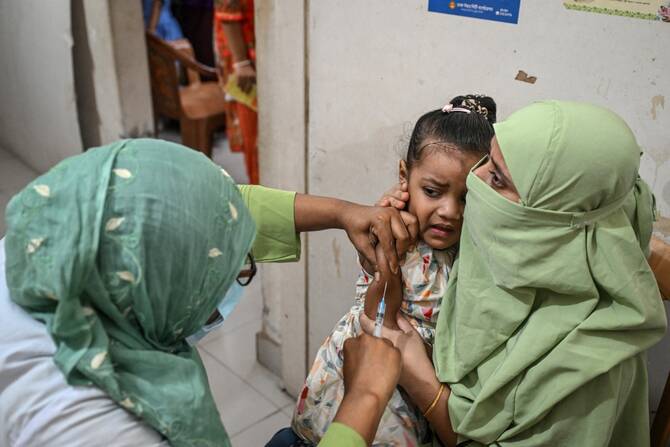

DHAKA: Bangladesh is battling its deadliest measles outbreak in recent history, following a disruption in a mass vaccination drive, doctors say, as authorities launched an emergency immunization drive for 20 million children.
More than 15,600 suspected measles cases have been reported across the country and at least 179 children have died with measles-like symptoms since March 15, Directorate General of Health Services data showed on Monday.
The number of confirmed infections is more than 2,600 — a sharp increase from 2025, when 125 cases were recorded throughout the whole year.
“I haven’t witnessed any measles outbreak in the country during the last 15 years. It’s something unprecedented,” said Prof. Nazma Begum from the pediatric department of the United Medical College in Dhaka.
“Children are coming to the hospital with symptoms of measles — including fever, along with cold, cough, and red eyes. Some children are presenting with more severe complications such as pneumonia, difficulty breathing, reduced oxygen levels ... It can definitely be fatal for children if complications develop.”
Measles is a highly contagious airborne disease, which is especially dangerous for children under five years old.
Bangladesh, a nation of 170 million people, has been able to contain measles outbreaks with routine vaccination — usually two doses given in early childhood, with the first administered at the age of nine months.
Even small gaps in coverage can lead to outbreaks. Supplementary mass immunization to prevent resurgence and boost population immunity is conducted every four to five years.
“The last campaign took place in 2020. Vaccine shortages in recent months have contributed to the current measles outbreak. The campaign should have been conducted in 2024-25,” Begum said.
The period was marked by political turmoil in the country, including mass student-led protests, the ouster of the previous administration, and rule by a caretaker government led by Nobel laureate Muhammad Yunus. A new, elected government only came to power in late February.
Health authorities finally launched the delayed drive last week, focusing on 1.2 million children in the most affected regions, and next week it will be expanded nationwide.
“It’s being administered after five and a half years. It was supposed to be delivered under the interim government. It was not done for some unknown reasons,” Prof. Dr. Halimur Rashid, director of disease control at the Directorate General of Health Services, told Arab News.
“The nationwide measles vaccination will begin on 20th April, and altogether we have a target to reach 20 million children across the country.”
The campaign is scheduled to conclude by the time of the Eid Al-Adha holiday in late May.
“We expect that the situation will improve significantly within one month, when most of the target population will be covered by the vaccination campaign,” Rashid said.
“We have a very strong infrastructure backbone for the vaccination campaign under the Expanded Program on Immunization.”
The EPI is a highly successful public health initiative, which Bangladesh launched in 1979 to target vaccine-preventable diseases such as measles, tuberculosis and diphtheria.
It provides free vaccines to children and women and has since increased coverage across the country from 2 percent in the 1980s to about 90 percent.


