
LONDON: It was a bold tactic that helped President Donald Trump topple longtime Venezuelan dictator Nicolas Maduro. Now, in the wake of the collapse of peace talks in Islamabad, Trump has ordered a US Navy blockade of the Strait of Hormuz, in a dramatic escalation aimed at forcing Tehran to submit to Washington’s terms.
The move, announced on Sunday, confirms what had until recently been speculation among US military strategists and analysts close to the administration.
“Effective immediately, the United States Navy, the Finest in the World, will begin the process of BLOCKADING any and all Ships trying to enter, or leave, the Strait of Hormuz,” Trump said on his Truth Social platform.
“Any Iranian who fires at us, or at peaceful vessels, will be BLOWN TO HELL!”

US President Donald Trump makes a fist upon arrival at Miami International Airport in Miami, on April 11, 2026. (AFP)
Even before the Islamabad talks began, a leading US military strategist with close ties to Trump had raised the possibility.
“If the war resumes and after we degrade Iran’s remaining military assets sufficiently, the US military could choose to occupy Kharg — or to destroy it,” wrote General Jack Keane in a column in the New York Post, published before Vice President JD Vance departed for Islamabad for what proved to be fruitless talks.
“Alternatively,” he added, “the US Navy could set up a blockade, shutting down Tehran’s export lifeline.”

Vessels and a boat at the Strait of Hormuz, off the coast of Oman's Musandam province, on April 12, 2026. (REUTERS)
Gen. Keane, a former vice chief of staff of the US Army, chairman of the Institute for the Study of War, and Fox News senior strategic analyst, is known to have the president’s ear. Over the past week he has appeared frequently in the media, apparently laying the groundwork for naval action.
In the early hours of Sunday morning, Trump reinforced that trajectory by posting on his Truth Social platform a link to an article highlighting a naval blockade as a key pressure tool — hours before formally ordering the move.
Naval analysts note that the USS Gerald Ford, which led the interception of sanctioned oil tankers off Venezuela last year — during which 10 vessels were seized — is now back in the region after undergoing repairs in Croatia.
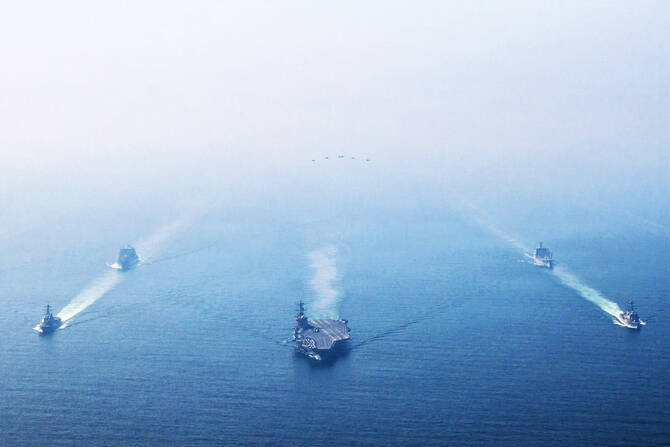
Described by the US Navy as “the most capable, adaptable, and lethal combat platform in the world,” the carrier and its battle group now joins the USS Abraham Lincoln, currently operating in the Arabian Sea.
The US, in other words, has ample naval assets in place to enforce the newly announced blockade.

The US Navy's aircraft carrier USS Gerald R. Ford departs Souda Bay on the island of Crete on February 26, 2026. (AFP)
Rebecca Grant, a national security expert at the Lexington Institute, a US security policy-focused think tank, said last week that “it would be very easy for the US Navy to exert complete control over what does and does not go up and down the Strait now.
“If Iran gets intransigent, then absolutely, the US Navy can set up with great overwater surveillance … and watch everything that goes in and out of that Strait.”
Even before the formal announcement, pressure on shipping had begun to reshape maritime traffic patterns.
A glance at marine tracking sites showed that, under pressure from Tehran, a new shipping lane had already emerged in and out of the Arabian Gulf, with vessels hugging the Iranian coastline and passing close to Qeshm Island rather than using the central channel of the Strait of Hormuz.

Far more ships, however, remain stationary, clustered off the UAE coast inside the Gulf or near Fujairah in the Gulf of Oman.
The London-based International Maritime Organization is increasingly concerned for the safety and welfare of an estimated 20,000 seafarers effectively trapped in the Gulf. Iranian threats alone had already stalled shipping, as insurers withdrew cover for vessels transiting the Strait.
When a ceasefire was briefly announced last week, Arsenio Dominguez, IMO secretary-general, said efforts were underway “to implement an appropriate mechanism to ensure the safe transit of ships through the Strait of Hormuz.”
“The priority now is to ensure an evacuation that guarantees the safety of navigation,” he added.
With talks now collapsed and a US blockade under way, the fate of those seafarers is once again uncertain.

This handout photo provided by Iran's Revolutionary Guard Corps (IRGC) official website via SEPAH News on July 28, 2020, shows an Iranian mockup imitating a US aircraft carrier being encircled by speedboats during a military exercise near the Strait of Hormuz. (AFP)
It remains unclear how the blockade will be enforced in practice — and whether the presence of US warships in the narrow waterway will reassure or further alarm shipowners and insurers.
History suggests such operations are fraught with risk.
During the so-called tanker war between 1981 and 1987, a total of 451 ships were attacked, including 259 oil tankers. Missiles accounted for most incidents, while mines damaged at least 10 vessels. The human toll included 116 killed, 167 wounded, and at least 37 missing.
If Tehran resists the blockade, the cost to Washington could rise beyond the 13 US military personnel already killed since the conflict began.
On May 17, 1987, an Iraqi missile struck the USS Stark, killing 37 crew members and injuring 21. Baghdad later said the vessel had been mistaken for an Iranian tanker.

A picture taken May 17, 1987 of American navy frigate USS Stark, which was hit by two Exocet missiles fired from an Iraqi Super-Etendard fighter during the Iran-Iraq war. (AFP)
Iran has already demonstrated an ability to disrupt GPS systems in the Gulf. Combined with the likelihood that ships on all sides may switch off their Automatic Identification System trackers to avoid detection, this could further complicate navigation.
During the tanker war, Iran relied heavily on fast attack boats — an asymmetric tactic it still retains and has yet to deploy in the current conflict. Their use could complicate enforcement of the blockade and pose risks to US naval vessels.
The dangers are not theoretical.
In November 1987, a US frigate escorting a cargo vessel opened fire on what it believed was an Iranian speedboat. It was, in fact, an Emirati fishing vessel; one crew member was killed and three injured.
INNUMBERS
• 3,300+ Iran’s official total death toll since strikes by US and Israel began on Feb. 28.
• 1,830+ Lebanon’s official toll, including Hezbollah fighters, in Israeli strikes since March 2.
• 117+ People, including militia members, killed in Iraq since outbreak of regional conflict.
• 35+ Israeli civilians and soldiers killed in Israel and Lebanon in strikes from Iran and Lebanon.
• 40+ Civilians and soldiers killed in Gulf Arab states, Syria and Palestine.
Nitya Labh, a maritime and transboundary disputes expert at think tank Chatham House, says it is not yet clear what Trump means by a blockade.
“The real question now is, how do they implement this? Even Trump has said it’ll take a little while for forces to get in place, but they’re coming quite soon,” she said.
“He has also mentioned the possibility that other allies and partners may join such an effort, but I don’t see any country committing to doing this with the US, and I also don’t know if the US could practically implement this on its own.”
However, Bob Harward, a former US Navy SEAL and former deputy commander of CENTCOM, says that “without a doubt” the navy is fully ready to tackle such a mission.
“Maritime interception is one of the key skills,” he told Arab News. "Not only do our special operations forces do it, our Marines do it, and our Coast Guard does it. Everyone has built the capability to do this.
“And we did this with Venezuela, so it’s ‘can do, will do – and should do.’ The president now has the moral high ground because they clearly don’t want to negotiate.”

A US Navy Seal Team secures the deck of a US Naval ship during a demonstration off Norfolk, Virginia,. AFP/File photo)
And, Harward predicted, “it’s going to go beyond a blockade. There are a lot more options on the table, so stand by.”
Iran has indicated that it plans to impose a toll on ships passing through the Strait of Hormuz and have them pay up in digital assets such as crypto.
But will the Gulf states, top trading nations and Global South countries agree to such demands after what they have been through in recent weeks?
In a LinkedIn post on Thursday, Sultan Al-Jaber, the UAE minister of industry and advanced technology and CEO of Adnoc, condemned Iran for restricting access and “weaponizing” access to the waterway.
“The Strait of Hormuz must be open — fully, unconditionally and without restriction. Energy security and global economic stability depend on it. The weaponization of this vital waterway, in any form, cannot stand,” he wrote.

In this April 12, 2016 US Navy handout photo, partner nation naval vessels sail in formation in the Arabian Gulf as part of the International Mine Countermeasures Exercise. IMCMEX was the largest maritime exercise in the world, with naval and civilian maritime forces from more than 30 nations spanning six continents training together across the Middle East. (US Navy photo / via AFP)
Likewise, in a reply to a parliamentary question last week, Vivian Balakrishnan, Singapore’s foreign affairs minister, ruled out engaging Iran or consider paying a toll for its vessels passing through the strait, saying that doing so would undermine fundamental principles of international law.
“There is a right of transit passage,” he said. “It is not a privilege to be granted by the bordering state, it’s not a license to be supplicated for, it is not a toll to be paid.”
Balakrishnan argued that the Strait of Hormuz, like the Strait of Malacca and the Strait of Singapore, is a waterway used for international navigation.
This right, according to him, is codified in the United Nations Convention on the Law of the Sea (UNCLOS), to which Singapore is a signatory.