

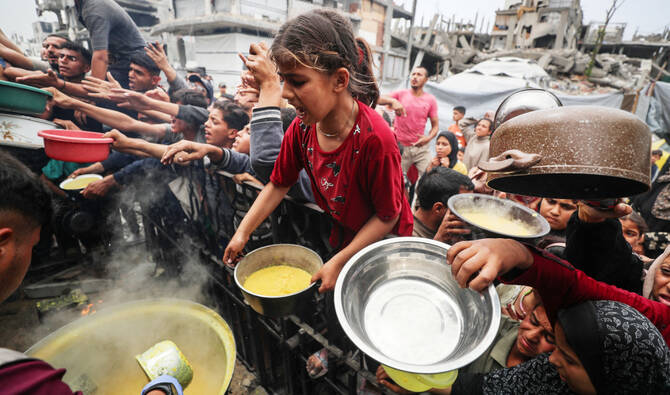

NUSEIRAT: In Gaza, where hunger gnaws and hope runs thin, flour and bread are so scarce that they are carefully divided by families clinging to survival.
“Because the crossing points are closed, there’s no more gas and no flour, and no firewood coming in,” said Umm Mohammed Issa, a volunteer helping to make bread with the few available resources.
Israel resumed military operations in the Palestinian territory in mid-March, shattering weeks of relative calm brought by a fragile ceasefire.
The UN has warned of a growing humanitarian catastrophe unfolding in the besieged territory, where Israel’s blockade on aid since March 2 has cut off food, fuel, and other essentials to Gaza’s 2.4 million people.
Once again, residents have had to resort to increasingly desperate measures to feed themselves.
Issa said the volunteers have resorted to burning pieces of cardboard to cook a thin flatbread called “saj,” named after the convex hotplate on which it is made.
“There’s going to be famine,” the Palestinian woman said, a warning international aid groups have previously issued over 18 months of war.
“We’ll be in the situation where we can no longer feed our children.”
Until the end of March, Gazans gathered outside the few bakeries still operating each morning, hoping to get some bread.
But one by one, the ovens cooled as ingredients — flour, water, salt, and yeast — ran out.
Larger industrial bakeries central to the UN’s World Food Programme operations also closed due to a lack of flour and fuel to power their generators.
On Wednesday, World Central Kitchen, or WCK, sounded the alarm about a humanitarian crisis “growing more dire each day.”
The organization’s bakery is the only one still operating in Gaza, producing 87,000 loaves of bread daily.
“Bread is precious, often substituting for meals where cooking has stopped,” it said.
“I built a clay oven to bake bread to sell,” said Baqer Deeb, a 35-year-old father from Beit Lahia in northern Gaza.
He has been displaced by the fighting, like almost the entire population of the territory, and is now in Gaza City.
“But now there’s a severe shortage of flour,” he said, “and that is making the bread crisis even worse.”
There is no longer much food for sale at makeshift roadside stalls, and prices are climbing, making many products unaffordable for most people.
Fidaa Abu Ummayra thought she had found a real bargain when she bought a large sack of flour for €90 at Al-Shati refugee camp in the north of the territory.
“If only I hadn’t bought it,” the 55-year-old said. “It was full of mold and worms. The bread was disgusting.”
Before the war, a typical 25-kilo sack like the one she bought would have gone for less than €10,
“We are literally dying of hunger,” said Tasnim Abu Matar in Gaza City.
“We count and calculate everything our children eat, and divide up the bread to make it last for days,” the 50-year-old added.
“We can’t take it anymore.”
People rummage through debris searching for something to eat as others walk for kilometers (miles) to aid distribution points, hoping to find food for their families.
Germany, France, and Britain on Wednesday called on Israel to stop blocking humanitarian aid into Gaza, warning of “an acute risk of starvation, epidemic disease and death.”
According to the UN humanitarian agency OCHA, displaced people at more than 250 shelters in Gaza had no or limited access to enough food last month.
Hamas, whose unprecedented Oct. 7, 2023, attack on southern Israel ignited the war, accuses Israel of using starvation as a weapon of war.


