
DUBAI: In the aftermath of an unprecedented number of Israeli airstrikes on Beirut and other parts of Lebanon, concerns among the international community are rising about the possibility of a new phase of escalation in the Middle East.
Lebanon was targeted without warning by about 100 strikes in the space of just 10 minutes on Wednesday, killing or injuring hundreds of people.
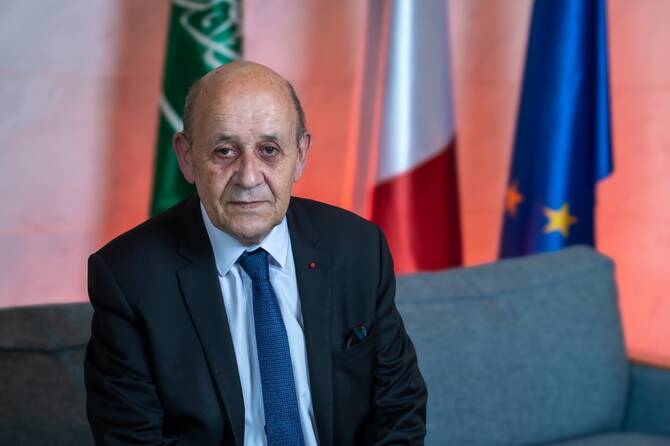
Jean-Yves Le Drian, executive president of the French Agency for the Development of AlUla, the personal envoy of the French president for Lebanon, and a former minister of defense and foreign affairs, told Arab News en Francais that the scale of the attacks marked a critical threshold.
He described the strikes as “unacceptable” and causing “terrifying carnage,” and noted that they took place just hours after the main parties to the conflict in the region, including the US and Iran, had announced a ceasefire in the conflict that began on Feb. 28.
Le Drian said the truce was essential but had already been undermined. It was “clear in its principles, unambiguous, and should have applied across the region, including Lebanon,” he added, yet its effect has been negated by the continuation of military operations.
By striking Beirut, he said, Israel was acting “against the diplomatic momentum that enabled the ceasefire.” This contradiction means the situation is “extremely serious” and is fueling widespread mistrust among all parties, he added.
Lebanon has become a secondary theater in a regional confrontation beyond its control, Le Drian said, as the fighting continues there even though the main protagonists in the wider conflict are not directly linked to the country. He fears it is a situation that jeopardizes fundamental aspects of the Lebanese state.
“What is at stake today is Lebanon’s integrity and sovereignty,” he warned, describing the country as trapped in an external confrontation.
Despite its shortcomings the truce agreement remains a strategic necessity, he believes. It was intended to halt a downward spiral deemed “unacceptable” both for regional stability and the global economy, he said, but its fragility is evident.
“Each side suspects the other of lies, misinterpretation or hiding its intentions,” he said, and the continuing strikes on Lebanon prevent any real chance of stabilizing the situation.
Le Drian clearly identified the role of Hezbollah in stoking the crisis, given its links with Iran, including the group’s initial cycle of strikes against Israel. At the same time, he denounced the Israeli response as “completely disproportionate.”
This creates a potential paradox, he warned: Rather than weakening Hezbollah, the intensification of the Israeli strikes might actually strengthen the group’s influence.
“The escalation today indirectly reinforces Hezbollah’s role, which is positioning itself as the protector of the nation,” Le Drian said.
Against this backdrop he issued a stark warning: “Hezbollah must choose: either Lebanon or Iran. There is no alternative.”
He said he hoped the choice would favor the welfare of the Lebanese state, and noted that the country currently has a “government of quality,” which he described as responsible and committed to strengthening the state. He pointed out that it has pledged to work to ensure that the state has a monopoly on weapons by disarming other groups.
But he added that “this government is today under strain due to the worsening crisis,” and stressed the need to provide it with support, particularly from international partners, including the Gulf countries.
Despite the intensity of the current hostilities, Le Drian believes there is still a political path to peace. The Lebanese government recently proposed direct talks with Israeli authorities, an initiative he described as a “considerable” gesture. He views it as a rare opportunity that could mark a turning point if seized. War offers no lasting solutions, he added, so it is vital that the central role of negotiation is restored.
The Gulf states, which have been indirectly affected by the conflict with Iran, have emerged as key players in deescalation efforts, Le Drian said, and back mediation efforts.
“There has been an offer for negotiation … with the support of several Gulf countries, particularly Saudi Arabia,” he added.
Since the beginning of the crisis, France has continued to support Saudi Arabia in its defense, Le Drian said. “We are helping the Saudis to ensure their own security, and the French president speaks very often with His Royal Highness the Crown Prince to work in that direction,” he added, stressing the continuity of Franco-Saudi dialogue on regional security issues.
Such involvement opens the door for a broader redefinition of regional security based on “collective security,” he said.
As for the continuing Israeli military operations in southern Lebanon, Le Drian warned: “Any occupation intervention by Israel in Lebanon is contrary to international law.”
Previous interventions of this kind helped to strengthen Hezbollah, he said, an outcome that must not be repeated.
Beyond the strategic issues arising from the conflict, the humanitarian situation in Lebanon is rapidly deteriorating.
“The Israeli intervention has displaced almost a million people who are now surviving on the streets,” Le Drian said.
He warned that the situation could quickly get even worse, with potentially serious consequences for Lebanon’s internal cohesion.
France continues to act in response to this crisis, he added. It provides support for the Lebanese Armed Forces, notably through recent deliveries of armored vehicles, and its humanitarian aid efforts continue.
One of its main goals is to help strengthen the core functions of Lebanese state, in particular its ability to achieve and maintain a monopoly on force.
Should the current conflict continue, it can only result in deadlock, Le Drian said. All parties are aware of this, he added, and so the need for a return to the pursuit of a diplomatic solution is more urgent than ever.
“France has always considered that conflicts must be resolved through negotiation,” he said, adding that the parameters for an agreement already exist: “It is on the table; it must be discussed.”
Regarding the wider regional and international stakes in the crisis, particularly its effects on international shipping, Le Drian warned that “freedom of navigation in the Strait of Hormuz is essential” and any further disruption could create “considerable difficulties for the global economy.”
A number of initiatives are already under consideration to secure this strategic waterway, he added, including maritime escorts once the deescalation process is sufficiently advanced.
To that end, the French president, Emmanuel Macron, and the British prime minister, Keir Starmer, have mobilized a group of countries in support of the secure transit of shipping in the Gulf.
In a tense moment for the region, Le Drian said, Lebanon finds itself at a potentially decisive point in its history, poised between total collapse and a potential resolution of crisis through diplomacy.
• This article originally appeared in French on Arab News en français.