ANDONG, South Korea: Wildfires raging in South Korea doubled in size on Thursday from a day earlier, as authorities called the blazes the country’s worst natural fire disaster with at least 28 people killed and historic temples incinerated.
More than 38,000 hectares (93,900 acres) have been charred or were still burning in the largest of the fires that began in the central Uiseong county, making it the biggest single forest fire in South Korea’s history. The previous record was 24,000 hectares (59,000 acres) in a March 2000 fire.
“We are nationally in a critical situation with numerous casualties because of the unprecedented rapid spread of forest fires,” Acting President Han Duck-soo told a government response meeting.
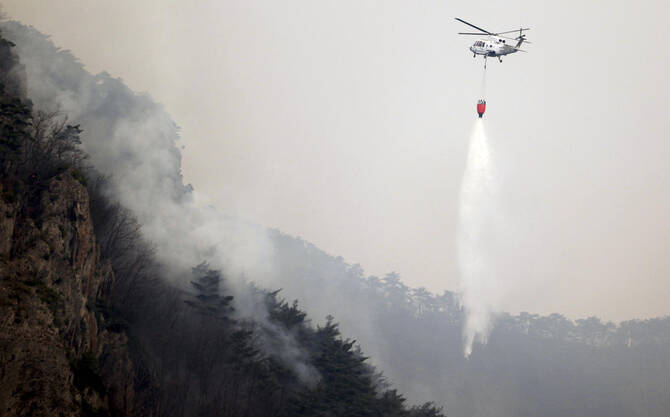
The military has released stocks of aviation fuel to help keep firefighting helicopters flying to douse flames across mountainous regions in the southeast of the country where fires have been burning now for nearly a week.
More than 120 helicopters have been deployed in three regions battling the blazes, the safety ministry said. South Korea relies on helicopters to fight forest fires because of its mountainous terrain. A helicopter pilot died on Wednesday after crashing while trying to tackle a blaze.
The wildfires that originated in Uiseong have been moving rapidly eastward, spreading almost to the coast, carried by gusty winds and with dry conditions aggravating the situation.
The Uiseong fire began spreading quickly on Wednesday, reaching the coastal county of Yeongdeok about 50 km (30 miles) away in just 12 hours, said Won Myung-soo, director of satellite imagery analysis for the national forestry service.
On Thursday evening, it rained briefly in some parts of the affected region. Precipitation of around one millimeter was too little to extinguish the main fire, but will help contain it, officials said.
About the same amount of rain is expected for some areas on Friday.
Experts have said the Uiseong fire showed extremely unusual spread in terms of its scale and speed, and that climate change is expected to make wildfires more frequent and deadly globally.
Higher temperatures amplified by human-caused climate change contributed to the existing seasonally dry conditions, “turning dry landscapes into dangerous fire fuel” in the region, the Climate Central group, an independent body made up of scientists and researchers, said in a report.
The wildfires have carved a trail of devastation through an area equivalent to about half of Singapore, ravaging everything in their path including historic temples and homes in the mountainous forest regions of North Gyeongsang province.
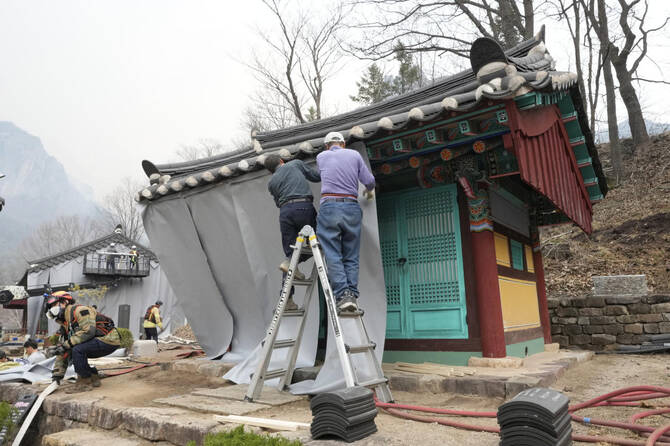
Teams of firefighters are on standby to protect the UNESCO World Heritage sites of Hahoe Village and the Byeongsan Confucian Academy in the city of Andong, if a blaze jumps the stream that flows around them.
The picturesque folk village has traditional Korean houses, many with thatched roofs, while the Confucian academy dates back more than 450 years.
The fires have already badly damaged other historic sites, including much of Gounsa Temple in Uiseong, which was built in 681.
“The buildings and remains of what Buddhist monks have left over 1,300 years are now all gone,” said Deungwoon, the head of the Gounsa Temple.


South Korea battles worst ever wildfires as death toll hits 28

https://arab.news/6zqfq
South Korea battles worst ever wildfires as death toll hits 28

- “We are nationally in a critical situation with numerous casualties because of the unprecedented rapid spread of forest fires,” Acting President Han Duck-soo said
- The wildfires that originated in Uiseong have been moving rapidly eastward, spreading almost to the coast


Starmer arrives in China to defend ‘pragmatic’ partnership
- British Prime Minister Keir Starmer arrived in Beijing on Wednesday to meet with Chinese leader Xi Jinping, hoping to restore long fraught relations
BEIJING: British Prime Minister Keir Starmer arrived in Beijing on Wednesday to meet with Chinese leader Xi Jinping, hoping to restore long fraught relations.
It is the first visit to China by a UK prime minister since 2018 and follows a string of Western leaders courting Beijing in recent weeks, pivoting from a mercurial United States.
Starmer, who is also expected to visit Shanghai on Friday, will later make a brief stop in Japan to meet with Prime Minister Sanae Takaichi.
For Xi, the trip is an opportunity to show Beijing can be a reliable partner at a time when President Donald Trump’s policies have rattled historic ties between Washington and its Western allies.
Starmer is battling record low popularity polls and hopes the visit can boost Britain’s beleaguered economy.
The trip has been lauded by Downing Street as a chance to boost trade and investment ties while raising thorny issues such as national security and human rights.
Starmer will meet with Xi for lunch on Thursday, followed by a meeting with Premier Li Qiang.
The British leader said on Wednesday this visit to China was “going to be a really important trip for us,” vowing to make “some real progress.”
There are “opportunities” to deepen bilateral relations, Starmer told reporters traveling with him on the plane to China.
“It doesn’t make sense to stick our head in the ground and bury in the sand when it comes to China, it’s in our interests to engage and not compromise on national security,” he added.
China, for its part, “is willing to take this visit as an opportunity to enhance political mutual trust,” foreign ministry spokesman Guo Jiakun reiterated Wednesday during a news briefing.
Starmer is the latest Western leader to be hosted by Beijing in recent months, following visits by Canadian Prime Minister Mark Carney and French President Emmanuel Macron.
Faced with Trump’s threats to impose tariffs on Canada for signing a trade agreement with China, and the US president’s attempts to create a new international institution with his “Board of Peace,” Beijing has been affirming its support for the United Nations to visiting leaders.
Reset ties
UK-China relations plummeted in 2020 after Beijing imposed a sweeping national security law on Hong Kong, which severely curtailed freedoms in the former British colony.
They soured further since with both powers exchanging accusations of spying.
Starmer, however, was quick to deny fresh claims of Chinese spying after the Telegraph newspaper reported Monday that China had hacked the mobile phones of senior officials in Downing Street for several years.
“There’s no evidence of that. We’ve got robust schemes, security measures in place as you’d expect,” he told reporters on Wednesday.
Since taking the helm in 2024, Starmer has been at pains to reset ties with the world’s second-largest economy and Britain’s third-biggest trade partner.
In China, he will be accompanied by around 60 business leaders from the finance, pharmaceutical, automobile and other sectors, and cultural representatives as he tries to balance attracting vital investment and appearing firm on national security concerns.
The Labour leader also spoke to Xi on the sidelines of the G20 summit in Brazil in November 2024.
Jimmy Lai
The prime minister is also expected to raise the case of Hong Kong media mogul and democracy supporter Jimmy Lai, 78, a British national facing years in prison after being found guilty of collusion charges in December.
When asked by reporters about his plans to discuss Lai’s case, Starmer avoided specifics, but said engaging with Beijing was to ensure that “issues where we disagree can be discussed.”
“You know my practice, which is to raise issues that need to be raised,” added Starmer, who has been accused by the Conservative opposition of being too soft in his approach to Beijing.
Reporters Without Borders urged Starmer in a letter to secure Lai’s release during his visit.
The British government has also faced fierce domestic opposition after it approved this month contentious plans for a new Chinese mega-embassy in London, which critics say could be used to spy on and harass dissidents.
At the end of last year, Starmer acknowledged that China posed a “national security threat” to the UK, drawing flak from Chinese officials.
The countries also disagree on key issues including China’s close ties with Russian President Vladimir Putin amid the war in Ukraine, and accusations of human rights abuses in China.


