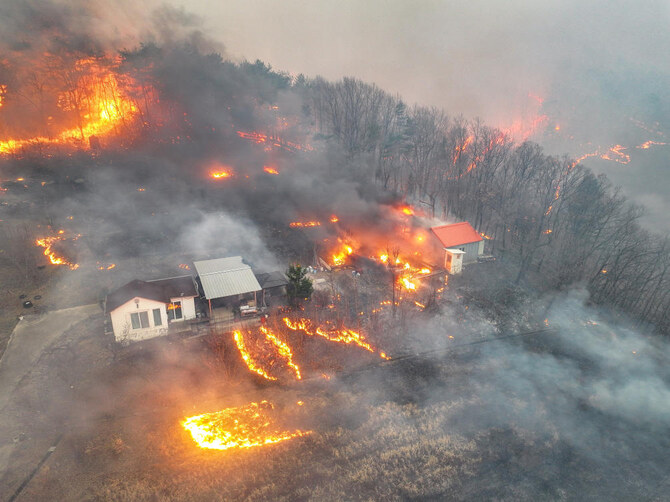
UISEONG, South Korea: Deadly wildfires in South Korea worsened overnight, officials said Tuesday, as dry, windy weather hampers efforts to contain one of the country’s worst-ever fire outbreaks.
More than a dozen different blazes broke out over the weekend, with the safety minister reporting thousands of hectares burned and four people killed.
“The wildfires have so far affected approximately 14,694 hectares (36,310 acres), with damage continuing to grow,” acting Interior and Safety Minister Ko Ki-dong said.
The extent of damage would make the fires collectively the third-largest in South Korea’s history. The largest was an April 2000 blaze that scorched 23,913 hectares (59,090 acres) across the east coast.
More than 3,000 people have been evacuated to shelters, Ko said. At least 11 people have been seriously injured.
“Strong winds, dry weather, and haze are hampering firefighting efforts,” Ko told a disaster and safety meeting.
The government is “mobilizing all available resources,” he said, and today, “110 helicopters and more than 6,700 personnel will be deployed.”
In Uiseong, the sky was full of smoke and haze, AFP reporters saw. Workers at a local temple were attempting to move historical artefacts and cover up Buddhist statues to protect them from possible damage.
The Korea Forest Service said the containment rate for the fire in Uiseong decreased from 60 to 55 percent by Tuesday morning.
More than 6,700 firefighters have been deployed to battle the wildfires, according to the Ministry of Interior and Safety, with nearly two-fifths of the personnel dispatched to Uiseong.
The government declared a state of emergency in four regions, citing “the extensive damage caused by simultaneous wildfires across the country.”
Some types of extreme weather have a well-established link with climate change, such as heatwaves or heavy rainfall.
Other phenomena, such as forest fires, droughts, snowstorms and tropical storms can result from a combination of complex factors.


![]()

South Korea struggles to contain deadly wildfires
Short Url
https://arab.news/y34d9
South Korea struggles to contain deadly wildfires
- More than a dozen different blazes broke out over the weekend
- The safety minister has reported thousands of hectares burned


Latest updates


Recommended


© 2026 SAUDI RESEARCH & PUBLISHING COMPANY, All Rights Reserved And subject to Terms of Use Agreement.