ISLAMABAD: Pakistan described Israel’s continued airstrikes in Syria as “unacceptable” at the United Nations Security Council on Tuesday, saying they constituted a breach of Syrian sovereignty and must cease immediately, as the council met to discuss the political and humanitarian situation in the Arab state.
Israel has intensified its military activity in Syria following the downfall of Bashar Assad’s regime in late 2024, citing security concerns over the alleged presence of hostile elements near its borders. The Israeli government has also declared an open-ended military presence in the area, framing it as necessary to and to secure its northern frontier.
In parallel, Israel has also reaffirmed and expanded its hold over the Golan Heights, a territory it captured from Syria in 1967 and later annexed, a move unrecognized by much of the international community. Its recent plans to double the settler population in the Golan have drawn criticism, with various international players warning that Israel’s actions risk further destabilizing an already volatile region.
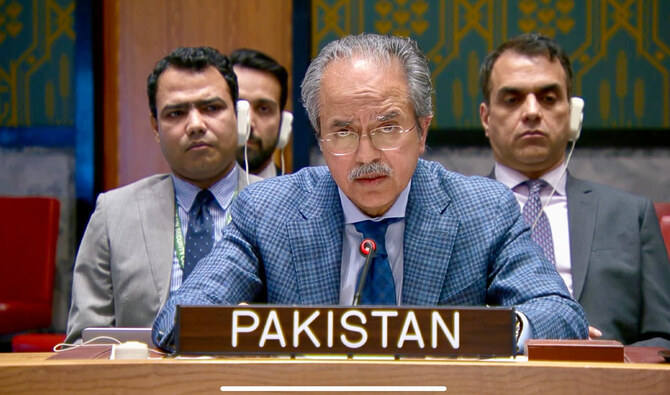
Pakistan’s Permanent Representative-designate to the UN, Ambassador Asim Iftikhar Ahmad, condemned what he called Israel’s “military escalation” in Syria, urging the Security Council to hold Tel Aviv accountable.
“Israel’s repeated and continuing incursions and airstrikes into Syrian territory, continued violations of the 1974 Disengagement of Forces Agreement, and its declared intent for an ‘indefinite’ presence and ‘full demilitarization of southern Syria’ are unacceptable, constitute blatant violations of Syria’s sovereignty and territorial integrity, and undermine international law and regional stability,” Ahmad said during his comments.
He maintained that Israel’s actions were in direct contravention of the council’s March 14 Presidential Statement, which reaffirmed Syria’s sovereignty and called on all states to refrain from interference that could further destabilize the country.
“Israel must cease its incursions forthwith and this council must hold Israel to its obligations,” he added.
Addressing the broader situation in Syria, Ahmad said the Arab state’s multifaceted challenges — political, economic, security and humanitarian — required a “holistic and coordinated response.”
He reaffirmed Pakistan’s support for a Syrian-led and Syrian-owned political process, calling it key to achieving lasting peace.
Welcoming Syria’s new interim Constitution as a “critical step” toward restoring the rule of law, Ahmad also described last month’s National Dialogue Conference as a “positive development.”
He expressed hope that the forthcoming appointment of an interim government, legislative council, and constitutional committee would reflect Syria’s diversity and promote inclusive governance.
Ahmad warned that Syria’s economic crisis — marked by cash shortages, fuel deficits, and rising prices — was worsening the humanitarian situation.
He called for robust international support for the UN’s transitional action plan focused on poverty reduction, refugee reintegration and institutional capacity-building.
“In this regard, lifting of unilateral sanctions is imperative to facilitating reconstruction and aid efforts,” he said, adding that a reassessment and drawdown of the UN sanctions regime was also warranted to ensure that vital economic and humanitarian initiatives were not obstructed.


![]()

Pakistan criticizes Israeli strikes in Syria, calls them ‘unacceptable’ breach of sovereignty
Short Url
https://arab.news/2wu44
Pakistan criticizes Israeli strikes in Syria, calls them ‘unacceptable’ breach of sovereignty
- Israel has intensified its military activity in Syria following the downfall of the Assad regime, citing security concerns
- Ambassador Asim Iftikhar Ahmad says Israel must cease its incursions and the UNSC must hold Tel Aviv accountable


Latest updates


© 2026 SAUDI RESEARCH & PUBLISHING COMPANY, All Rights Reserved And subject to Terms of Use Agreement.