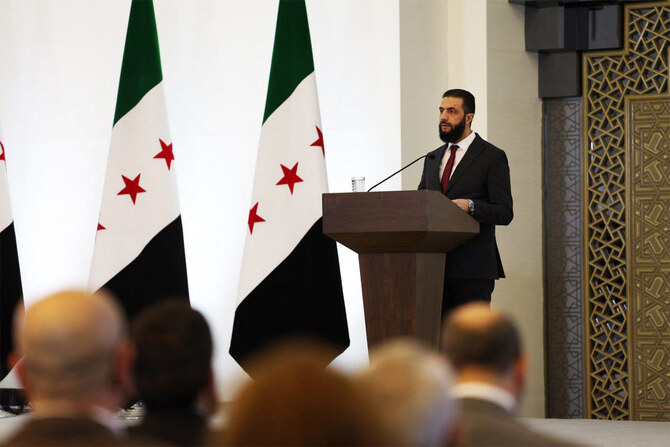
DAMASCUS: Participants in Syria’s national dialogue conference affirmed on Tuesday their rejection of “provocative” statements by Israeli Prime Minister Benjamin Netanyahu, who has said no Syrian armed forces should be deployed south of Damascus.
In a closing statement read out by Houda Atassi, a member of the conference’s preparatory committee, the attendees stressed their “rejection of the provocative statements by the Israeli prime minister.”
They also called on the international community to pressure Israel to stop any “aggression and violations,” while condemning “the Israeli incursion into Syrian territory.”
On Sunday, Netanyahu said: “We will not allow forces from the HTS organization or the new Syrian army to enter the area south of Damascus,” referring to the Islamist group Hayat Tahrir Al-Sham which spearheaded the offensive that toppled Bashar Assad in December.
“We demand the complete demilitarization of southern Syria, including the Quneitra, Daraa and Suwayda provinces,” the Israeli prime minister declared at a military ceremony.
In Suwayda city, whose surrounding province is predominantly Druze Arab, hundreds of people gathered to protest against Netanyahu.
In Damascus, dozens of protesters gathered outside the headquarters of the United Nations, AFP photographers reported.
“I am here to support the people of my country and to affirm that Syria is sovereign over its entire territory,” Marwa Al-Maqbil, an artist at the protest, told AFP.
There were similar protests in Daraa and Quneitra in the south, in Latakia and Tartus in the west and in Aleppo in the north of Syria, according to the official SANA news agency.
Before the overthrow of Assad, his forces abandoned their positions in the south of the country ahead of the arrival of armed rebels in Damascus.
At the time, Israel launched an incursion into the UN-patrolled buffer zone between Israeli and Syrian forces on the Golan Heights.
It also launched hundreds of air strikes on Syrian military positions, saying it was moving to prevent strategic weapons from falling into the hands of groups hostile to Israel.
On Sunday, Netanyahu said Israeli troops would remain in the buffer zone “for an indefinite period to protect our communities and thwart any threat.”


![]()

Syria conference denounces ‘provocative’ Israeli remarks, military presence
Short Url
https://arab.news/8qq7x
Syria conference denounces ‘provocative’ Israeli remarks, military presence
- Syria called on the international community to pressure Israel to stop any “aggression and violations"
- Israeli Prime Minister Benjamin Netanyahu said no Syrian armed forces should be deployed south of Damascus


Latest updates


© 2026 SAUDI RESEARCH & PUBLISHING COMPANY, All Rights Reserved And subject to Terms of Use Agreement.