

Saudi, Pakistani private entities sign agreement to launch $500 million joint venture projects

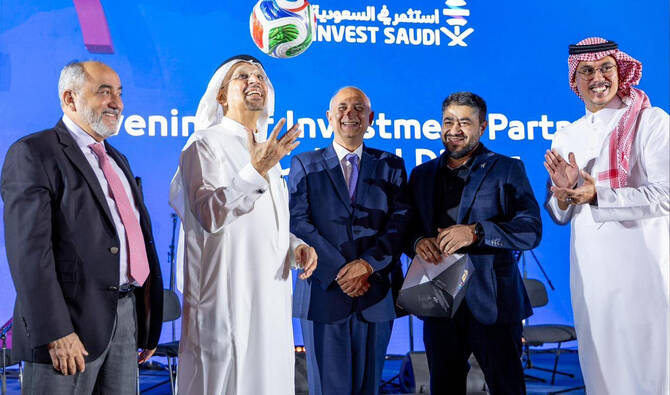
Officials of PREF and Saudi Bridge sign a memorandum of understanding (MoU) to establish a bilateral platform to encourage investments in joint venture projects worth $500 million, in Riyadh, Saudi Arabia, on February 3, 2026. (Haroon Sharif)
Short Url
Updated 09 February 2026
Follow

Saudi, Pakistani private entities sign agreement to launch $500 million joint venture projects

  • Pakistan Regional Economic Forum, Saudi Bridge private entities sign MoU in Riyadh to establish “Saudi-Pakistan Bridge Initiative“
  • Initiative to accelerate private sector investment flows, cross-border economic partnerships between Islamabad, Riyadh, regional nations

Karachi: The Pakistan Regional Economic Forum (PREF) and Saudi Bridge, two private business entities, this month signed a memorandum of understanding (MoU) to establish a bilateral platform that would encourage investments in joint venture projects worth $500 million, the PREF’s chairman confirmed on Monday. 

The PREF is a regional advisory private sector forum registered in Pakistan that says it facilitates the development of the regional market through multi-country joint ventures. Led by Pakistan’s former chairman of the Board of Investment, Haroon Sharif, PREF says it is supported by the Chinese government, other regional countries and private sector organizations.

Saudi Bridge is also a private sector entity that says on its website that it enables mutual understanding and creates opportunities between Saudi Arabia and other stakeholders around the world. Saudi Bridge says it delivers solutions that helps businesses and governments achieve sustainable, long-term impact. These solutions include market entries, strategic matchmakings, hosting delegations and ecosystem activations.

The PREF and Saudi Bridge signed the MoU in Riyadh on Feb. 3 to establish the “Saudi-Pakistan Bridge Initiative,” a joint statement by both sides said. The bridge initiative is a bilateral platform designed to accelerate private sector investment flows, market entry and cross-border economic partnerships between Saudi Arabia, Pakistan and other regional countries, the statement said. 

“PREF and Saudi Bridge are working on $500 million joint venture projects between the two countries and are also aiming to reach out to China and other countries,” Sharif told Arab News. 

The bridge initiative will function as an activation platform, enabling transaction-oriented collaboration between investors, enterprises, funds and ecosystem stakeholders, the joint statement said. 

The initiative will cover sectors such as energy, mining, sports goods manufacturing, logistics, food, agri-processing, health care, technology, industrial manufacturing, construction, and strategic services.

The platform will roll out sector-focused delegations, market entry and soft-landing programs, regulatory workshops, joint investment forums and a One-Stop Bridge Desk to support bilateral engagement over its initial three-year term, the joint statement added. 

Sharif clarified that projects part of the bridge would be executed in both countries. 

“In some cases, the production capacity will be enhanced here,” he said. “In some cases manufacturing will start in Saudi Arabia with the help of Pakistani expertise and Chinese technology.”

The agreement takes place as Pakistan and Saudi Arabia move to broaden their economic and defense cooperation in recent months. The two countries signed a strategic defense pact in September 2025, according to which both pledged to treat an attack against one of them as aggression against both. 

In October, both nations agreed to launch an economic cooperation framework to strengthen bilateral trade and investment relations.


Pakistan deputy PM speaks with Iranian FM as Saudi Arabia intercepts missiles and drones

Updated 06 March 2026
Follow

Pakistan deputy PM speaks with Iranian FM as Saudi Arabia intercepts missiles and drones

  • Ishaq Dar expresses concern over evolving regional situation as both officials agree to remain in contact
  • Pakistan earlier reminded Tehran of its mutual defense pact with Saudi Arabia during diplomatic outreach

ISLAMABAD: Pakistan’s Deputy Prime Minister and Foreign Minister Ishaq Dar spoke with Iranian Foreign Minister Seyyed Abbas Araghchi on Friday amid escalating tensions in the Gulf, including recent missile and drone attacks targeting Saudi Arabia that were intercepted by the Kingdom’s air defenses.

The call comes as Islamabad remains in contact with both Tehran and Gulf states to prevent the widening Iran conflict from spilling further across the region, particularly after attempted strikes on Saudi territory, a sensitive development for Pakistan, which signed a mutual defense pact with the Kingdom last year.

Pakistan’s foreign ministry said Dar raised concerns about the evolving regional situation during the conversation.

“Deputy Prime Minister/Foreign Minister Senator Mohammad Ishaq Dar spoke this evening with the Foreign Minister of Iran, Seyyed Abbas Araghchi,” the ministry said in a statement.

“The DPM/FM expressed concern over the evolving regional situation. The two agreed to remain in touch on the developments,” it added.

The ministry did not share details of the conversation, though it came amid fast-moving developments in the region, with Saudi Arabia saying its air defenses intercepted multiple missiles and drones early on Friday.

Earlier this week, Prime Minister Shehbaz Sharif’s adviser on political affairs Rana Sanaullah said Pakistan was in contact with Iran to discourage attacks on Gulf countries and prevent misunderstandings.

“Such attacks should not be carried out from Iran’s side,” he told Geo TV.

Prior to that, the deputy prime minister told Pakistan’s Senate that Islamabad had engaged both Iran and Saudi Arabia at the outset of Iran’s retaliation in the region, reminding Tehran of its defense agreement with Saudi Arabia and conveying assurances from Riyadh that Saudi territory would not be used against Iran.

Pakistan says its administration is striving to end the conflict, though the United States-Israeli strikes on Iran, which triggered the war and led to its spillover, have only intensified.

Iranian President Masoud Pezeshkian said on Friday some countries had begun mediation efforts but insisted Tehran would defend its sovereignty.

Meanwhile, US President Donald Trump has called for Iran’s “unconditional surrender” on his Truth Social platform as the confrontation shows little sign of easing.
