

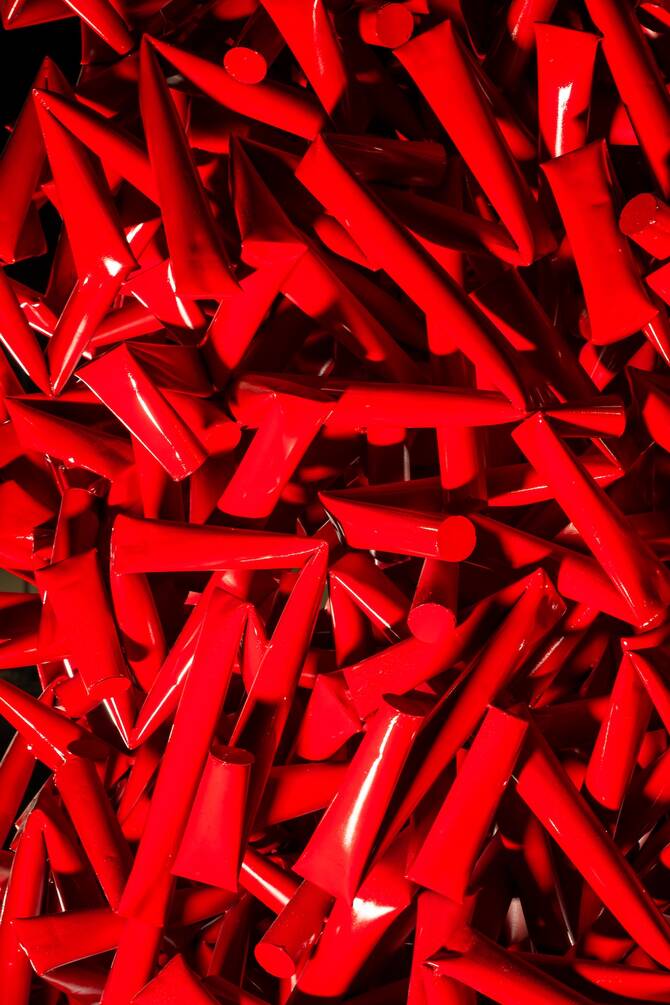
Seventh Tuwaiq Sculpture Exhibition opens with completed works on display

1 / 5
(Supplied)
2 / 5
(Supplied)
3 / 5
(Supplied)
4 / 5
(Supplied)
5 / 5
(Supplied)
Short Url
Updated 09 February 2026
Follow

Seventh Tuwaiq Sculpture Exhibition opens with completed works on display

RIYADH: This year’s Tuwaiq Sculpture Exhibition has officially opened on Al-Tahlia street, free of charge to members of the public.

Now in its seventh iteration, the exhibition runs from Feb. 9 to Feb. 22, showcasing the work of Saudi and international artists.

It features 25 new large-scale sculptures created during a live sculpting phase held from Jan. 10 to Feb. 5, allowing visitors to witness the artistic process as it was underway.

Working with locally sourced stone and reclaimed metal, artists transformed raw materials into visually stunning works.

Artists from 18 countries took part, with 650 people applying to take part in the symposium this year.

The sculptures represent diverse artistic interpretations of the symposium’s theme — “Traces of What Will Be” — addressing ideas of memory, responsible use of resources, environmental innovation and the impact of human intervention in natural and urban contexts.

The curation was overseen by Lulwa Al-Homoud, Sarah Staton and Rut Blees Luxemburg, who have a wealth of expertise in public art, spatial practice and contemporary visual culture.

An interactive program accompanies the exhibition, including workshops, panel talks and educational visits.

All artworks produced during the Tuwaiq 2026 event will join the permanent Riyadh Art Collection and will be installed at prominent public locations across the city in the future, extending the program’s impact beyond the exhibition period and integrating contemporary sculpture into public spaces across the city.

Since it began in 2019, the Tuwaiq symposium has brought together more than 170 local and international artists, with each event contributing new works to Riyadh Art’s permanent collection.

To date, more than 60 sculptures from past events have been permanently installed across the city, with additional works scheduled for installation in future phases, reflecting the program’s long-term approach to expanding public art across Riyadh.


Saudi Arabia’s KAUST named FIFA’s first research institute in MENA

The canal in the King Abdullah University of Science and Technology campus. (Shutterstock)
Updated 10 February 2026
Follow

Saudi Arabia’s KAUST named FIFA’s first research institute in MENA

  • KAUST President Prof. Sir Edward Byrne said that the university’s selection as the fifth FIFA Research Institute in the world — and the first in the region — marks a significant achievement, reflecting Kingdom’s growing presence in international football

RIYADH: FIFA has designated the King Abdullah University of Science and Technology as its first research institute in the Middle East and Asia to support the development of innovative football research, the Saudi Press Agency reported on Tuesday.

The recognition highlights KAUST’s commitment to integrating sports, academic research and industry through advanced, high-level initiatives grounded in rigorous scientific methodologies, contributing to the advancement of football studies.

KAUST President Prof. Sir Edward Byrne said that the university’s selection as the fifth FIFA Research Institute in the world — and the first in the region — marks a significant achievement, reflecting Saudi Arabia’s growing presence in international football.

The accreditation aligns with national efforts to invest in research and development and promote the knowledge economy, supporting Saudi Vision 2030’s goals of building an advanced sports system based on innovation and sustainability.

The collaboration’s first project focuses on developing advanced AI algorithms to analyze historical FIFA World Cup broadcast footage, transforming decades of match videos into structured, searchable data, according to the KAUST website.

This work opens new opportunities to apply state-of-the-art computer vision techniques and deepen understanding of how football has evolved over time.

The second project uses player and ball tracking data from the FIFA World Cup 2022 in Qatar and the FIFA Women’s World Cup 2023 in Australia and New Zealand to compile comprehensive datasets capturing in-game dynamics.

These datasets provide deeper insights into human movement, playing techniques and performance dynamics through AI-driven analysis.