

Agreements signed to strengthen Royal Saudi Air Force fleet

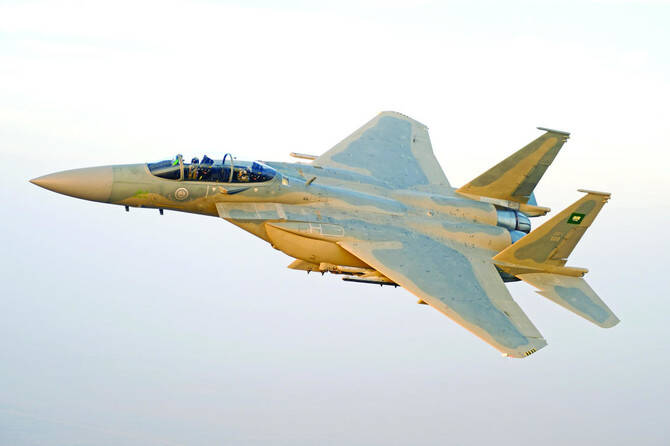
File photo of a Royal Saudi Air Force F-15SA. (SUPPLIED)
Short Url
Updated 09 February 2026
Follow

Agreements signed to strengthen Royal Saudi Air Force fleet

  • A number of agreements have been signed during the opening days of the World Defense Show in Riyadh

RIYADH: A number of agreements have been signed during the opening days of the World Defense Show in Riyadh this week to enhance the operational readiness of the Royal Saudi Air Force’s F110 jet engines.

GE Aerospace signed agreements with Saudi Arabia’s General Authority for Military Industries, or GAMI, and the Middle East Propulsion Company.

With GAMI, GE Aerospace signed an industrial participation agreement to enhance F110 repair capabilities and strengthen maintenance, repair and overhaul — or MRO — skills.

A memorandum of understanding was also signed between the two entities to explore building a globally competitive industrial base and accelerating the Kingdom’s manufacturing roadmap in the aerospace sector.

GE Aerospace and the MEPC signed three agreements to ensure vital material support as well as repair and overhaul services for the engine fleet.

The two companies have worked together for more than a decade to support Saudi Arabia’s F110 fleet, which is the world’s largest outside of the US.

Nawaf Albawardi, deputy governor for the localization sector of GAMI, said in a statement that the agreement “will contribute to strengthening GAMI’s ongoing efforts to localize and develop the military industries sector.”

Mohammed Al-Nawkhani, managing director, MEPC, added: “These agreements represent the next phase of our strategic partnership with GE Aerospace and a major step forward in enhancing readiness for the RSAF F110 fleet.”

Salim Mousallam, vice president, defense & systems for the Middle East, Africa and Turkiye at GE Aerospace, added: “These agreements will significantly increase engine availability, streamline MRO processes and directly support the RSAF’s critical missions.”

Under the F110-129 Material Support Agreement, GE Aerospace will provide essential ENSIP Kits (F110-129 parts) to support MEPC in performing the necessary overhaul of RSAF F110-129 engines within the Kingdom.

GE Aerospace also signed a new F110-129 services agreement to extend critical repair and overhaul capabilities to support other F110 customers across the region.



Iran will be the ‘biggest loser’ from escalation: Riyadh

Updated 09 March 2026
Follow

Iran will be the ‘biggest loser’ from escalation: Riyadh

  • Attacks on neighbors violates international law, threatens region
  • KSA rejects claims it allowed use of airspace for assaults on Iran

RIYADH: Saudi Arabia has condemned what it describes as Iran’s sustained campaign of aggression against the Kingdom, fellow GCC and other nations, cautioning that continued escalation would ultimately devastate Iran itself.

In a statement issued on Monday, Saudi Arabia’s Ministry of Foreign Affairs said that if Iran presses ahead with its attacks, it would bear the heaviest diplomatic, economic, and strategic consequences, and be “the biggest loser.”

The ministry stated that the attacks were “unacceptable under any circumstances,” and reaffirmed the Kingdom’s right to take measures to protect its people, territory, and sovereignty.

Riyadh condemned Iran’s attacks on civilian airports and oil infrastructure, calling them a violation of international law and a deliberate attempt to destabilize the region.

“The targeting of civilian airports and oil facilities is nothing but a demonstration of determination to threaten security and stability and a flagrant violation of international covenants and international law,” the statement said.

The ministry also pushed back against recent remarks by Iran’s President Masoud Pezeshkian, who had publicly stated that Tehran had no intention of attacking neighboring countries.

The ministry rejected that assurance as hollow, arguing that Iran’s strikes had continued unabated both during and after the speech, driven by what Riyadh called “flimsy pretexts.”

Saudi Arabia rejected Iran’s allegation that the Kingdom had allowed fighter jets and refueling aircraft to launch from Saudi territory to participate in hostilities against Iran.

“The reality is that those aircraft are conducting air patrols to monitor and protect the airspace of the Kingdom and the GCC states from Iranian missiles and drones,” the ministry stated.