

Pakistan to invest $1 billion in AI by 2030 in push to modernize economy

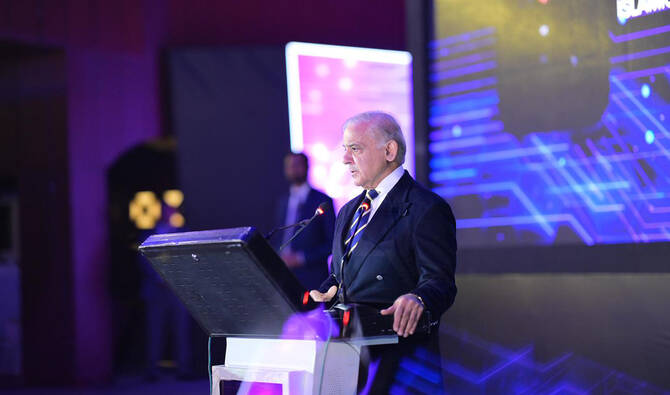
Prime Minister Shehbaz Sharif addresses the inaugural ceremony of AI Indus Week being organized by Ministery of Information Technology in Islamabad, on February 9, 2026. (PMO)
Short Url
Updated 09 February 2026
Follow

Pakistan to invest $1 billion in AI by 2030 in push to modernize economy

  • PM says government will introduce AI curriculum in schools nationwide
  • The transformation plan will help train 1 million non-IT professionals in AI

ISLAMABAD: Prime Minister Shehbaz Sharif on Monday announced that Pakistan would invest $1 billion in artificial intelligence (AI) by 2030, in a major step to modernize the South Asian nation’s digital economy.

Pakistan, a country of 240 million people, seeks to become a key participant in the global AI economy, amid growing interest from governments in the Global South to harness AI for productivity, skills development and innovation.

The South Asian nation has been actively developing its AI landscape and approved its National AI Policy in July last year, which was followed by the launch of the country’s sovereign AI cloud and a startup fund.

Speaking at the launch of the Indus AI Week 2026 in Islamabad, Sharif unveiled a multi-pronged roadmap intended to transform Pakistan from a provider of IT technicians into a global hub for AI expertise.

“I am pleased to announce that the Government of Pakistan is committed to invest $1 billion in AI by 2030, which will go a long way in building AI ecosystem in our country,” he told policymakers and international tech experts at Islamabad’s Jinnah Convention Center.

Sharif detailed several flagship initiatives to support this transformation, including a sweeping educational reform, at the event organized by the Information Technology (IT) Ministry, which will be running until Feb. 15, featuring strategic dialogues on sovereign AI and technical showcases.

“AI curriculum will be introduced not only in all federally controlled or run schools, but also in all schools of AJK, that is Azad Jammu and Kashmir, and Gilgit-Baltistan, as well as remote parts of Balochistan,” he said.

The government will provide 1,000 fully funded PhD scholarships in AI to postgraduates to bolster high-level research, according to the PM. It plans to launch a nationwide program to train 1 million “non-IT professionals in AI skills” to enhance productivity and improve livelihoods across traditional sectors of the economy.

Sharif emphasized that the focus would remain on high-impact sectors, including agriculture, mines and minerals, and the empowerment of Pakistan’s youth which makes up 60 percent of its 240 million population.

“We will, God willing, bring in programs to transform them from IT technicians to AI experts, which will lead to our agriculture production in terms of its yield, its quality, its efficiency, like never before,” he said.

Drawing parallels to previous digitization efforts in the Punjab province, such as land record digitization and the establishment of the first IT university in Lahore, Sharif framed the AI push as a “gamechanger” for national governance. He noted the Federal Board of Revenue is already undergoing a digital overhaul to curb smuggling and tax evasion.

“Pakistan is absolutely ready to accept the challenge and walk with our global partners absolutely with great commitment and dedication,” he said. “Our commitment is solid, unwavering. We will never look back.”



Sindh assembly passes resolution rejecting move to separate Karachi

Updated 21 February 2026
Follow

Sindh assembly passes resolution rejecting move to separate Karachi

  • Chief Minister Shah cites constitutional safeguards against altering provincial boundaries
  • Calls to separate Karachi intensified amid governance concerns after a mall fire last month

ISLAMABAD: The provincial assembly of Pakistan’s southern Sindh province on Saturday passed a resolution rejecting any move to separate Karachi, declaring its territorial integrity “non-negotiable” amid political calls to carve the city out as a separate administrative unit.

The resolution comes after fresh demands by the Muttahida Qaumi Movement (MQM) and other voices to grant Karachi provincial or federal status following governance challenges highlighted by the deadly Gul Plaza fire earlier this year that killed 80 people.

Karachi, Pakistan’s largest and most densely populated city, is the country’s main commercial hub and contributes a significant share to the national economy.

Chief Minister Syed Murad Ali Shah tabled the resolution in the assembly, condemning what he described as “divisive statements” about breaking up Sindh or detaching Karachi.

“The province that played a foundational role in the creation of Pakistan cannot allow the fragmentation of its own historic homeland,” Shah told lawmakers, adding that any attempt to divide Sindh or separate Karachi was contrary to the constitution and democratic norms.

Citing Article 239 of Pakistan’s 1973 Constitution, which requires the consent of not less than two-thirds of a provincial assembly to alter provincial boundaries, Shah said any such move could not proceed without the assembly’s approval.

“If any such move is attempted, it is this Assembly — by a two-thirds majority — that will decide,” he said.

The resolution reaffirmed that Karachi would “forever remain” an integral part of Sindh and directed the provincial government to forward the motion to the president, prime minister and parliamentary leadership for record.

Shah said the resolution was not aimed at anyone but referred to the shifting stance of MQM in the debate while warning that opposing the resolution would amount to supporting the division of Sindh.

The party has been a major political force in Karachi with a significant vote bank in the city and has frequently criticized Shah’s provincial administration over its governance of Pakistan’s largest metropolis.

Taha Ahmed Khan, a senior MQM leader, acknowledged that his party had “presented its demand openly on television channels with clear and logical arguments” to separate Karachi from Sindh.

“It is a purely constitutional debate,” he told Arab News by phone. “We are aware that the Pakistan Peoples Party, which rules the province, holds a two-thirds majority and that a new province cannot be created at this stage. But that does not mean new provinces can never be formed.”

Calls to alter Karachi’s status have periodically surfaced amid longstanding complaints over governance, infrastructure and administrative control in the megacity, though no formal proposal to redraw provincial boundaries has been introduced at the federal level.