

Pakistan, seven Muslim countries condemn new Israeli measures aimed at annexing West Bank

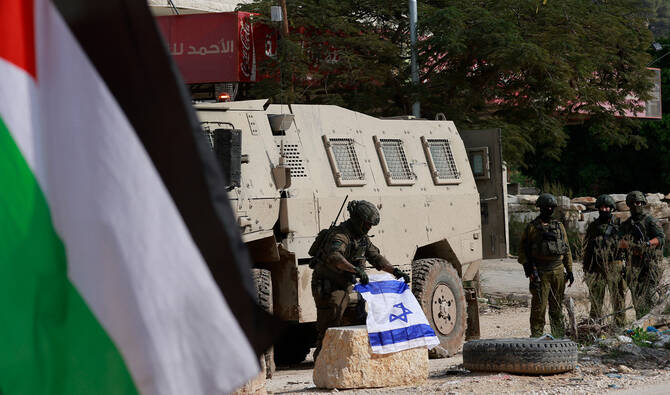
An Israeli soldier places the Israeli flag on a bollard at the entrance of the Nur Shams Palestinian refugee camp, in the Israeli-occupied northern West Bank on December 15, 2025. (AFP)
Short Url
Updated 09 February 2026
Follow

Pakistan, seven Muslim countries condemn new Israeli measures aimed at annexing West Bank

  • Israel approves steps to make it easier for settlers to buy land in West Bank, grant Israeli authorities more enforcement powers over Palestinians
  • Foreign ministries of Pakistan, Egypt, Jordan, United Arab Emirates, Indonesia, Türkiye, Saudi Arabia and Qatar issue joint condemnation 

ISLAMABAD: Pakistan and seven Arab and Muslim states on Monday jointly condemned recent Israeli decisions to impose new legal and administrative measures in the occupied West Bank, saying they amount to an attempt to enforce unlawful sovereignty and accelerate annexation of Palestinian territory.

The West Bank is among the territories that the Palestinians seek for a future independent state. Much of it is under Israeli military control, with limited Palestinian self-rule in some areas run by the Western-backed Palestinian Authority (PA).

Israel’s security cabinet approved a series of steps on Sunday that would make it easier for settlers in the occupied West Bank to buy land while granting Israeli authorities more enforcement powers over Palestinians. The measures reportedly include scrapping decades-old regulations that prevent Jewish private citizens buying land in the West Bank. They are also reported to include allowing Israeli authorities to administer some religious sites, and expand supervision and enforcement in areas under PA administration in matters of environmental hazards, water offenses and damage to archaeological sites.

In a joint statement issued in Islamabad, the foreign ministries of Pakistan, Egypt, Jordan, the United Arab Emirates, Indonesia, Türkiye, Saudi Arabia and Qatar said Israel had no sovereignty over the occupied Palestinian territory and accused it of pursuing measures aimed at entrenching settlement activity and imposing a new legal and administrative reality on the ground.

“The foreign ministers condemned in the strongest terms the illegal Israeli decisions and measures aimed at imposing unlawful Israeli sovereignty, entrenching settlement activity, and enforcing a new legal and administrative reality in the occupied West Bank,” the statement said, adding that such actions were accelerating attempts at “illegal annexation and the displacement of the Palestinian people.”

The ministers warned that continued Israeli expansionist policies and “illegal measures” in the West Bank were fueling violence and instability across the region.

They said the actions constituted “a blatant violation of international law,” undermined the two-state solution and infringed on the Palestinian people’s right to establish an independent and sovereign state along the pre-1967 borders, with East Jerusalem as its capital.

The statement said these measures were “null and void” and in clear violation of United Nations Security Council Resolution 2334, which condemns Israeli actions aimed at altering the demographic and legal status of territory occupied since 1967, including East Jerusalem.

Calling on the international community to act, the foreign ministers urged states to fulfill their “legal and moral responsibilities” and to compel Israel to halt what they described as dangerous escalation in the West Bank and inflammatory statements by Israeli officials.

They reiterated that fulfilling the Palestinian people’s right to self-determination and statehood through a two-state solution, in line with international resolutions and the Arab Peace Initiative, remained “the only path” to achieving lasting peace, security and stability in the region.

Prime Minister Benjamin Netanyahu’s ruling coalition includes many pro-settler members who want Israel to annex the West Bank, land captured in the 1967 Middle East war to which Israel cites biblical and historical ties.

The United Nations’ highest court said in a non-binding advisory opinion in 2024 that Israel’s occupation of Palestinian territories and settlements there is illegal and should be ended as soon as possible. Israel disputes this view.


Pakistan invites Austrian firms to partner in citrus value-addition, mining, renewable energy

Updated 16 February 2026
Follow

Pakistan invites Austrian firms to partner in citrus value-addition, mining, renewable energy

  • PM Shehbaz Sharif attends joint business forum in Vienna, invites Austrian companies to the EU-Pakistan business summit in Islamabad in April
  • The premier addresses the issue of illegal immigration, saying his government working to offer Europe workers with international certifications

ISLAMABAD: Prime Minister Shehbaz Sharif on Monday invited Austrian companies to partner with Pakistani firms in citrus value-addition, mining and renewable energy sectors, saying their world-class expertise could help accelerate Pakistan’s growth.

Sharif said this while speaking at the Pakistan-Austria Business Forum during his two-day official visit to the European country, the first by any Pakistani premier in more than 30 years, according to the Pakistani foreign office.

The visit is focused on trade, investment and economic cooperation, and would involve productive interactions with the International Atomic Energy Agency, United Nations Office of Drugs and Crime, and the UN Industrial Development Organization.

Speaking at the business forum in Vienna, Sharif said Pakistan is an agrarian economy and nearly 60 percent of its population resides in rural areas, with its hardworking farmers adding to the country's huge potential in agriculture.

"Austria can be a great partner providing Pakistan with experience, with modern technology to have value addition in the field of citrus fruit and make marmalade, juices and export them to Austria, to Middle East, other parts of the world," he said.

"Secondly, in mines and minerals, again Austria can become a great partner. Pakistan has vast resources of minerals and of course very rare minerals in the province of KP (Khyber Pakhtunkhwa), Gilgit-Baltistan, Balochistan and Azad Kashmir."

Sharif's visit comes at a time when Pakistan is treading a long path to economic recovery under a $7 billion International Monetary Fund (IMF) bailout and seeks to boost trade and foreign investment to consolidate economic gains Islamabad has made in recent years.

Besides agriculture, PM Sharif invited Austrian companies to participate in renewable energy and grid modernization projects in Pakistan.

"Austria with its world-class expertise in engineering, renewable energy, environmental technology, advanced manufacturing [is well positioned] to benefit Pakistan’s growth trajectory," he said.

ILLEGAL IMMIGRATION, SKILLED LABOR

Sharif also addressed the issue of illegal immigration of citizens from Pakistan, among other countries, to Europe and said his government was working end the practice and instead offer trained, skilled human resource to European nations, with international certifications.

Thousands of citizens from Pakistan, Afghanistan, Bangladesh and other countries embark on perilous journeys each year attempting to enter Europe illegally in search of a better life.

In Dec., Pakistan's interior ministry said it had achieved a 47 percent drop in illegal immigration to Europe in 2025, with more than 1,700 human smugglers arrested as part of an expanded nationwide crackdown.

"I am absolutely against illegal immigration and we are working with our European friends, countries like Austria, Germany, France and other countries, to jointly bring this illegal immigration to a grinding halt," Sharif said.

"In return, your demand for trained labor, skilled labor, we are going to fulfill that demand with international certification to your requirement and your satisfaction."

The Pakistan premier said he looked forward to the participation of Austrian companies in the European Union-Pakistan Business Forum at the end of April in Islamabad.