


DAMASCUS: Wafa Mustafa had long dreamed of returning to Syria but the absence of her father tarnished her homecoming more than a decade after he disappeared in Bashar Assad’s jails.
Her father Ali, an activist, is among the tens of thousands killed or missing in Syria’s notorious prison system, and whose relatives have flocked home in search of answers after Assad’s toppling last month by Islamist-led rebels.
“From December 8 until today, I have not felt any joy,” said Mustafa, 35, who returned from Berlin.
“I thought that once I got to Syria, everything would be better, but in reality everything here is so very painful,” she said. “I walk down the street and remember that I had passed by that same corner with my dad” years before.
Since reaching Damascus she has scoured defunct security service branches, prisons, morgues and hospitals, hoping to glean any information about her long-lost father.
“You can see the fatigue on people’s faces” everywhere, said Mustafa, who works as a communications manager for the Syria Campaign, a rights group.

Members of the security forces of Syria's new administration inspect the Saydnaya prison in Damascus on January 3, 2025. The prison is infamous for its inhumane conditions and its central role in the violent repression carried out by the clan of the ousted Syian president Bashar al-Assad. (AFP)
In 2021, she was invited to testify at the United Nations about the fate of Syria’s disappeared.
The rebels who toppled Assad freed thousands of detainees nearly 14 years into a civil war that killed more than 500,000 people and displaced millions.
Mustafa returned to Branch 215, one of Syria’s most notorious prisons run by military intelligence, where she herself had been detained simply for participating in pro-democracy protests in 2011.
She found documents there mentioning her father. “That’s already a start,” Mustafa said.
Now, she “wants the truth” and plans to continue searching for answers in Syria.
“I only dream of a grave, of having a place to go to in the morning to talk to my father,” she said. “Graves have become our biggest dream.”
In Damascus, Mustafa took part in a protest demanding justice for the disappeared and answers about their fate.

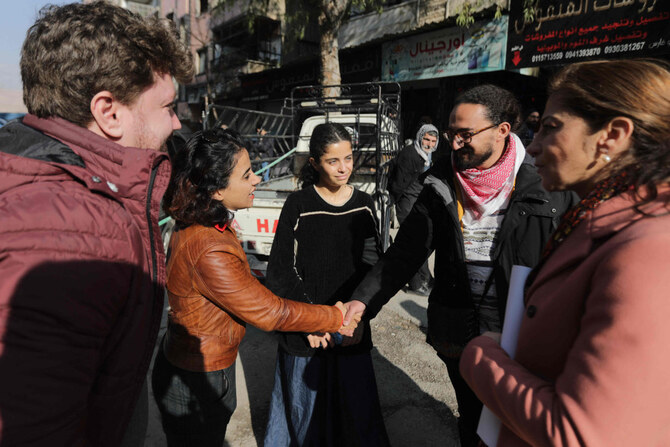
Syrian activist and former refugee Ayat Ahmad (C) lifts a placard as she attends a demonstration in Damascus on January 1, 2025. (AFP)
Youssef Sammawi, 29, was there too. He held up a picture of his cousin, whose arrest and beating in 2012 prompted Sammawi to flee for Germany.
A few years later, he identified his cousin’s corpse among the 55,000 images by a former military photographer codenamed “Caesar,” who defected and made the images public.
The photos taken between 2011 and 2013, authenticated by experts, show thousands of bodies tortured and starved to death in Syrian prisons.
“The joy I felt gave way to pain when I returned home, without being able to see my cousin,” Sammawi said.
He said his uncle had also been arrested and then executed after he went to see his son in the hospital.
“When I returned, it was the first time I truly realized that they were no longer there,” he said with sadness in his voice.
“My relatives had gotten used to their absence, but not me,” he added. “We demand that justice be served, to alleviate our suffering.”

A boy runs after a sheep next to tanks that belonged to the ousted Assad government, parked in front of a destroyed building in Palmyra, Syria, on Jan. 25, 2025. (AP)
While Assad’s fall allowed many to end their exile and seek answers, others are hesitant.
Fadwa Mahmoud, 70, told AFP she has had no news of her son and her husband, both opponents of the Assad government arrested upon arrival at Damascus airport in 2012.
She fled to Germany a year later and co-founded the Families For Freedom human rights group.
She said she has no plans to return to Syria just yet.
“No one really knows what might happen, so I prefer to stay cautious,” she said.
Mahmoud said she was disappointed that Syria’s new authorities, who pledged justice for victims of atrocities under Assad’s rule, “are not yet taking these cases seriously.”
She said Syria’s new leader Ahmed Al-Sharaa “has yet to do anything for missing Syrians,” yet “met Austin Tice’s mother two hours” after she arrived in the Syrian capital.
Tice is an American journalist missing in Syria since 2012.
Sharaa “did not respond” to requests from relatives of missing Syrians to meet him, Mahmoud said.
“The revolution would not have succeeded without the sacrifices of our detainees,” she said.


